Reusable canning lids
They work, they are reusable, and the technique is different enough that a first batch often fails. Here is the honest version.
Disclosure: we earn a commission on purchases made through links on this page, at no extra cost to you. It does not change what we recommend — see how we pick and our affiliate disclosure.
Reusable canning lids use a rigid plastic lid with a separate rubber sealing ring, designed to be used repeatedly rather than once. Used according to the manufacturer's instructions they seal, and the technique differs from a metal lid: the band is tightened differently before and after processing, and getting that wrong is the usual cause of a failed first batch.
"Are Tattler lids safe?" is a fair question and the honest answer has two halves. The system works when used as instructed. Whether it works for you depends on whether you will follow a procedure that differs from the one everything else you read describes.
How they differ from metal lids
| Metal flat lid | Reusable plastic lid | |
|---|---|---|
| Parts | One disc, single use | Rigid lid plus a separate rubber ring |
| Reuse | Never | Repeatedly, as designed |
| Up-front cost | Low | Several times higher |
| Cost per use | Full price, every jar, every time | Falls with each reuse |
| Technique | Fingertip tight, then leave alone | Different band handling before and after processing — follow the maker's instructions |
| Learning curve | None | Real. First batches commonly fail to seal |
| Consumable part | The whole lid | The rubber ring, eventually |
| Availability | Every store, most of the year | Mostly online |
The technique difference, and why it matters
With a metal lid, you tighten the band to fingertip tight, process, and then leave it entirely alone while it cools. The whole seal happens passively as the vacuum forms.
Reusable systems specify a different sequence, and it includes handling the band after processing. That is the step that catches people, because every other instruction they have ever read about canning says do not touch the jars while they cool. Read the manufacturer's instructions for the lids you actually bought and follow them exactly rather than blending them with metal-lid habits — that blend is what produces a batch of failures.
When the arithmetic works
The break-even is a function of how many jars you can per year and how many reuses you actually get. Two things decide it, and neither is on the packaging: your annual jar count, and how long the rubber rings last in your hands. If you can a few dozen jars a year, the payback horizon is long. If you can hundreds, it is short and the case is straightforward.
We are not going to print a payback figure, because doing so honestly requires a current price we do not have from the live layer and a reuse count we have not measured. Work it out with the price in front of you: divide the reusable lid cost by the metal lid cost to get the number of uses it has to survive.
The other reasons people buy them
- Waste. A metal flat lid is thrown away after one seal, and for people canning at volume that adds up visibly.
- Supply security. Lids sell out in peak season every year. A stock of reusable lids does not.
- Preference for not having a consumable in a process that is otherwise entirely durable goods.
Quick picks
Every pick below is screened against the National Center for Home Food Preservation’s published canner rules first. Tap a row for the full write-up.
| # | Product | Best for | Key spec | Price |
|---|---|---|---|---|
| 1 |  Tattler Reusable Canning LidsA two-piece plastic lid and rubber ring designed to be used again and again, which changes the arithmetic if you can a lot. The technique differs from a metal lid, and getting it wrong shows up as a failed seal — so learn it on a batch you can afford to lose. | Long-run cost, if you commit | Plastic lid + rubber ring | $32.00 · View on Amazon#ad we earn a commission · price as of October 18, 2026 |
| 2 |  Ball Regular Mouth Canning LidsThe lid every tested recipe assumes. Single-use by design — the sealing compound is meant to compress once — and cheap enough that reusing one to save a few cents is a bad trade against losing a jar of food. | The default lid | 70 mm, single use | $22.99 · View on Amazon#ad we earn a commission · price as of October 18, 2026 |
| 3 |  ForJars Canning LidsA widely available alternative for the weeks when the shelf is bare. Same single-use design and same standard sizes; buy it as a hedge against the September shortage rather than as an upgrade. | A stocked backup brand | Single use, 70 or 86 mm | $20.45 · View on Amazon#ad we earn a commission · price as of October 18, 2026 |
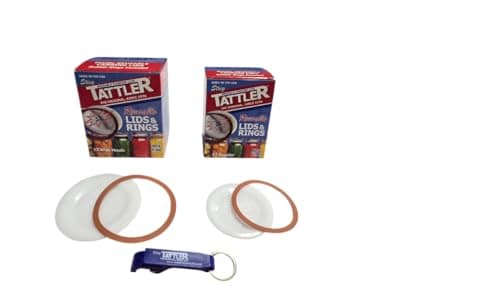
Tattler Reusable Canning Lids
A two-piece plastic lid and rubber ring designed to be used again and again, which changes the arithmetic if you can a lot. The technique differs from a metal lid, and getting it wrong shows up as a failed seal — so learn it on a batch you can afford to lose.
Published specs
- Design
- Plastic lid plus a separate rubber sealing ring
- Reuse
- Designed for repeated use
- Sizes
- Regular and wide mouth
- Technique
- Band tightening differs from a metal lid — follow the maker's instructions
What works
- Genuinely reusable, so the per-jar cost falls sharply once you are canning a lot every year
- No metal disc to dispose of after every batch
- Available in both mouth sizes, so they can replace your whole lid habit rather than half of it
What to know first
- The tightening technique is different and unforgiving, and a first batch with them commonly produces failed seals
- Higher up-front cost, which only pays back over several seasons
- Rings perish eventually and are a consumable of their own
Specs from NCHFP, Recommended Canners. We have not handled this product — see how we pick.
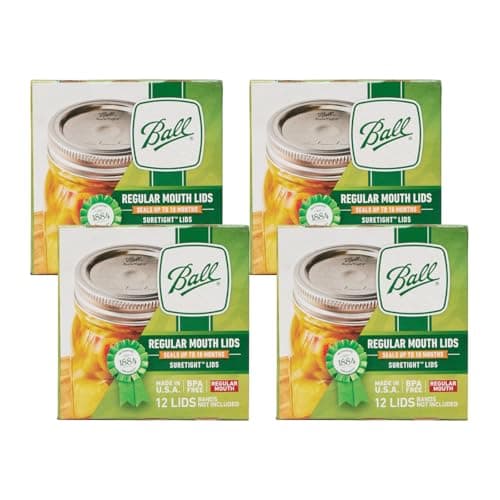
Ball Regular Mouth Canning Lids
The lid every tested recipe assumes. Single-use by design — the sealing compound is meant to compress once — and cheap enough that reusing one to save a few cents is a bad trade against losing a jar of food.
Published specs
- Size
- Regular mouth, about 70 mm
- Use
- Flat lid single-use; band reusable
- Compatibility
- Ball and Kerr regular mouth jars
What works
- The most widely stocked lid in the country, which is the thing that matters in September
- What every NCHFP and Ball tested recipe is written around, so nothing about your process needs adapting
- Bands are reusable indefinitely as long as they are not bent or rusted
What to know first
- Single use. The flat lid goes in the recycling after one seal
- Sells out first in peak season — buy your lids in July, not September
- Does not fit wide mouth jars, and there is no adapter
Specs from Ball, Mason Jars & Lids, Regular Mouth. We have not handled this product — see how we pick.
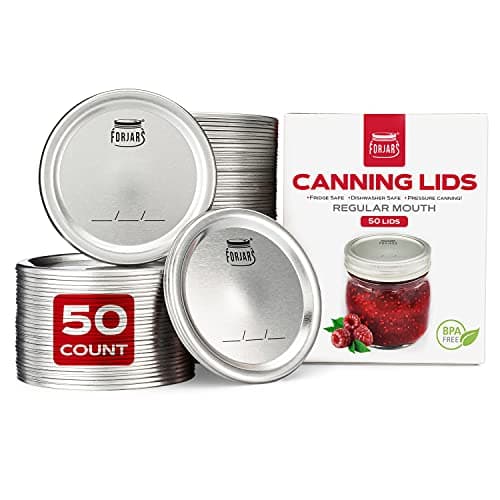
ForJars Canning Lids
A widely available alternative for the weeks when the shelf is bare. Same single-use design and same standard sizes; buy it as a hedge against the September shortage rather than as an upgrade.
Published specs
- Sizes
- Regular and wide mouth
- Use
- Single-use flat lids
- Compatibility
- Standard Ball and Kerr jar threads
What works
- Available online through the season when the big-box shelves are cleared out
- Standard sizing, so nothing about your process changes
- Usually sold in larger counts, which suits a heavy canning week
What to know first
- No published advantage over the Ball lid — the reason to buy it is availability
- Any lid brand you have not used before deserves a careful check of the seals after 24 hours
- Still a single-use consumable
Specs from NCHFP, Recommended Canners. We have not handled this product — see how we pick.
What we would do
Learn on metal lids. They are cheap, they are forgiving, and the technique is the one every tested recipe assumes. Once you are getting consistent seals and you know how much you actually can in a year, buy a small quantity of reusable lids and run one batch with them, following the manufacturer's instructions to the letter. If that batch seals, scale up. If it does not, you have lost one batch instead of a season.
Next stepCan you reuse ordinary canning lids?Common questions
Are Tattler lids safe?
How many times can you reuse them?
Do reusable lids work in a pressure canner?
Why did my reusable lids not seal?
Are they cheaper overall?
Sources
Product specifications are taken from each manufacturer’s own published page, cited on the product. We have not handled these products — how we pick.