The best pressure canners for beginners
Five canners against the same published rules, plus the one measurement that eliminates half the shortlist before you compare a feature.
Disclosure: we earn a commission on purchases made through links on this page, at no extra cost to you. It does not change what we recommend — see how we pick and our affiliate disclosure.
The best pressure canner for a beginner is a 23-quart aluminum stovetop canner: it holds a full seven-quart load, doubles as a boiling-water canner for pints and half-pints, and costs a fraction of a cast-aluminum model. The main trade is a dial gauge, which should be tested for accuracy once a year. If that annual test is the thing putting you off, the weighted-gauge alternative is in the Mirro pressure canner review.
A pressure canner is the only way to safely can low-acid food at home, which makes this the most consequential purchase on the site. It is also the one where the marketing is furthest from the requirements, so we screened against the published rules before looking at a single feature.
The screening rules, before any opinion
The National Center for Home Food Preservation publishes what a canner has to be, and it is short. Everything below cleared all of it, or is on the list specifically as the thing to avoid.
- UL approval. "Use only canners that have the Underwriter's Laboratory (UL) approval to ensure their safety."
- Capacity. Enough for seven quart jars or eight to nine pints. "Pressure saucepans with smaller volume capacities are not recommended for use in canning."
- A flat bottom, for use on an electric range.
- Base diameter no more than 4 inches wider than your element, on an electric range — the rule that eliminates more canners than any other.
We have not used any of these canners and we will not pretend we have. What we did was take the specifications from each manufacturer's own page, check them against those rules, and do the stove arithmetic where a diameter is published. The method is on how we pick.
Quick picks
Every pick below is screened against the National Center for Home Food Preservation’s published canner rules first. Tap a row for the full write-up.
| # | Product | Best for | Key spec | Price |
|---|---|---|---|---|
| 1 |  Presto 23-Quart Pressure Canner and Cooker (01781)The default first pressure canner, and the one most beginners should buy: it takes a full seven-quart load, it doubles as a boiling-water canner for pints and half-pints, and it costs a fraction of a cast-aluminum canner. The dial gauge is the catch, and it is a real one. | A first pressure canner | 7 quarts / 20 pints | |
| 2 | All American 921 (21.5 qt)Cast aluminum with a machined metal-to-metal seal, so there is no gasket to perish, swell or go missing the week you need it. It is also 24 pounds empty and its base is wider than most electric elements, which is a genuine constraint rather than a footnote. | Buying once, for decades | Base 15 3/8", no gasket | Check price on Amazon#ad we earn a commission · live price pending |
| 3 | Presto 16-Quart Pressure Canner (01745)The weighted-gauge alternative: nothing to calibrate, ever, because the regulator rocks when the pressure is right. The trade is height. It is not tall enough to boiling-water can quart jars under the required inch of water, so it is a pints-and-half-pints canner. | Pints only, and a small kitchen | Weighted gauge, no calibration | Check price on Amazon#ad we earn a commission · live price pending |
| 4 |  Presto Precise 12-Quart Digital Pressure Canner (02144)The one electric appliance in this category that Presto states meets USDA home-canning guidelines for low-acid foods, and it holds the temperature itself — including at altitude, with no adjustment. It is also a countertop appliance, so it sidesteps the stove-fit question entirely. | Glass tops, and altitude | 5 quarts, no altitude math | |
| 5 | All American 925 (25 qt)The 921 made taller. It sits on the same base, so it fits — or does not fit — your stove exactly like the 921 does, and the extra capacity buys you a taller stack rather than a wider one. | Bigger batches, same footprint | 25 qt, same base as 921 | Check price on Amazon#ad we earn a commission · live price pending |
| 6 | Small pressure cookers and multi-cookers sold as cannersSkipSkip anything under the seven-quart-jar mark, and skip every electric multi-cooker with a canning button that is not specifically specified for pressure canning. The NCHFP is explicit: pressure saucepans with smaller volume capacities are not recommended for canning. | Nothing — skip these | Excluded by NCHFP | Check price on Amazon#ad we earn a commission · live price pending |
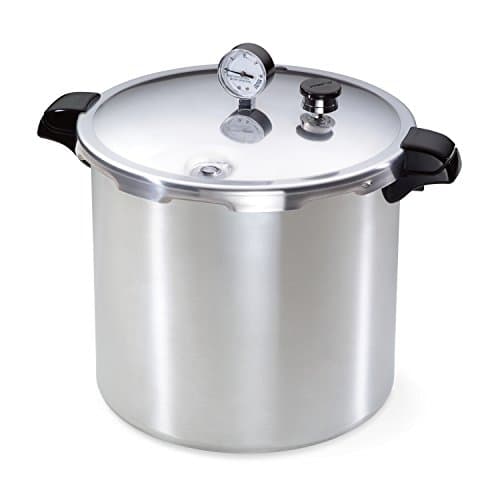
Presto 23-Quart Pressure Canner and Cooker (01781)
The default first pressure canner, and the one most beginners should buy: it takes a full seven-quart load, it doubles as a boiling-water canner for pints and half-pints, and it costs a fraction of a cast-aluminum canner. The dial gauge is the catch, and it is a real one.
Published specs
- Liquid capacity
- 23 quarts (21.8 liters)
- Jar capacity
- 26 half-pints, 20 pints, 7 quarts
- Material
- Warp-resistant aluminum
- Gauge
- Dial gauge
- Ranges
- Regular and smooth-top
- Burner limit
- 12,000 BTUs or less
- Also
- Doubles as a boiling-water canner
- Warranty
- 12-year limited
- Base diameter
- Not published by Presto
What works
- Seven quart jars is the standard batch size every tested NCHFP recipe is written around, so you are never processing a half load
- Doubles as a boiling-water canner for pints and half-pints, which means one pot covers the jam-and-pickles year as well as the beans
- Presto sells a replacement dial gauge and sealing ring separately, so a decade-old canner is a repair rather than a replacement
What to know first
- A dial gauge should be checked for accuracy every year — most extension offices do it free, and most owners never go. A weighted gauge needs no calibration at all
- Presto does not publish a base diameter, so you cannot check it against the NCHFP element rule without measuring the box yourself. See will it fit your stove
- Rated for burners of 12,000 BTUs or less, which rules out most outdoor propane burners and some high-output gas ranges
Specs from Presto, 23-Quart Pressure Canner and Cooker (01781). We have not handled this product — see how we pick.
All American 921 (21.5 qt)
Cast aluminum with a machined metal-to-metal seal, so there is no gasket to perish, swell or go missing the week you need it. It is also 24 pounds empty and its base is wider than most electric elements, which is a genuine constraint rather than a footnote.
Published specs
- Liquid capacity
- 21.5 quarts
- Jar capacity
- 18 pints or 7 quarts
- Seal
- Metal-to-metal, no gasket
- Gauge
- Geared steam gauge
- Regulator
- 5, 10 or 15 psi
- Inside diameter
- 12 1/4 inches
- Inside height
- 10 1/2 inches
- Bottom exterior diameter
- 15 3/8 inches
- Weight (empty)
- 24 pounds
What works
- No gasket means no annual replacement part, and nothing that hardens in a hot attic between seasons
- All American publishes the base diameter, which almost nobody in this category does — you can check it against your element before you buy
- The 921 and its siblings are the canners people hand down. Parts and gauges remain available for very old units
What to know first
- The 15 3/8" base needs an element of at least 11 3/8" to stay inside the NCHFP 4-inch rule, and most household electric elements are 6" to 9". Check your stove first
- 24 pounds empty, and considerably more loaded with jars and water — a real consideration if lifting is difficult
- Several times the price of a Presto, which is money better spent on jars and lids for a first season
Specs from All American, 921 21.5-Quart Pressure Canner, NCHFP, Recommended Canners. We have not handled this product — see how we pick.
Presto 16-Quart Pressure Canner (01745)
The weighted-gauge alternative: nothing to calibrate, ever, because the regulator rocks when the pressure is right. The trade is height. It is not tall enough to boiling-water can quart jars under the required inch of water, so it is a pints-and-half-pints canner.
Published specs
- Liquid capacity
- 16 quarts
- Regulator
- 3-piece weighted, 5 / 10 / 15 psi
- Material
- Aluminum
- Calibration
- None required
- Boiling-water use
- Pints and half-pints only — not tall enough for quarts
- Base diameter
- Not published by Presto
What works
- A weighted gauge never needs testing. It rocks when the pressure is correct, and that is the whole interface
- Smaller footprint and lighter than a 23-quart, which matters if you are canning on an apartment range or storing it in a closet
- The audible rocking is easier for a nervous first-timer to read than a needle you are trying to hold at exactly 11 psi
What to know first
- Cannot boiling-water can quart jars — Presto states it is not tall enough to cover them with the required 1 inch of water
- Smaller pressure-canning loads mean more batches on a heavy tomato or bean day
- Weighted gauges only do 5, 10 and 15 psi, so at altitude you round up to the next weight rather than dialing an exact number
Specs from Presto, 16-Quart Pressure Canner (01745), NCHFP, Recommended Canners. We have not handled this product — see how we pick.
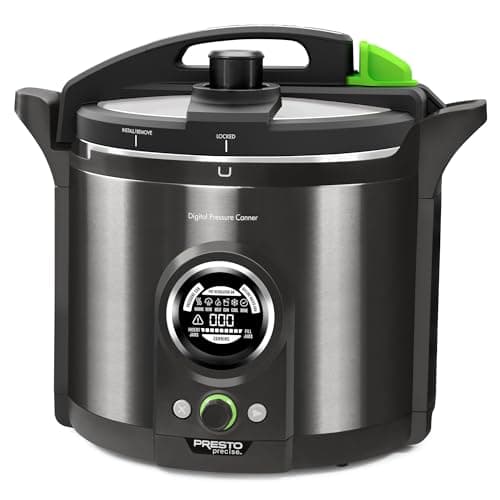
Presto Precise 12-Quart Digital Pressure Canner (02144)
The one electric appliance in this category that Presto states meets USDA home-canning guidelines for low-acid foods, and it holds the temperature itself — including at altitude, with no adjustment. It is also a countertop appliance, so it sidesteps the stove-fit question entirely.
Published specs
- Liquid capacity
- 12 quarts
- Jar capacity
- 10 half-pints, 8 pints, 5 quarts
- Boiling-water use
- Pints and half-pints only
- Power
- 120 volts AC, 1,485 watts (Presto)
- USDA
- Presto states it meets USDA guidelines for meat, poultry, fish and vegetables
- Altitude
- No adjustment needed — the sensor handles it
What works
- Removes the two things beginners get wrong most often: holding pressure steady, and adjusting for altitude
- Countertop, so your stove element size stops mattering — the single most common reason a canner does not work out
- The built-in timer will not start counting until the canner is genuinely at temperature, which is exactly the mistake a nervous first-timer makes
What to know first
- Five quart jars per load against seven in a 23-quart stovetop, so a heavy day is more batches
- It is an appliance with electronics. A stovetop canner has a gauge and a gasket and will outlive it
- Most electric multi-cookers are NOT safe for pressure canning — this one is specified for it and generic pressure cookers are not. Do not generalize from it
Specs from Presto, Precise 12-Quart Digital Pressure Canner (02144). We have not handled this product — see how we pick.
All American 925 (25 qt)
The 921 made taller. It sits on the same base, so it fits — or does not fit — your stove exactly like the 921 does, and the extra capacity buys you a taller stack rather than a wider one.
Published specs
- Liquid capacity
- 25 quarts
- Seal
- Metal-to-metal, no gasket
- Regulator
- 5, 10 or 15 psi
- Bottom exterior diameter
- 15 3/8 inches, same as the 921
- Base model
- Same body diameter as the 921
What works
- Extra height without extra width, so it does not make your stove-fit problem any worse than the 921 already does
- Same gasket-free seal and same long parts availability as the rest of the range
- Worth the step up only if you are already canning enough to fill a 921 twice in a session
What to know first
- Same 15 3/8-inch base as the 921, so the same element-size problem applies in full
- Heavier again than the 921, and taller means more reach to lift a full rack out
- For a first harvest this is more canner than the job needs
Specs from All American, 921 21.5-Quart Pressure Canner, NCHFP, Recommended Canners. We have not handled this product — see how we pick.
Small pressure cookers and multi-cookers sold as canners
Skip anything under the seven-quart-jar mark, and skip every electric multi-cooker with a canning button that is not specifically specified for pressure canning. The NCHFP is explicit: pressure saucepans with smaller volume capacities are not recommended for canning.
Published specs
- NCHFP position
- "Pressure saucepans with smaller volume capacities are not recommended for use in canning"
- Required capacity
- Enough for seven quart jars or eight to nine pints
- Required approval
- UL approval
What works
- There is no upside worth listing. This entry exists so you can recognize the category and walk past it
What to know first
- Too small to hold heat the way tested processing times assume, so the times on a tested recipe do not transfer
- A "canning" preset on a multi-cooker is a marketing label, not a validation. Only appliances specified for pressure canning, like the Presto Precise, have been through that work
- This is the failure mode with the worst consequences in the whole category — under-processed low-acid food is where botulism comes from
Specs from NCHFP, Recommended Canners. We have not handled this product — see how we pick.
Dial gauge or weighted gauge: the real decision
Every other difference between these canners is secondary to this one, and it is a genuine fork rather than a better-and-worse.
| Dial gauge | Weighted gauge | |
|---|---|---|
| How you read it | A needle showing exact pressure | A weight that rocks when pressure is right |
| Precision | Exact psi, useful at altitude | Fixed steps of 5, 10 and 15 psi |
| Maintenance | Should be tested for accuracy annually — often free at a county extension office. Dial gauge vs weighted gauge sets out the trade | None, ever. Nothing to calibrate |
| Failure mode | Drifts silently out of calibration | Essentially none — it is a machined weight |
| At altitude | Dial to the exact required pressure | Round up to the next weight |
| Attention needed | Watch the needle and adjust the heat | Listen for the rocking |
The honest recommendation: if there is a county extension office near you and you will actually go once a year, a dial gauge is slightly more efficient at altitude. If you will not go — and most people do not — buy weighted. An uncalibrated dial gauge is a number you are trusting for no reason, and Penn State Extension's guide to buying a pressure canner makes the same point about matching the canner to how you will actually use it.
The stove problem is sharper here
Pressure canners are heavier and wider than water bath canners, and the cast-aluminum ones considerably so. The All American 921 publishes a bottom exterior diameter of 15 3/8 inches. Under the NCHFP's 4-inch rule that needs an element of at least 11 3/8 inches — larger than nearly any household electric element.
That is not a fault in the canner. It is a mismatch, it is entirely predictable, and it is the single most common reason a beautiful canner ends up unused in a basement. Measure your element and run it through will it fit your stove before you spend the money.
Do you need one this year?
If your list is jam, pickles, fruit and acidified tomatoes, no. A water bath canner covers all of it at a fraction of the cost — see best water bath canners. The moment you need this purchase is the moment you want green beans, corn, carrots, potatoes, meat or stock, and that list is set out in what foods need pressure canning.
Next stepAll American vs Presto, head to headCommon questions
What size pressure canner should I buy?
Is a dial gauge or weighted gauge better for a beginner?
Can I use a pressure cooker for canning?
Do pressure canners work on glass top stoves?
How often does a dial gauge need testing?
Can a pressure canner also water bath?
Sources
- NCHFP — Recommended Canners
- Penn State Extension — Buying a Pressure Canner
- Presto — 23-Quart Pressure Canner (01781)
- All American — 921 Pressure Canner
Product specifications are taken from each manufacturer’s own published page, cited on the product. We have not handled these products — how we pick.