The best canning lids
The only true consumable in canning, and the part most seal failures trace back to.
Disclosure: we earn a commission on purchases made through links on this page, at no extra cost to you. It does not change what we recommend — see how we pick and our affiliate disclosure.
Standard two-piece canning lids are single-use flat metal discs with a sealing compound, paired with a reusable screw band. Any major brand sized correctly for your jar mouth will seal reliably — including the US-made alternative we looked at in detail, Superb. The one lid to avoid is a flat lid you have already used — the compound is designed to compress once.
Lids are where the running cost of canning lives and where most seal failures start. The good news is that the category has almost no quality spread: a correctly sized flat lid from any established brand does the same job. What matters is buying the right size, buying enough, and never reusing one.
How the two-piece system works
The flat lid carries a ring of sealing compound around its underside. During processing, air is driven out of the jar, and as the jar cools a vacuum forms and pulls the lid down onto the rim. The compound softens with heat, conforms to the exact surface of that rim, and sets. The screw band holds the lid in place only until the vacuum takes over — after that it is doing nothing, which is why bands come off for storage.
That mechanism explains almost every rule about lids, whichever brand you buy — Superb's Ohio-made version works the same way. The compound conforms once, which is why lids are single-use. Anything on the rim stops it conforming, which is why you wipe the rim. Air has to escape during processing, which is why bands go on fingertip tight.
Quick picks
Every pick below is screened against the National Center for Home Food Preservation’s published canner rules first. Tap a row for the full write-up.
| # | Product | Best for | Key spec | Price |
|---|---|---|---|---|
| 1 |  Ball Regular Mouth Canning LidsThe lid every tested recipe assumes. Single-use by design — the sealing compound is meant to compress once — and cheap enough that reusing one to save a few cents is a bad trade against losing a jar of food. | The default lid | 70 mm, single use | $22.99 · View on Amazon#ad we earn a commission · price as of October 18, 2026 |
| 2 |  Ball Wide Mouth Canning LidsThe same lid in the larger size. Buy it because your jars are wide mouth, not because it is better — it is the identical sealing compound on a bigger disc, at a higher price per lid. | Wide mouth jars | 86 mm, single use | $44.99 · View on Amazon#ad we earn a commission · price as of October 18, 2026 |
| 3 |  ForJars Canning LidsA widely available alternative for the weeks when the shelf is bare. Same single-use design and same standard sizes; buy it as a hedge against the September shortage rather than as an upgrade. | A stocked backup brand | Single use, 70 or 86 mm | $20.45 · View on Amazon#ad we earn a commission · price as of October 18, 2026 |
| 4 |  Tattler Reusable Canning LidsA two-piece plastic lid and rubber ring designed to be used again and again, which changes the arithmetic if you can a lot. The technique differs from a metal lid, and getting it wrong shows up as a failed seal — so learn it on a batch you can afford to lose. | Long-run cost, if you commit | Plastic lid + rubber ring | $32.00 · View on Amazon#ad we earn a commission · price as of October 18, 2026 |
| 5 | Flat lids you have already usedSkipThe lid to skip is the one already in your drawer. A flat metal lid's sealing compound is designed to compress once against a jar rim. Used again it often appears to seal, then releases weeks later on a shelf - which is the worst possible time to find out. | Nothing - skip these | Single use by design | Check price on Amazon#ad we earn a commission · live price pending |
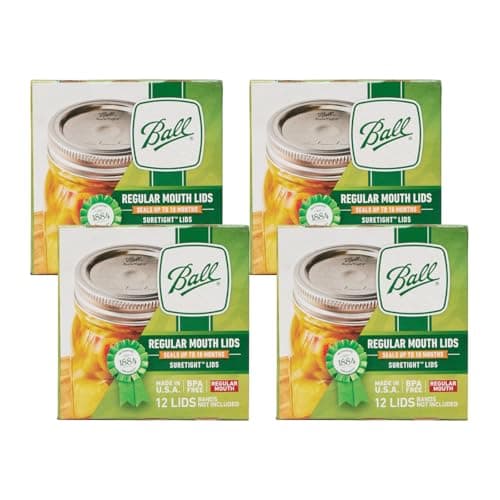
Ball Regular Mouth Canning Lids
The lid every tested recipe assumes. Single-use by design — the sealing compound is meant to compress once — and cheap enough that reusing one to save a few cents is a bad trade against losing a jar of food.
Published specs
- Size
- Regular mouth, about 70 mm
- Use
- Flat lid single-use; band reusable
- Compatibility
- Ball and Kerr regular mouth jars
What works
- The most widely stocked lid in the country, which is the thing that matters in September
- What every NCHFP and Ball tested recipe is written around, so nothing about your process needs adapting
- Bands are reusable indefinitely as long as they are not bent or rusted
What to know first
- Single use. The flat lid goes in the recycling after one seal
- Sells out first in peak season — buy your lids in July, not September
- Does not fit wide mouth jars, and there is no adapter
Specs from Ball, Mason Jars & Lids, Regular Mouth. We have not handled this product — see how we pick.
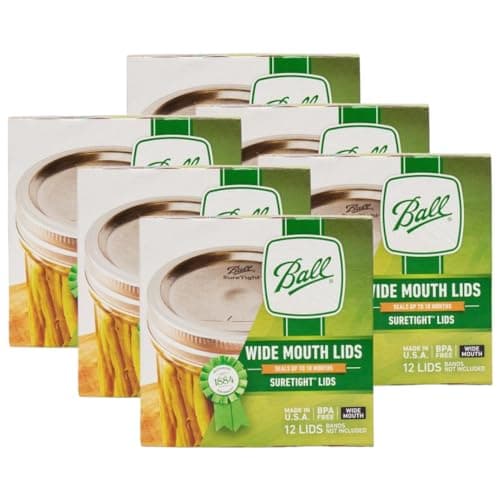
Ball Wide Mouth Canning Lids
The same lid in the larger size. Buy it because your jars are wide mouth, not because it is better — it is the identical sealing compound on a bigger disc, at a higher price per lid.
Published specs
- Size
- Wide mouth, about 86 mm
- Use
- Flat lid single-use; band reusable
- Compatibility
- Ball and Kerr wide mouth jars
What works
- Fits both Ball and Kerr wide mouth jars, so brand does not matter once you have picked a mouth size
- Same proven sealing compound as the regular mouth lid
- Easier to place squarely on a full jar than a regular mouth lid, which is a small real advantage when you are tired
What to know first
- Costs more per lid than regular mouth, every time
- Harder to find in a rural hardware store than the regular size
- Still single-use, so a wide mouth habit is a permanently higher running cost
Specs from Ball, Mason Jars & Lids, Wide Mouth. We have not handled this product — see how we pick.
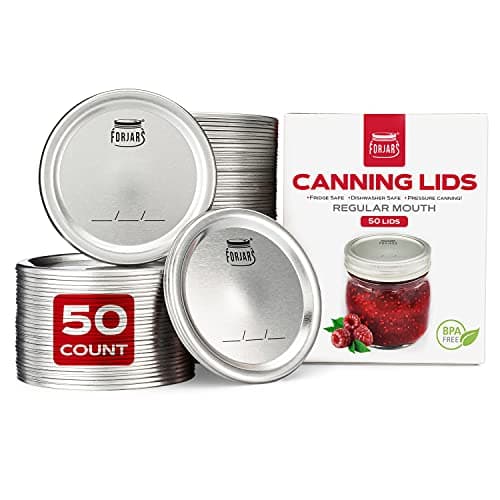
ForJars Canning Lids
A widely available alternative for the weeks when the shelf is bare. Same single-use design and same standard sizes; buy it as a hedge against the September shortage rather than as an upgrade.
Published specs
- Sizes
- Regular and wide mouth
- Use
- Single-use flat lids
- Compatibility
- Standard Ball and Kerr jar threads
What works
- Available online through the season when the big-box shelves are cleared out
- Standard sizing, so nothing about your process changes
- Usually sold in larger counts, which suits a heavy canning week
What to know first
- No published advantage over the Ball lid — the reason to buy it is availability
- Any lid brand you have not used before deserves a careful check of the seals after 24 hours
- Still a single-use consumable
Specs from NCHFP, Recommended Canners. We have not handled this product — see how we pick.
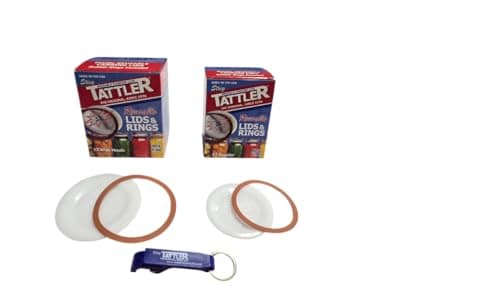
Tattler Reusable Canning Lids
A two-piece plastic lid and rubber ring designed to be used again and again, which changes the arithmetic if you can a lot. The technique differs from a metal lid, and getting it wrong shows up as a failed seal — so learn it on a batch you can afford to lose.
Published specs
- Design
- Plastic lid plus a separate rubber sealing ring
- Reuse
- Designed for repeated use
- Sizes
- Regular and wide mouth
- Technique
- Band tightening differs from a metal lid — follow the maker's instructions
What works
- Genuinely reusable, so the per-jar cost falls sharply once you are canning a lot every year
- No metal disc to dispose of after every batch
- Available in both mouth sizes, so they can replace your whole lid habit rather than half of it
What to know first
- The tightening technique is different and unforgiving, and a first batch with them commonly produces failed seals
- Higher up-front cost, which only pays back over several seasons
- Rings perish eventually and are a consumable of their own
Specs from NCHFP, Recommended Canners. We have not handled this product — see how we pick.
Flat lids you have already used
The lid to skip is the one already in your drawer. A flat metal lid's sealing compound is designed to compress once against a jar rim. Used again it often appears to seal, then releases weeks later on a shelf - which is the worst possible time to find out.
Published specs
- Design life
- One seal
- Reusable parts
- The jar and the screw band, indefinitely
- Cost of the mistake
- A jar of food, and the doubt about the rest of the batch
What works
- Saves a few cents per jar, which is the whole case and it does not survive contact with the cost of losing a jar
What to know first
- A false seal is invisible. The lid can be concave and firm and still fail later
- One failure casts doubt over the whole batch, because you cannot tell which other lids were reused
- Lids are the cheapest item in the entire process. This is not where the savings are
Specs from NCHFP, Recommended Canners. We have not handled this product — see how we pick.
Regular or wide mouth
Buy the size your jars are. Regular is about 70 mm, wide is about 86 mm, they are not interchangeable, and there is no adapter. Wide mouth lids cost more per lid and are harder to find in a small store, which is a real argument for standardizing your jars on regular mouth if you have no reason not to.
Do brands actually differ?
Not in any way we can substantiate. We have not run comparative seal-rate testing, and we are not going to imply we have — that is exactly the claim this site does not make. What we can say is that the sizing is standardized, established brands seal reliably against a clean undamaged rim, and the variables that genuinely affect your seal rate are all in your process: a clean rim, correct headspace, fingertip-tight bands and a full processing time.
The practical reason to know a second brand exists is availability. Lids sell out in peak season, regular mouth first. Having an alternative you are willing to buy is worth more than a marginal preference between two that seal the same.
Reusable lids, and the arithmetic
Systems like Tattler use a plastic lid and a separate rubber ring and are designed for repeated use — they are not the same thing as plastic storage lids, which are not for canning at all. They genuinely are reusable and they genuinely change the long-run cost if you can a lot. The catch is technique: band tightening differs from a metal lid, and first batches with them commonly produce failed seals while you learn.
Buy them to learn on a batch you can afford to lose, not on your first canning day and not on the day you are processing a bushel of something. The full comparison is in reusable canning lids.
How many to buy
At least twice your jar count, and buy them in July. Lids are the item that vanishes from shelves once harvest starts, they take almost no storage space, and they do not go off in any practical sense. Running out of lids mid-batch with jars of hot food waiting is the most avoidable bad afternoon in this hobby.
Next stepHow to check a seal properlyCommon questions
Can canning lids be reused?
Are all canning lids the same?
How do I know which size lid to buy?
Do canning lids expire?
Should I boil lids before use?
Why did my lid buckle?
Sources
- Ball — Mason Jars & Lids, Regular Mouth
- Ball — Mason Jars & Lids, Wide Mouth
- National Center for Home Food Preservation
Product specifications are taken from each manufacturer’s own published page, cited on the product. We have not handled these products — how we pick.