The best canning labels
Labeling is in every tested procedure. The hard part is a label that leaves when you want it to.
Disclosure: we earn a commission on purchases made through links on this page, at no extra cost to you. It does not change what we recommend — see how we pick and our affiliate disclosure.
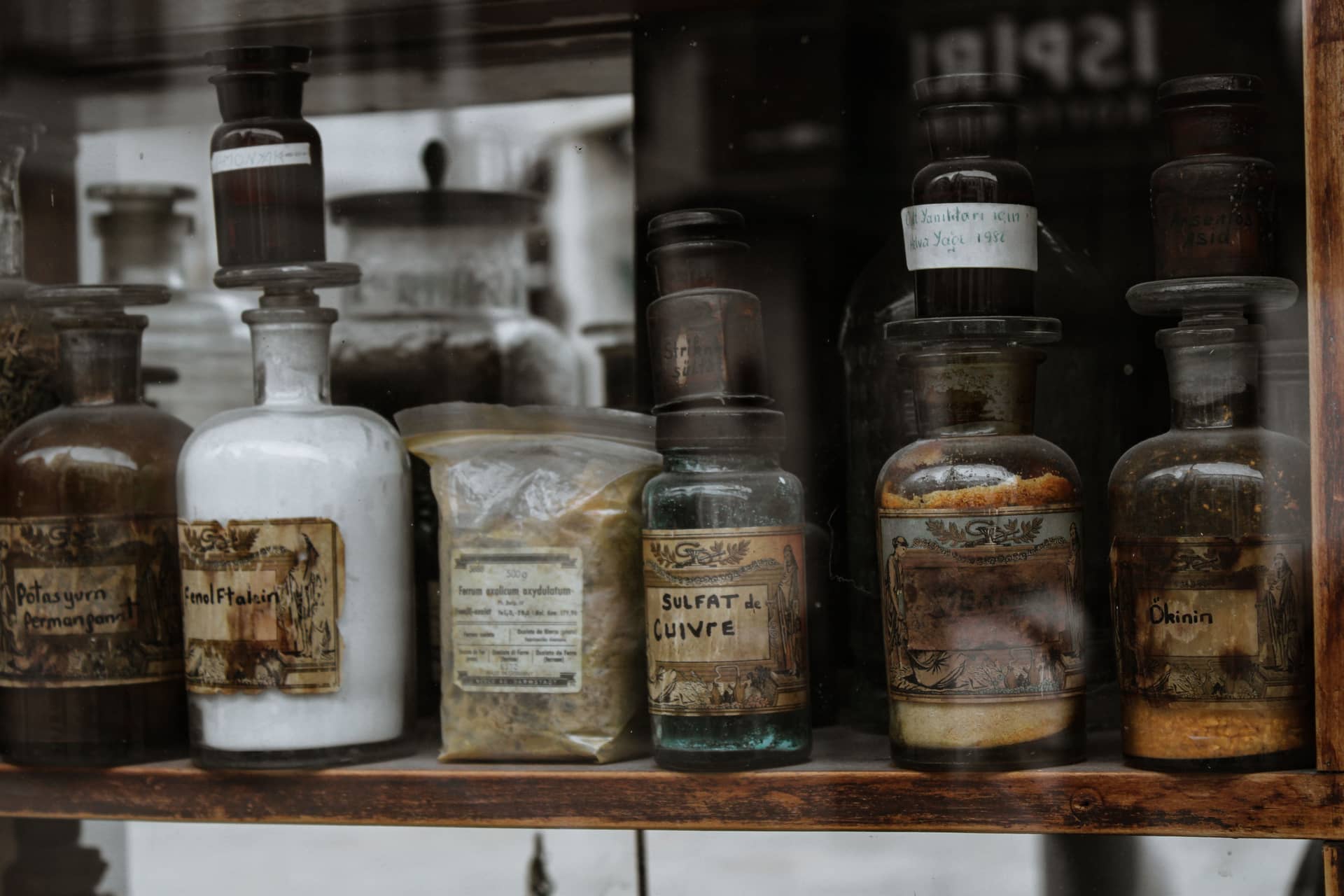
Label every jar with its contents and the date — the NCHFP's storing instruction is "Label and date the jars and store them in a clean, cool, dark, dry place." Buy dissolvable or removable labels rather than permanent ones, because canning jars get reused every year and the adhesive has to come off completely before the jar goes back in a canner.
Labeling is the least glamorous instruction in canning and one of the few that appears in every extension publication. It is also the one people skip, on the reasonable-sounding grounds that they will obviously remember what is in a jar of red stuff.
You will not, by February. More to the point, the date is what tells you which jars to eat first, and "best within a year" is guidance you cannot follow if you do not know when the jar was filled.
What the procedures actually ask for
The NCHFP's instruction is short: label and date. Penn State Extension is more specific about what goes on: "Label with contents, date, and lot number if you canned several canner loads that day." The lot number is the detail worth borrowing — if a jar turns out to be a problem, it tells you which other jars came out of the same canner load.
The date matters because quality has a horizon. The NCHFP: "For best quality, can no more food than you will use within a year unless directions for a specific food provide other advice." The University of Minnesota gives the same figure — "Home-canned foods have a shelf life of 12 months" — and Utah State adds the rotation habit: "Always use FIFO (First-in, first-out), meaning use your oldest cans first."
| On the label | Why |
|---|---|
| What it is | Red stuff is tomato sauce, salsa or pizza sauce, and they are not interchangeable |
| The date processed | Quality guidance is "within a year"; without a date you cannot follow it |
| Lot or batch, if you canned several loads | Penn State's suggestion — it isolates a batch if something is wrong |
| Which recipe, for anything you adapt often | Next August you will want to know which salsa this was |
How we screened these
We have not run a soak test across brands. What we checked is what each maker publishes about removal — the property that actually matters on a jar you refill every year — along with size, count, and whether you can print them. The method is on how we pick.
- Comes off cleanly. Dissolvable labels are designed to wash away; removable adhesive peels without residue. Permanent adhesive is the wrong tool here.
- Sized for a jar, not for a filing cabinet. Anything from about 1 by 2 inches up to 2 inches square works.
- Writable or printable, depending on how many jars you fill in a season.
- Count per pack against a real canner load. Seven quarts per load adds up fast.
- A published claim we can cite, rather than a seller's description.
Quick picks
Every pick below is screened against the National Center for Home Food Preservation’s published canner rules first. Tap a row for the full write-up.
| # | Product | Best for | Key spec | Price |
|---|---|---|---|---|
| 1 |  Avery Printable Dissolvable Labels (4224)The label that disappears in the wash, which is the specific problem home canners have: jars are reused every year and last year's label has to come off completely. Avery's 4224 sheets are printable, so a batch of forty jars gets identical labels with the contents and date already on them. | Printing a whole batch at once | 90 labels, dissolvable, printable | |
| 2 |  Ball Dissolvable Canning Labels, 60-PackBall's own dissolvable label, sold in a box that doubles as a dispenser. Made to be written on with a pen and washed off later, which is exactly the rhythm of a canning day — label the jar while it cools, remove it when the jar comes back empty. | Handwriting, straight from the box | 60 labels, dissolvable | $24.77 · View on Amazon#ad we earn a commission · price as of October 18, 2026 |
| 3 |  Norpro Round Canning Labels (635)Two-inch round labels that sit on the lid of a pint or quart jar, which is where a gift jar wants its label. Twenty-four per pack, cheap, and pleasant to write on — the practical limitation is that Norpro does not say they are removable, so treat them as a jar you are giving away rather than one you are getting back. | Gift jars | 24 labels, 2" round | |
| 4 | Permanent-adhesive labels on canning jarsSkipPermanent labels are made to survive moisture and handling, which is a virtue on a wine bottle and a nuisance on a jar you refill every September. The residue has to be scrubbed off before the jar goes back in a canner, and a gummy rim is the last thing you want near a sealing surface. | Nothing - jars come back | Adhesive outlives the food | Check price on Amazon#ad we earn a commission · live price pending |
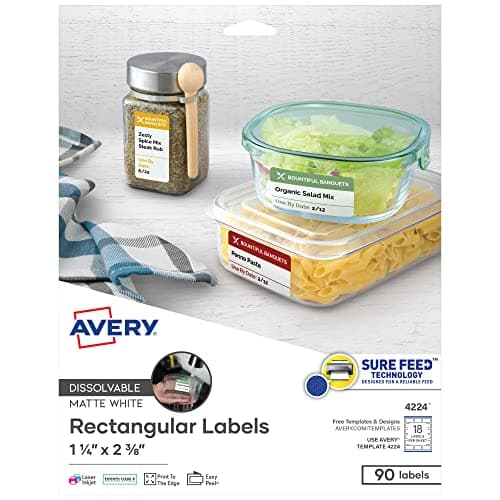
Avery Printable Dissolvable Labels (4224)
The label that disappears in the wash, which is the specific problem home canners have: jars are reused every year and last year's label has to come off completely. Avery's 4224 sheets are printable, so a batch of forty jars gets identical labels with the contents and date already on them.
Published specs
- Product
- Avery 4224
- Size
- 1-1/4" x 2-3/8" rectangle, 18 per sheet, 90 labels (Avery)
- Material
- Dissolvable paper label, laser and inkjet printable (Avery)
- Removal
- "Labels dissolve quickly and easily with no residue when washed by hand or in the dishwasher" (Avery)
- Food contact
- Freezer and microwave safe; FDA-compliant adhesive for indirect food contact (Avery)
What works
- Printable, so contents, date and batch go on every jar legibly without forty handwritten labels
- Dissolves rather than peels, which is the difference between a jar you can reuse and one with a gummy ghost on the side
- Avery publishes a template number, so the sheet lines up correctly the first time
What to know first
- Dissolvable means dissolvable: a jar wiped with a wet cloth or stored somewhere damp can lose its label
- You need a printer and a template, which is more setup than writing on a sticker
- Ninety labels is not many if you can in volume, and the per-label cost is the highest of our picks
Specs from Avery, 4224 Dissolvable Rectangle Labels, NCHFP, Storing Home Canned Foods. We have not handled this product — see how we pick.
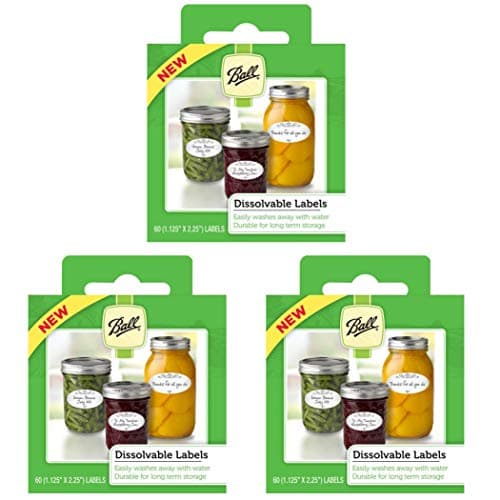
Ball Dissolvable Canning Labels, 60-Pack
Ball's own dissolvable label, sold in a box that doubles as a dispenser. Made to be written on with a pen and washed off later, which is exactly the rhythm of a canning day — label the jar while it cools, remove it when the jar comes back empty.
Published specs
- Model
- 1440010734 (Ball)
- Pack
- 60 labels; box acts as a dispenser (Ball)
- Removal
- Ball says the labels "dissolve by hand washing or in the dishwasher", while the same page's spec table lists "Dishwasher Safe: No"
- Made in
- USA (Ball)
What works
- Designed to be written on, so there is no printer, template or sheet alignment involved
- Dissolves off in water, which keeps reused jars clean without scraping
- The dispenser box means the labels are findable in a drawer the following August
What to know first
- Ball's own page contradicts itself on dishwasher safety, so treat the dishwasher claim as unsettled
- Sixty labels goes quickly across a season, and it is often sold in multi-box packs to compensate
- Ball's site currently lists this product as out of stock, which is why we cite the specification and let the live listing speak for availability
Specs from Ball, Dissolvable Labels, 60-Pack, NCHFP, Storing Home Canned Foods. We have not handled this product — see how we pick.
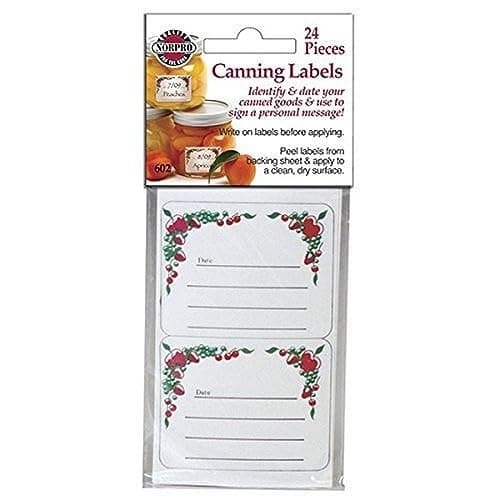
Norpro Round Canning Labels (635)
Two-inch round labels that sit on the lid of a pint or quart jar, which is where a gift jar wants its label. Twenty-four per pack, cheap, and pleasant to write on — the practical limitation is that Norpro does not say they are removable, so treat them as a jar you are giving away rather than one you are getting back.
Published specs
- Model
- 635
- Pack
- 24 per package (Norpro)
- Size
- 2" x 2" / 5 cm x 5 cm (Norpro)
- Intended for
- "Perfect for quart or pint-size jars. Identify and date your canned goods" (Norpro)
- Removal
- Not stated by Norpro — assume they are not dissolvable
What works
- The right size and shape for a lid, which is where a label is most readable on a shelf of jars
- Cheapest per label of our picks, and no printer involved
- Norpro publishes the size and count, so you know what is in the pack before it arrives
What to know first
- No published claim that they come off cleanly, which is the one thing a canner most wants from a label
- Twenty-four labels is a single canner load and a bit
- A lid label is lost the moment you remove the band and stack the jars, so it suits gifting better than storage
Specs from Norpro, 635 Canning Labels, Round, NCHFP, Storing Home Canned Foods. We have not handled this product — see how we pick.
Permanent-adhesive labels on canning jars
Permanent labels are made to survive moisture and handling, which is a virtue on a wine bottle and a nuisance on a jar you refill every September. The residue has to be scrubbed off before the jar goes back in a canner, and a gummy rim is the last thing you want near a sealing surface.
Published specs
- What they are
- Water-resistant labels with permanent adhesive, sold for bottles and gift jars
- Why not here
- Canning jars are reused for years; the label has to come off completely each time
- Buy instead
- Dissolvable or removable labels, or a grease pencil on the lid
What works
- They genuinely stay put on a gift jar that is never coming back, and they look better than a handwritten sticker
What to know first
- Adhesive residue near the jar rim is a cleaning job you do not want before processing
- Scraping at a jar with a blade risks the chip that retires it
- Anything you write on this year's label is wrong next year, and the label is still there
Specs from NCHFP, Storing Home Canned Foods, Avery, 4224 Dissolvable Rectangle Labels. We have not handled this product — see how we pick.
Dissolvable, removable or permanent?
These are three different adhesives and the choice is really about what happens in twelve months' time.
- Dissolvable labels are designed to disappear in water. Avery says of its 4224 sheets: "Labels dissolve quickly and easily with no residue when washed by hand or in the dishwasher." This is the canner's default, because the jar goes back into rotation clean.
- Removable adhesive peels off deliberately. Avery describes its removable labels as sticking to glass and plastic and then peeling "away cleanly and easily when needed" — good if you want the label to survive a wet hand but still come off.
- Permanent adhesive is for a jar you are giving away and not getting back. Avery's arched bottle labels, for instance, are water resistant with permanent adhesive — excellent on a gift jar of syrup, a nuisance on your own pint of beans.
Label the jar, not just the lid
We could not find an extension source that rules on where a label should go, so this is practical rather than official: the band comes off for storage, and on many shelves the lid is not what you see. Penn State and the NCHFP both advise removing screw bands from sealed jars before storing them, which means a label written on a band disappears the moment you follow that advice.
A label on the jar body survives band removal, is readable from the front of a shelf, and does not interfere with the one thing you never want to obstruct — the lid itself, which you check for seal before opening. How to do that check is in how to tell if a jar sealed.
What to write with
Anything permanent enough to survive handling. A fine permanent marker on a dissolvable label works and stays legible; ballpoint drags on the coated ones. If you print, Avery's dissolvable sheets are laser and inkjet compatible and carry a template number so a sheet of forty lines up the first time.
A grease pencil straight onto the glass is the zero-cost version and wipes off with a cloth. It is genuinely fine for jars that will be eaten within the season, and genuinely annoying if the writing rubs off in a crate.
The rest of the storage instruction
Labeling is one clause in a longer sentence. The NCHFP's full version is to label and date the jars and store them in a clean, cool, dark, dry place, with a temperature between 50 and 70°F for best quality. Penn State adds the band removal; Utah State adds keeping jars away from furnaces, pipes and uninsulated attics where temperatures swing.
None of that changes whether a jar is safe on the day it seals. It changes how good the food is when you open it, and how many of them you eat rather than pour away next August.
A dating system that survives February
The instruction is to date the jar; the useful version is to date it in a way that still tells you something a year later. Month and year is enough for most people. If you can the same food several times in a season — three batches of salsa from three pickings — add a batch letter, which is the lightweight version of Penn State's lot number.
- Write the year in full. "9/26" is ambiguous in a cellar containing jars from two seasons.
- Date what happened, not what you hope. The processing date is the fact; a "best by" date is a guess layered on top of it.
- Keep one line for the recipe source if you use more than one — "NCHFP" or "Ball p.94" costs three seconds and settles arguments next summer.
- Rotate by date, not by reach. Utah State's instruction is first-in, first-out: use the oldest jars first, which only works if the dates are legible from the front of the shelf.
And when a label does come off — which dissolvable ones eventually will, somewhere damp — the fallback is the lid. A jar whose label is gone is not unsafe, it is just anonymous, and an anonymous jar of something low-acid is one you should not be guessing about. Eat the mystery jars first, or open them for lunch rather than storing them on.
The decision, in one paragraph
If you can in volume, buy Avery's printable dissolvable labels and print contents and date for a whole batch at once. If you fill a canner load at a time and would rather write, buy Ball's dissolvable labels and keep the dispenser box with the lids. If the jars are gifts, Norpro's round labels sit neatly on the lid and look the part — just do not expect them to come off cleanly. And skip permanent-adhesive labels on any jar you intend to see again.
Next stepChecking the seal before you store itCommon questions
What should you write on a canning label?
What are the best labels for canning jars?
Do dissolvable canning labels really come off?
Should you label the lid or the jar?
How long do home-canned foods keep?
Can you write directly on canning lids?
Are permanent labels bad for canning jars?
How many labels do you need?
Do you earn a commission on these?
Sources
- NCHFP — Storing Home Canned Foods
- Penn State Extension — Let's Preserve: Basics of Home Canning
- Penn State Extension — Storage Guidelines for Home Preserved Foods
- University of Minnesota Extension — Storing canned food
- Utah State University Extension — Storing Canned Goods
- Avery — 4224 Dissolvable Rectangle Labels
- Ball — Dissolvable Labels, 60-Pack
- Norpro — 635 Canning Labels, Round
Product specifications are taken from each manufacturer’s own published page, cited on the product. We have not handled these products — how we pick.