All American 921 review
A genuinely better-built canner with one published number that decides whether you can use it at all.
Disclosure: we earn a commission on purchases made through links on this page, at no extra cost to you. It does not change what we recommend — see how we pick and our affiliate disclosure.

The All American 921 is a 21.5-quart cast aluminum pressure canner holding 7 quarts or 18 pints, sealed by a machined metal-to-metal fit with no gasket to replace. Its published bottom exterior diameter is 15 3/8 inches, which exceeds the NCHFP 4-inch element rule on nearly every household electric element.
This is the canner people aspire to, and the review most likely to disappoint somebody. It deserves its reputation: the build is better, the seal has no consumable, and these get handed down. It also has one published measurement that quietly disqualifies it in a lot of kitchens, and that measurement is the most useful thing on this page.
We have not used it. What follows is its published specifications against the NCHFP's published rules.
The specifications, as published
| All American 921 | |
|---|---|
| Liquid capacity | 21.5 quarts |
| Jar capacity | 18 pints or 7 quarts |
| Seal | Metal-to-metal, no gasket |
| Gauge | Geared steam gauge |
| Regulator | 5, 10 or 15 psi |
| Inside diameter | 12 1/4 inches |
| Inside height | 10 1/2 inches |
| Bottom exterior diameter | 15 3/8 inches |
| Weight (empty) | 24 pounds |
The gasket-free seal is the real advantage
This is not marketing. A machined metal-to-metal seal has no rubber component, which means nothing to perish in a hot attic, nothing that swells, and nothing to source in September when you discover last year's ring has hardened. On a Presto the sealing ring is the part that fails first; on an All American that part does not exist.
Presto does sell replacement rings, so this is a maintenance difference rather than a lifespan difference — but it is a maintenance step you will forget and the All American simply does not have. Over twenty years that is a real distinction.
The number that decides it
All American publishes a bottom exterior diameter of 15 3/8 inches, which almost nobody in this category does and which is genuinely to their credit. The same base carries the 915, 925 and 930 — see All American canner sizes compared. The NCHFP's rule for electric ranges is that a canner should be no more than 4 inches wider in diameter than the element it is heated on. Run the arithmetic: 15 3/8 minus 4 means you need an element of at least 11 3/8 inches.
Household electric elements are commonly 6 to 9 inches. That is not close. On a standard electric coil or a radiant smooth top, this canner frequently is not usable however good it is, and the outcome is uneven heating where the outer jars may never hold temperature for the full processing time.
Quick picks
Every pick below is screened against the National Center for Home Food Preservation’s published canner rules first. Tap a row for the full write-up.
| # | Product | Best for | Key spec | Price |
|---|---|---|---|---|
| 1 | All American 921 (21.5 qt)Cast aluminum with a machined metal-to-metal seal, so there is no gasket to perish, swell or go missing the week you need it. It is also 24 pounds empty and its base is wider than most electric elements, which is a genuine constraint rather than a footnote. | Buying once, for decades | Base 15 3/8", no gasket | Check price on Amazon#ad we earn a commission · live price pending |
| 2 | All American 925 (25 qt)The 921 made taller. It sits on the same base, so it fits — or does not fit — your stove exactly like the 921 does, and the extra capacity buys you a taller stack rather than a wider one. | Bigger batches, same footprint | 25 qt, same base as 921 | Check price on Amazon#ad we earn a commission · live price pending |
| 3 |  Presto 23-Quart Pressure Canner and Cooker (01781)The default first pressure canner, and the one most beginners should buy: it takes a full seven-quart load, it doubles as a boiling-water canner for pints and half-pints, and it costs a fraction of a cast-aluminum canner. The dial gauge is the catch, and it is a real one. | A first pressure canner | 7 quarts / 20 pints |
All American 921 (21.5 qt)
Cast aluminum with a machined metal-to-metal seal, so there is no gasket to perish, swell or go missing the week you need it. It is also 24 pounds empty and its base is wider than most electric elements, which is a genuine constraint rather than a footnote.
Published specs
- Liquid capacity
- 21.5 quarts
- Jar capacity
- 18 pints or 7 quarts
- Seal
- Metal-to-metal, no gasket
- Gauge
- Geared steam gauge
- Regulator
- 5, 10 or 15 psi
- Inside diameter
- 12 1/4 inches
- Inside height
- 10 1/2 inches
- Bottom exterior diameter
- 15 3/8 inches
- Weight (empty)
- 24 pounds
What works
- No gasket means no annual replacement part, and nothing that hardens in a hot attic between seasons
- All American publishes the base diameter, which almost nobody in this category does — you can check it against your element before you buy
- The 921 and its siblings are the canners people hand down. Parts and gauges remain available for very old units
What to know first
- The 15 3/8" base needs an element of at least 11 3/8" to stay inside the NCHFP 4-inch rule, and most household electric elements are 6" to 9". Check your stove first
- 24 pounds empty, and considerably more loaded with jars and water — a real consideration if lifting is difficult
- Several times the price of a Presto, which is money better spent on jars and lids for a first season
Specs from All American, 921 21.5-Quart Pressure Canner, NCHFP, Recommended Canners. We have not handled this product — see how we pick.
All American 925 (25 qt)
The 921 made taller. It sits on the same base, so it fits — or does not fit — your stove exactly like the 921 does, and the extra capacity buys you a taller stack rather than a wider one.
Published specs
- Liquid capacity
- 25 quarts
- Seal
- Metal-to-metal, no gasket
- Regulator
- 5, 10 or 15 psi
- Bottom exterior diameter
- 15 3/8 inches, same as the 921
- Base model
- Same body diameter as the 921
What works
- Extra height without extra width, so it does not make your stove-fit problem any worse than the 921 already does
- Same gasket-free seal and same long parts availability as the rest of the range
- Worth the step up only if you are already canning enough to fill a 921 twice in a session
What to know first
- Same 15 3/8-inch base as the 921, so the same element-size problem applies in full
- Heavier again than the 921, and taller means more reach to lift a full rack out
- For a first harvest this is more canner than the job needs
Specs from All American, 921 21.5-Quart Pressure Canner, NCHFP, Recommended Canners. We have not handled this product — see how we pick.
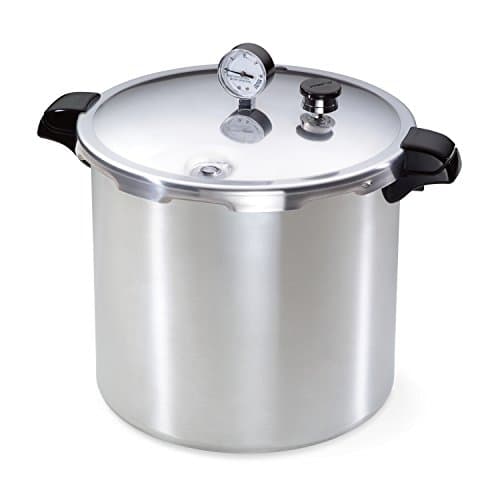
Presto 23-Quart Pressure Canner and Cooker (01781)
The default first pressure canner, and the one most beginners should buy: it takes a full seven-quart load, it doubles as a boiling-water canner for pints and half-pints, and it costs a fraction of a cast-aluminum canner. The dial gauge is the catch, and it is a real one.
Published specs
- Liquid capacity
- 23 quarts (21.8 liters)
- Jar capacity
- 26 half-pints, 20 pints, 7 quarts
- Material
- Warp-resistant aluminum
- Gauge
- Dial gauge
- Ranges
- Regular and smooth-top
- Burner limit
- 12,000 BTUs or less
- Also
- Doubles as a boiling-water canner
- Warranty
- 12-year limited
- Base diameter
- Not published by Presto
What works
- Seven quart jars is the standard batch size every tested NCHFP recipe is written around, so you are never processing a half load
- Doubles as a boiling-water canner for pints and half-pints, which means one pot covers the jam-and-pickles year as well as the beans
- Presto sells a replacement dial gauge and sealing ring separately, so a decade-old canner is a repair rather than a replacement
What to know first
- A dial gauge should be checked for accuracy every year — most extension offices do it free, and most owners never go. A weighted gauge needs no calibration at all
- Presto does not publish a base diameter, so you cannot check it against the NCHFP element rule without measuring the box yourself. See will it fit your stove
- Rated for burners of 12,000 BTUs or less, which rules out most outdoor propane burners and some high-output gas ranges
Specs from Presto, 23-Quart Pressure Canner and Cooker (01781). We have not handled this product — see how we pick.
Weight is the other thing to be honest about
Twenty-four pounds empty. Add seven quart jars and several inches of water and it is a two-handed lift you plan your kitchen around. That is worth confronting before it arrives rather than after, particularly if you will be moving it on and off a stove alone.
The practical habit this forces is a good one regardless of canner: load and unload jars while the canner is already on the burner, rather than carrying it loaded. On a 24-pound cast aluminum canner it stops being optional.
The gauge still needs testing
Worth saying because the price tag suggests otherwise. The 921 carries a geared steam gauge plus a regulator offering 5, 10 or 15 psi, so it is effectively both systems — a dial to read and weights to set. The dial does not escape the NCHFP's instruction to check dial gauges for accuracy before use each year.
The weights are the useful half: at altitude you can run a weight rather than holding a needle. The trade-off between the two systems is in dial gauge vs weighted gauge.
The 921 against the 925
If you have decided on All American, the choice between the 21.5-quart 921 and the 25-quart 925 is simpler than it looks: the 925 is taller on the same base. It buys about one extra pint of capacity, and — this is the part that matters — it does not improve or worsen your stove-fit situation at all, because the base diameter is the same.
Buy the larger one only if you are genuinely filling a 921 twice in a session. The sizing logic is in what size pressure canner do you need.
Is it worth the money?
If it fits your stove and you will use it for years, yes — the gasket-free build and the parts availability are real, and these canners are genuinely handed down. If your element is small, no price makes a canner that does not fit worth buying, and the Presto 23-quart takes a larger load for a fraction of the cost.
For a first canner, we would still point most people at the Presto and let them discover how much canning they actually do. A 921 is an excellent second canner and an expensive way to find out you make jam twice a year.
Looking after the seal
The metal-to-metal seal removes the gasket, and it replaces it with a surface that has to stay clean and lightly lubricated. The mating faces of the lid and body are machined to fit, which means anything on them — dried food, grit, a dent from a knock — stops them fitting.
In practice that is a wipe of the sealing surfaces after each use and a light film of oil on them before the canner goes away. Follow All American's own instructions for the lubricant and the amount rather than improvising; the point is to stop the faces binding, not to grease them. Store the lid resting on the body rather than clamped down, so nothing is held under tension for a year.
Why these get inherited
It is worth being specific about the longevity claim rather than leaving it as folklore. Two things make a 921 a multi-generation object. There is no consumable in the seal, so the failure that retires most canners does not exist. And All American maintains parts for models that have been out of production for a long time, so a canner from decades ago is usually a gauge and a regulator away from working.
If you are given one, two checks before the first batch and both are non-negotiable. Get the gauge tested, because you have no idea what it has been through or how long it sat. And inspect the sealing faces for dents or corrosion, because that is the one damage on this canner that is not a spare part away from fixed.
Next stepThe head-to-head against the PrestoCommon questions
Is the All American 921 worth the extra money?
Will an All American 921 work on an electric stove?
Does the All American 921 need a gasket?
How many jars does the 921 hold?
What is the difference between the 921 and the 925?
Does the 921 gauge need annual testing?
Do you earn a commission on these?
Sources
- All American — 921 Pressure Canner
- NCHFP — Recommended Canners
- Penn State Extension — Buying a Pressure Canner
Product specifications are taken from each manufacturer’s own published page, cited on the product. We have not handled these products — how we pick.