All American canner sizes compared
Six sizes, one design, and a set of published numbers that do not always agree with each other. What each model actually holds.
Disclosure: we earn a commission on purchases made through links on this page, at no extra cost to you. It does not change what we recommend — see how we pick and our affiliate disclosure.

Six sizes share one design. The 915 takes 7 quart jars — a full load — in the shortest pot; the 921 adds double-decked pints (19); the 925 and 930 go taller; the 941 takes 19 quarts and is too heavy for a glass range by the maker's own manual. The 910 holds 4 quarts, exactly the USDA minimum for a pressure canner.
All American canners are the same object at six scales: cast aluminum, a machined metal-to-metal seal with no gasket, wing nuts around the rim, and a lifetime limited warranty. Choosing between them is therefore not about quality. It is about jar counts and whether the thing fits your stove.
We have not weighed these or measured them. Every figure below is the manufacturer's, and where the manufacturer publishes two different numbers for the same thing — which happens more than you would expect — we say so.
The whole range, from the maker's manual
| 910 | 915 | 921 | 925 | 930 | 941 | |
|---|---|---|---|---|---|---|
| Liquid capacity (qt) | 10 1/2 | 15 1/2 | 21 1/2 | 25 | 30 | 41 1/2 |
| Quart jars | 4 | 7 | 7 | 7 | 14 | 19 |
| Pint jars | 7 | 10 | 19 | 19 | 19 | 32 |
| Inside diameter | 10 3/8" | 12 5/8" | 12 5/8" | 12 5/8" | 12 5/8" | 15 1/4" |
| Inside height | 7 5/8" | 7 1/2" | 10 1/2" | 11 1/2" | 14" | 13 3/4" |
| Shipping weight | 16 lb | 21 lb | 24 lb | 25 lb | 30 lb | 39 lb |
| Racks included | 1 | 1 | 2 | 2 | 2 | 2 |
Three things in that table do most of the deciding.
- Quart capacity plateaus at 7 from the 915 all the way to the 925. Quart jars stand in one layer, and the pot's diameter — not its height — sets how many fit. Paying for a taller canner buys pints, not quarts.
- Pints double-deck from the 921 up, which is where 10 becomes 19. That single row is the real argument for the 921 over the 915.
- The 930 is the first model to take 14 quarts, because it is tall enough to stack them — and the 941 is a different class of object entirely.
The part that rules models out: your stove
All American's current manual is more nuanced than the version extension services still quote. It now reads: "ALL AMERICAN pressure cooker/canners are NOT recommended for use on glass top ranges without first checking with your manufacturer. Our models 930 and 941 are too heavy and could cause damage to your range/ DO NOT slide the pressure canner over a glass range surface as it could scratch and damage it."
Clemson Extension quotes the older, flatter wording — "ALL-AMERICAN Pressure Cooker/Canners are NOT recommended for use on glass top/flat ranges because its weight may cause the glass/ceramic to break" — and adds the second problem: "The diameter of the canner is also larger than most burners and may cause heat to transfer outward and damage the surrounding surface."
And one more constraint that catches people: induction is out entirely. All American's own FAQ answers it directly — "No, our pressure canners are not compatible with induction cooktops" — because cast aluminum is not magnetic. If your range is induction, this whole line is off the table; the options are in canning on an induction cooktop.
Quick picks
Every pick below is screened against the National Center for Home Food Preservation’s published canner rules first. Tap a row for the full write-up.
| # | Product | Best for | Key spec | Price |
|---|---|---|---|---|
| 1 | All American 921 (21.5 qt)Cast aluminum with a machined metal-to-metal seal, so there is no gasket to perish, swell or go missing the week you need it. It is also 24 pounds empty and its base is wider than most electric elements, which is a genuine constraint rather than a footnote. | Buying once, for decades | Base 15 3/8", no gasket | Check price on Amazon#ad we earn a commission · live price pending |
| 2 |  All American 915 (15.5 qt)The quiet value pick of the line. It takes the same seven quart jars as the 921 — a full canner load — in a shorter pot that fits under more range hoods and weighs less to lift. What you give up is the second layer of pints, and for many households that is the whole reason to size up. | Seven quarts without the height | 7 quarts, single layer | $399.95 · View on Amazon#ad we earn a commission · price as of October 18, 2026 |
| 3 | All American 925 (25 qt)The 921 made taller. It sits on the same base, so it fits — or does not fit — your stove exactly like the 921 does, and the extra capacity buys you a taller stack rather than a wider one. | Bigger batches, same footprint | 25 qt, same base as 921 | Check price on Amazon#ad we earn a commission · live price pending |
| 4 | All American 910 (10.5 qt)The smallest All American, and the smallest canner the USDA's rule tolerates: four quart jars is exactly the published minimum for a pressure canner. It exists for kitchens where a 21-quart cast aluminum canner is simply too big — and it is the one model the maker says should not be used for smoked fish. | Four quarts, and a small stove | 4 quarts, single layer | Check price on Amazon#ad we earn a commission · live price pending |
| 5 |  All American 941 (41.5 qt)The one that stops being kitchen equipment and starts being infrastructure. Nineteen quart jars or thirty-two pints per load, a 15-inch inside diameter, and a shipping weight around 39 pounds empty. All American's own manual says the 930 and 941 are too heavy for a glass range, and NCHFP's burner rules effectively send it outdoors or to a heavy gas range. | Homestead-scale batches | 19 quarts, 32 pints | $649.95 · View on Amazon#ad we earn a commission · price as of October 18, 2026 |
| 6 |  Presto 23-Quart Pressure Canner and Cooker (01781)The default first pressure canner, and the one most beginners should buy: it takes a full seven-quart load, it doubles as a boiling-water canner for pints and half-pints, and it costs a fraction of a cast-aluminum canner. The dial gauge is the catch, and it is a real one. | A first pressure canner | 7 quarts / 20 pints |
All American 921 (21.5 qt)
Cast aluminum with a machined metal-to-metal seal, so there is no gasket to perish, swell or go missing the week you need it. It is also 24 pounds empty and its base is wider than most electric elements, which is a genuine constraint rather than a footnote.
Published specs
- Liquid capacity
- 21.5 quarts
- Jar capacity
- 18 pints or 7 quarts
- Seal
- Metal-to-metal, no gasket
- Gauge
- Geared steam gauge
- Regulator
- 5, 10 or 15 psi
- Inside diameter
- 12 1/4 inches
- Inside height
- 10 1/2 inches
- Bottom exterior diameter
- 15 3/8 inches
- Weight (empty)
- 24 pounds
What works
- No gasket means no annual replacement part, and nothing that hardens in a hot attic between seasons
- All American publishes the base diameter, which almost nobody in this category does — you can check it against your element before you buy
- The 921 and its siblings are the canners people hand down. Parts and gauges remain available for very old units
What to know first
- The 15 3/8" base needs an element of at least 11 3/8" to stay inside the NCHFP 4-inch rule, and most household electric elements are 6" to 9". Check your stove first
- 24 pounds empty, and considerably more loaded with jars and water — a real consideration if lifting is difficult
- Several times the price of a Presto, which is money better spent on jars and lids for a first season
Specs from All American, 921 21.5-Quart Pressure Canner, NCHFP, Recommended Canners. We have not handled this product — see how we pick.
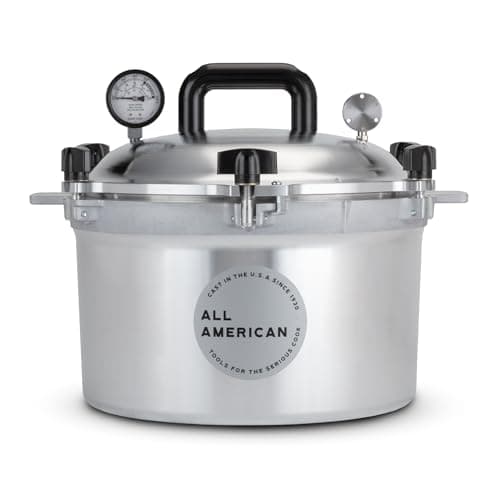
All American 915 (15.5 qt)
The quiet value pick of the line. It takes the same seven quart jars as the 921 — a full canner load — in a shorter pot that fits under more range hoods and weighs less to lift. What you give up is the second layer of pints, and for many households that is the whole reason to size up.
Published specs
- Liquid capacity
- 15.5 quarts (All American)
- Jar capacity
- 10 pints, 7 quarts (All American manual)
- Inside dimensions
- 12 5/8" diameter, 7 1/2" tall (All American manual)
- Racks
- One rack; single-layer canner (All American)
- Seal
- Metal-to-metal, no gasket (All American)
- Heat
- All American: do not use a heat source over 24,000 BTUs; NCHFP says 12,000
What works
- Seven quart jars — the same full load as the 21.5-quart model — in a pot four inches shorter inside
- Lighter than the 921 by every published figure, which matters on a range with a weight limit and when lifting it full
- The cheapest way into the gasketless All American design
What to know first
- Ten pints per load against nineteen in the 921, because it cannot double-deck
- Still cast aluminum: no induction, and All American says its canners are "not compatible with induction cooktops"
- Its base is wider than most electric elements, which is the NCHFP rule that eliminates more canners than any other
Specs from All American (Wisconsin Aluminum Foundry), Pressure Cooker Manual, NCHFP, Using Pressure Canners. We have not handled this product — see how we pick.
All American 925 (25 qt)
The 921 made taller. It sits on the same base, so it fits — or does not fit — your stove exactly like the 921 does, and the extra capacity buys you a taller stack rather than a wider one.
Published specs
- Liquid capacity
- 25 quarts
- Seal
- Metal-to-metal, no gasket
- Regulator
- 5, 10 or 15 psi
- Bottom exterior diameter
- 15 3/8 inches, same as the 921
- Base model
- Same body diameter as the 921
What works
- Extra height without extra width, so it does not make your stove-fit problem any worse than the 921 already does
- Same gasket-free seal and same long parts availability as the rest of the range
- Worth the step up only if you are already canning enough to fill a 921 twice in a session
What to know first
- Same 15 3/8-inch base as the 921, so the same element-size problem applies in full
- Heavier again than the 921, and taller means more reach to lift a full rack out
- For a first harvest this is more canner than the job needs
Specs from All American, 921 21.5-Quart Pressure Canner, NCHFP, Recommended Canners. We have not handled this product — see how we pick.
All American 910 (10.5 qt)
The smallest All American, and the smallest canner the USDA's rule tolerates: four quart jars is exactly the published minimum for a pressure canner. It exists for kitchens where a 21-quart cast aluminum canner is simply too big — and it is the one model the maker says should not be used for smoked fish.
Published specs
- Liquid capacity
- 10.5 quarts (All American)
- Jar capacity
- 7 pints, 4 quarts (All American manual)
- Inside dimensions
- 10 3/8" diameter, 7 5/8" tall (All American manual)
- Racks
- One rack; the 910 and 915 are single-layer canners (All American)
- Seal
- Metal-to-metal, no gasket (All American)
- Note
- All American: the 10.5 qt model "should not be used for canning smoked fish"
What works
- Clears the USDA's four-quart-jar minimum, so it is a real pressure canner rather than a saucepan
- Same gasketless metal-to-metal seal and lifetime limited warranty as the big models, in a size a small kitchen can store
- Lightest of the range, which matters because All American canners are cast aluminum and heavy for their volume
What to know first
- Four quart jars per load is the floor, not a comfortable capacity — a bushel of beans becomes a weekend
- Single layer only: no stacking pints, where the 921 and up double-deck them
- The published weight figures disagree across All American's own documents, from 11.5 lb to 16 lb for this model
Specs from All American (Wisconsin Aluminum Foundry), Pressure Cooker Manual, All American 1930, pressure cookers. We have not handled this product — see how we pick.
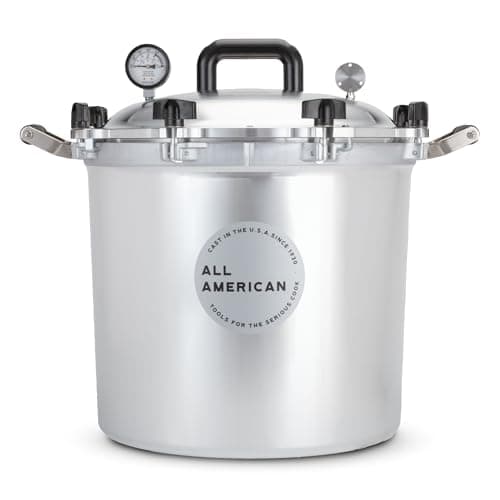
All American 941 (41.5 qt)
The one that stops being kitchen equipment and starts being infrastructure. Nineteen quart jars or thirty-two pints per load, a 15-inch inside diameter, and a shipping weight around 39 pounds empty. All American's own manual says the 930 and 941 are too heavy for a glass range, and NCHFP's burner rules effectively send it outdoors or to a heavy gas range.
Published specs
- Liquid capacity
- 41.5 quarts (All American)
- Jar capacity
- 32 pints, 19 quarts (All American manual)
- Inside dimensions
- 15 1/4" diameter, 13 3/4" tall (All American manual)
- Weight
- 39 lb shipping weight (manual); All American's product page lists 36 lb
- Heat sources
- "Gas, and electric only" (All American product page)
- Glass tops
- All American manual: models 930 and 941 "are too heavy and could cause damage to your range"
What works
- Nineteen quarts in one load turns a harvest that would take three runs into one
- Double-decks pints with a second rack, which is where the capacity advantage really shows
- Same gasketless seal and lifetime limited warranty as every other model in the line
What to know first
- Ruled out for glass-top ranges by the maker itself, and too wide for almost any domestic electric element under the NCHFP's 4-inch rule
- Heavy empty and dangerous full — a 41-quart canner of water and jars is not a pot you lift off a stove
- The most expensive canner on this site by a wide margin, and the capacity is wasted below homestead scale
Specs from All American (Wisconsin Aluminum Foundry), Pressure Cooker Manual, All American 1930, pressure cookers. We have not handled this product — see how we pick.
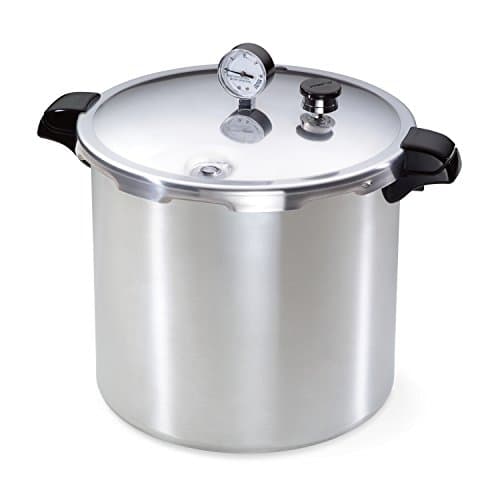
Presto 23-Quart Pressure Canner and Cooker (01781)
The default first pressure canner, and the one most beginners should buy: it takes a full seven-quart load, it doubles as a boiling-water canner for pints and half-pints, and it costs a fraction of a cast-aluminum canner. The dial gauge is the catch, and it is a real one.
Published specs
- Liquid capacity
- 23 quarts (21.8 liters)
- Jar capacity
- 26 half-pints, 20 pints, 7 quarts
- Material
- Warp-resistant aluminum
- Gauge
- Dial gauge
- Ranges
- Regular and smooth-top
- Burner limit
- 12,000 BTUs or less
- Also
- Doubles as a boiling-water canner
- Warranty
- 12-year limited
- Base diameter
- Not published by Presto
What works
- Seven quart jars is the standard batch size every tested NCHFP recipe is written around, so you are never processing a half load
- Doubles as a boiling-water canner for pints and half-pints, which means one pot covers the jam-and-pickles year as well as the beans
- Presto sells a replacement dial gauge and sealing ring separately, so a decade-old canner is a repair rather than a replacement
What to know first
- A dial gauge should be checked for accuracy every year — most extension offices do it free, and most owners never go. A weighted gauge needs no calibration at all
- Presto does not publish a base diameter, so you cannot check it against the NCHFP element rule without measuring the box yourself. See will it fit your stove
- Rated for burners of 12,000 BTUs or less, which rules out most outdoor propane burners and some high-output gas ranges
Specs from Presto, 23-Quart Pressure Canner and Cooker (01781). We have not handled this product — see how we pick.
Which size, for which kitchen
- 910 (10.5 qt) — 4 quart jars, which is exactly the USDA's published minimum for a pressure canner. For a small kitchen or a small household. Note All American says this model "should not be used for canning smoked fish."
- 915 (15.5 qt) — the value pick. Same 7 quart jars as the 921, four inches shorter inside, lighter to lift. Single layer, so 10 pints instead of 19.
- 921 (21.5 qt) — the default, and the one we reviewed separately. Seven quarts or nineteen double-decked pints, which suits most serious home canning.
- 925 (25 qt) — the 921 with more headroom. Same jar counts on the maker's own figures; buy it only if you want the extra depth for tall loads.
- 930 (30 qt) — the first size that doubles quart capacity to 14. Manual says not for glass tops on weight grounds.
- 941 (41.5 qt) — 19 quarts or 32 pints. Homestead scale, gas or electric coil only, and a canner you do not lift when it is full.
About those weights
Worth a short section because the numbers are genuinely unreliable and buyers use them to judge whether a range can take one. For the 921 alone, All American publishes 24 lb in its manual's shipping-weight column, 22 lb in the specification block on its product page, and 17.75 lb in a comparison table on the same page. Retailers publish two more figures.
Our reading: the manual's column is explicitly shipping weight, so the true empty weight is lower — somewhere between the other two figures — and none of them is the number that matters anyway. The number that matters is the loaded weight, which adds jars, food and two to three inches of water, and no published figure covers it. If your range has a weight limit, assume a loaded canner is in the range of 40 to 50 pounds and take the question to your range manufacturer, which is what every extension service advises.
What every size shares
The reason people buy these rather than a Presto is the closure. All American: "Our metal-to-metal seal represents a breakthrough in pressure canner design, eliminating the need for traditional rubber or silicone gaskets," and maintenance is correspondingly simple — "there's no gasket to replace. Cleaning involves simple wiping of the sealing surfaces and occasional checks of the pressure gauge and vents for any blockages." The wing nuts, they note, need occasional lubrication.
- Lifetime limited warranty on canners sold since September 2024, excluding wear parts — gauges, overpressure plugs, wing nuts, clamp bolts, pins and racks.
- Both gauges: a dial gauge for reading pressure and a weighted regulator, so the annual gauge check still applies — see dial gauge vs weighted gauge.
- Made in the USA, in Manitowoc, Wisconsin.
- Cast aluminum, so no induction, and no sudden temperature changes — the manual warns that thermal shock "can crack a cast aluminum utensil."
- 5, 10 and 15 psi settings across the range.
A sourcing note, since it affects what you will read elsewhere. The site that ranks first for these canners and looks like the manufacturer's is not: its own footer says it is an independently owned retailer, not affiliated with the maker beyond being an authorized dealer. Its published specifications differ from the manufacturer's on every model we checked. Every figure on this page comes from Wisconsin Aluminum Foundry's own manual and product pages instead.
Buying used, which is how many of these are bought
All American canners outlive their owners, so the second-hand market is real and the design makes it unusually safe to buy into. There is no gasket to have perished in a cupboard, and the parts that do wear are all replaceable: the gauge, the overpressure plug, the wing nuts, the clamp bolts and the racks — which is exactly the list All American's warranty excludes as wear items.
Two checks before money changes hands. Look at the sealing surfaces on the rim and cover for gouges, because a machined metal-to-metal seal depends on them being smooth and flat. And plan on a gauge test whatever the seller says — the NCHFP's rule is to check dial gauges for accuracy every year, and a canner of unknown history is the case that rule was written for. Testing is often free at a county extension office, and the procedure is in dial gauge vs weighted gauge.
The decision, in one paragraph
For most kitchens the honest answer is the 915 or the 921: identical quart capacity, and the 921 costs you four inches of height in exchange for nine more pints per load. Go 910 only if space or weight genuinely rules the others out, 925 if you want headroom, and 930 or 941 only at homestead scale and never on a glass top. And if your range is induction, or your element is small, buy a Presto 23-quart or an induction-compatible canner instead — a canner that does not fit your stove is not a bargain at any warranty length.
Next stepThe 921 in depthCommon questions
What is the difference between the All American 915 and 921?
Which All American size holds the most quart jars?
Can you use an All American canner on a glass top stove?
Are All American canners induction compatible?
What is the smallest All American that counts as a pressure canner?
How much does an All American canner weigh?
Do All American canners need a gasket?
What burner can I use?
Do you earn a commission on these?
Sources
- All American — Pressure Cooker Manual (PDF)
- All American 1930 — pressure cookers
- All American 1930 — Lifetime Limited Warranty
- NCHFP — Using Pressure Canners
- NCHFP — How to Use Boiling Water and Pressure Canners
- Clemson Cooperative Extension — Canning on Smooth Top Ranges
- Penn State Extension — Canning on Smooth Cooktops
Product specifications are taken from each manufacturer’s own published page, cited on the product. We have not handled these products — how we pick.