Mirro pressure canner review
Weighted regulators, a seven-quart load, two racks, and a published base diameter nobody else in this category prints. Also a manual that tells you to can everything at 15 psi.
Disclosure: we earn a commission on purchases made through links on this page, at no extra cost to you. It does not change what we recommend — see how we pick and our affiliate disclosure.

Buy the Mirro 22-quart if your electric element is small. It is the only full-size stovetop canner on this site whose maker publishes a base diameter - 24 cm, about 9.45 inches - which clears the NCHFP element rule on anything 5.5 inches or wider. It is weighted-gauge, so no annual gauge test, and it ships with two racks for double-stacking pints. The catch: Mirro's own manual says canning uses the 15 psi weight, for everything.
We have not canned a season in this pot and will not write as though we have. What follows is read out of Mirro's own user manual - the June 2024 edition, reference 1520016623, which covers models 92116 and 92122 - checked against the NCHFP's published canner rules. Our method is on how we pick.
The reason this canner is worth a page is one number. Every other full-size stovetop canner in this category declines to publish a base diameter, which makes the single most useful rule in home canning unusable. Mirro publishes it, in a table, in the manual. That is the review.
The number that makes this canner interesting
The NCHFP's rule for electric ranges is that a canner "should be no more than 4 inches wider in diameter than the element on which it is heated." A canner wider than that heats unevenly, and the jars around the outside may never hold temperature for the full processing time. It is the most consequential thing you can know before buying a canner, and almost nobody publishes the input.
Mirro's manual does, under Basic specifications: pot diameter 31 cm, base diameter 24 cm, for both the 16-quart and the 22-quart. Twenty-four centimetres is about 9.45 inches. Subtract four and you get the smallest element this canner is suited to: 5.45 inches. Household electric elements run roughly 6 to 9 inches, so the Mirro clears the rule on essentially any of them.
| Canner | Published base | Smallest element it suits | Source |
|---|---|---|---|
| Mirro 92122 (22 qt) | 24 cm / 9.45 in | 5.45 in | Mirro manual |
| Mirro 92116 (16 qt) | 24 cm / 9.45 in | 5.45 in | Mirro manual |
| All American 921 (21.5 qt) | 15 3/8 in | 11.4 in | All American |
| Presto 01781 (23 qt) | Not published | Unknown - measure it | Presto publishes no figure |
| Granite Ware (21.5 qt) | Not published | Unknown - measure it | Granite Ware publishes no figure |
Run your own element size through will it fit your stove, which now includes this canner. On a gas burner the rule matters far less, because the flame wraps the base rather than transferring by contact.
Quick picks
Every pick below is screened against the National Center for Home Food Preservation’s published canner rules first. Tap a row for the full write-up.
| # | Product | Best for | Key spec | Price |
|---|---|---|---|---|
| 1 |  Mirro 22-Quart Aluminum Pressure Canner (92122)The only full-size stovetop canner on this site whose maker publishes a base diameter, which makes it the only one you can check against the NCHFP element rule without a tape measure. Weighted regulators mean no gauge to have tested every year. The catch is that Mirro's own canning instruction is the 15 psi weight, for everything. | A weighted canner that fits a normal element | 9.45 in base, 7 quart jars | $129.99 · View on Amazon#ad we earn a commission · price as of October 18, 2026 |
| 2 |  Mirro 16-Quart Aluminum Pressure Canner (92116)The 16-quart shares the 92122's base diameter, its three weighted regulators and its seven-quart load. What it gives up is the second rack, so pints go in one layer rather than two. If you are not double-stacking, this is the same canner for less money and less cupboard. | The same canner in a smaller kitchen | 9.45 in base, 7 quart jars | $119.99 · View on Amazon#ad we earn a commission · price as of October 18, 2026 |
| 3 |  Presto 23-Quart Pressure Canner and Cooker (01781)The default first pressure canner, and the one most beginners should buy: it takes a full seven-quart load, it doubles as a boiling-water canner for pints and half-pints, and it costs a fraction of a cast-aluminum canner. The dial gauge is the catch, and it is a real one. | A first pressure canner | 7 quarts / 20 pints | |
| 4 |  All American 915 (15.5 qt)The quiet value pick of the line. It takes the same seven quart jars as the 921 — a full canner load — in a shorter pot that fits under more range hoods and weighs less to lift. What you give up is the second layer of pints, and for many households that is the whole reason to size up. | Seven quarts without the height | 7 quarts, single layer | $399.95 · View on Amazon#ad we earn a commission · price as of October 18, 2026 |
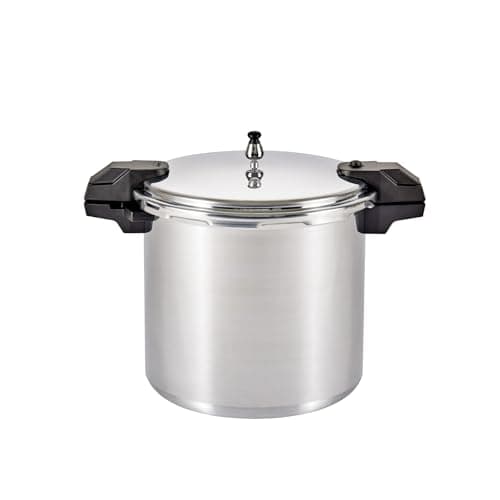
Mirro 22-Quart Aluminum Pressure Canner (92122)
The only full-size stovetop canner on this site whose maker publishes a base diameter, which makes it the only one you can check against the NCHFP element rule without a tape measure. Weighted regulators mean no gauge to have tested every year. The catch is that Mirro's own canning instruction is the 15 psi weight, for everything.
Published specs
- Capacity
- 20.8 L / 22 qt (Mirro manual, basic specifications)
- Jar capacity
- 7 quart jars, or 16 wide-mouth pints double-stacked with the second rack (Mirro)
- Base diameter
- 24 cm, about 9.45 inches (Mirro manual; converted from the metric figure Mirro publishes)
- Pot diameter
- 31 cm, about 12.2 inches (Mirro)
- Material
- Aluminum, pot and lid (Mirro)
- Pressure control
- Three weighted operating valves - low 5 psi, medium 10 psi, high 15 psi (Mirro)
- Canning setting
- "Pressure canning can only be done using the high-pressure operating valve" - the 15 psi weight (Mirro)
- Maximum pressures
- 103 kPa / 15 psi operating; 180 kPa / 26.1 psi safety (Mirro)
- Water for canning
- 2 1/2 qt in the 22-quart model (Mirro canning table)
- Racks
- Two canning racks in the 22-quart, one in the 16-quart (Mirro)
- Gasket
- "Change the gasket on your pressure cooker once a year or if it shows any signs of splitting or damage" (Mirro)
- Service interval
- Mirro says the cooker must be checked by IMUSA customer service after 10 years of use
What works
- Mirro publishes the base diameter - 24 cm, about 9.45 inches - which clears the NCHFP rule that a canner "should be no more than 4 inches wider in diameter than the element on which it is heated" on any element of 5.5 inches or more. Presto and Granite Ware publish no such figure
- Weighted regulators instead of a dial, so there is no gauge to get tested for accuracy every year and nothing to fall out of calibration in a cupboard
- Ships with two canning racks, so double-stacking pints is something the pot does out of the box rather than a second purchase
- A full seven-quart load, which is what the USDA processes assume, at the cheapest end of full-size canners
What to know first
- Mirro's own instruction is that canning uses the 15 psi weight only. Most USDA processes are written for 10 or 11 psi at sea level, so following the manual at low altitude over-processes the food - safe, but softer than it needs to be. Use the process from your tested recipe, not from the manual
- Mirro publishes no process times worth following and no altitude table, and the Amazon listing does not print the model number - the manual is the only place the 92116 and 92122 numbers appear
- The manual lists induction among its compatible heat sources while also stating the pot is aluminum. Aluminum is not ferrous and an induction cooktop will not detect it, so read that icon as a line-wide graphic rather than a claim about this pot
- Aluminum discolors with use, and a thin aluminum base over a hot element is more prone to warping than a cast or clad one
Specs from Mirro, User's Manual for models 92116-92122 (June 2024, ref. 1520016623), Mirro, Pressure Cookers & Canners, NCHFP, Recommended Canners. We have not handled this product — see how we pick.
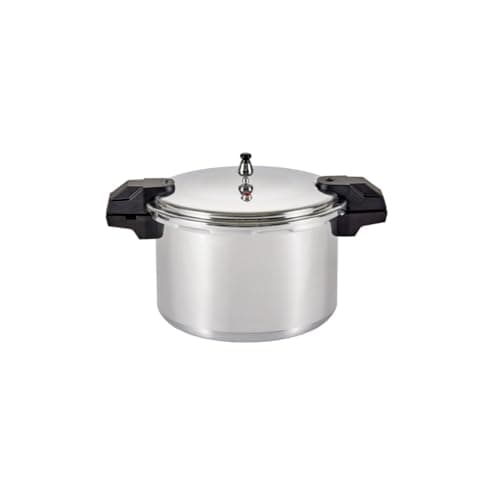
Mirro 16-Quart Aluminum Pressure Canner (92116)
The 16-quart shares the 92122's base diameter, its three weighted regulators and its seven-quart load. What it gives up is the second rack, so pints go in one layer rather than two. If you are not double-stacking, this is the same canner for less money and less cupboard.
Published specs
- Capacity
- 15.1 L / 16 qt (Mirro manual)
- Jar capacity
- 7 quart jars, or 7 wide-mouth pints and 8 regular-mouth pints in a single layer (Mirro canning table)
- Base diameter
- 24 cm, about 9.45 inches - identical to the 22-quart (Mirro)
- Material
- Aluminum, pot and lid (Mirro)
- Pressure control
- Three weighted operating valves - 5, 10 and 15 psi (Mirro)
- Racks
- One canning rack (Mirro)
- Water for canning
- 2 1/2 qt (Mirro canning table)
What works
- Holds the same full seven-quart load as the 22-quart in a noticeably shorter pot, which matters under a range hood or a low cabinet
- Same published 24 cm base, same weighted regulators, same gasket - everything that makes the 22-quart worth considering, minus the height
- Lighter to lift full, which is the most underrated property a canner has
What to know first
- One rack, not two, so pints go in a single layer - the 22-quart's double-stacking is the whole reason to pay more
- Carries the same 15 psi-only canning instruction, and the same absence of usable process times, as the 22-quart
- Often priced close enough to the 22-quart that the smaller pot only wins if height or weight is the deciding constraint
Specs from Mirro, User's Manual for models 92116-92122 (June 2024, ref. 1520016623), NCHFP, Recommended Canners. We have not handled this product — see how we pick.
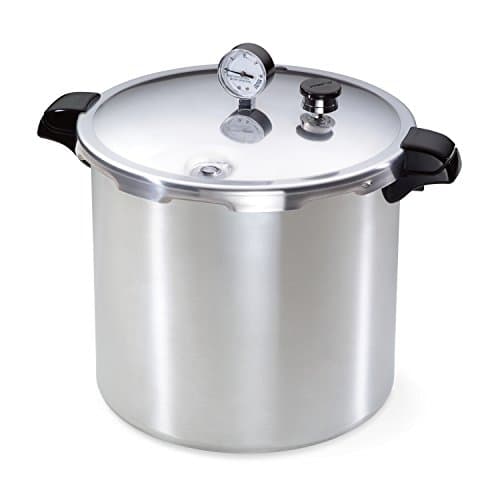
Presto 23-Quart Pressure Canner and Cooker (01781)
The default first pressure canner, and the one most beginners should buy: it takes a full seven-quart load, it doubles as a boiling-water canner for pints and half-pints, and it costs a fraction of a cast-aluminum canner. The dial gauge is the catch, and it is a real one.
Published specs
- Liquid capacity
- 23 quarts (21.8 liters)
- Jar capacity
- 26 half-pints, 20 pints, 7 quarts
- Material
- Warp-resistant aluminum
- Gauge
- Dial gauge
- Ranges
- Regular and smooth-top
- Burner limit
- 12,000 BTUs or less
- Also
- Doubles as a boiling-water canner
- Warranty
- 12-year limited
- Base diameter
- Not published by Presto
What works
- Seven quart jars is the standard batch size every tested NCHFP recipe is written around, so you are never processing a half load
- Doubles as a boiling-water canner for pints and half-pints, which means one pot covers the jam-and-pickles year as well as the beans
- Presto sells a replacement dial gauge and sealing ring separately, so a decade-old canner is a repair rather than a replacement
What to know first
- A dial gauge should be checked for accuracy every year — most extension offices do it free, and most owners never go. A weighted gauge needs no calibration at all
- Presto does not publish a base diameter, so you cannot check it against the NCHFP element rule without measuring the box yourself. See will it fit your stove
- Rated for burners of 12,000 BTUs or less, which rules out most outdoor propane burners and some high-output gas ranges
Specs from Presto, 23-Quart Pressure Canner and Cooker (01781). We have not handled this product — see how we pick.
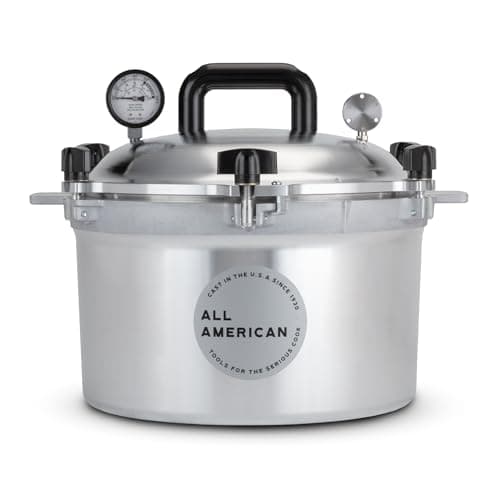
All American 915 (15.5 qt)
The quiet value pick of the line. It takes the same seven quart jars as the 921 — a full canner load — in a shorter pot that fits under more range hoods and weighs less to lift. What you give up is the second layer of pints, and for many households that is the whole reason to size up.
Published specs
- Liquid capacity
- 15.5 quarts (All American)
- Jar capacity
- 10 pints, 7 quarts (All American manual)
- Inside dimensions
- 12 5/8" diameter, 7 1/2" tall (All American manual)
- Racks
- One rack; single-layer canner (All American)
- Seal
- Metal-to-metal, no gasket (All American)
- Heat
- All American: do not use a heat source over 24,000 BTUs; NCHFP says 12,000
What works
- Seven quart jars — the same full load as the 21.5-quart model — in a pot four inches shorter inside
- Lighter than the 921 by every published figure, which matters on a range with a weight limit and when lifting it full
- The cheapest way into the gasketless All American design
What to know first
- Ten pints per load against nineteen in the 921, because it cannot double-deck
- Still cast aluminum: no induction, and All American says its canners are "not compatible with induction cooktops"
- Its base is wider than most electric elements, which is the NCHFP rule that eliminates more canners than any other
Specs from All American (Wisconsin Aluminum Foundry), Pressure Cooker Manual, NCHFP, Using Pressure Canners. We have not handled this product — see how we pick.
What it is, mechanically
An aluminum pot and lid - Mirro states the material outright - with a gasket, a lid-position indicator, a pressure indicator, a safety valve and a filter. Pressure is set by swapping one of three weighted operating valves onto the steam release outlet: low at 35.4 kPa (5 psi), medium at 69 kPa (10 psi), high at 103 kPa (15 psi). Maximum operating pressure is 15 psi; the safety pressure is 180 kPa, 26.1 psi.
No dial. That is a real advantage and the reason some people buy weighted canners on purpose: a dial gauge should be tested for accuracy once a year, and a weight is a machined piece of metal that either rocks or does not. The full argument is dial gauge vs weighted gauge.
Capacity, from Mirro's own canning table: the 22-quart takes 7 quart jars, or 16 wide-mouth pints, 18 regular pints or 24 half-pints when the jars are double-stacked using a second canning rack. Mirro includes two racks in the 22-quart and one in the 16-quart, which means double-stacking is something the pot does out of the box rather than after a parts order.
Where the manual is wrong for you
The canning section opens with this: "Pressure canning can only be done using the high-pressure operating valve" - the 15 psi weight. Read as written, that tells a sea-level canner to process green beans at 15 psi when the USDA process for green beans is 10 or 11 psi.
This is not dangerous. Higher pressure means higher temperature, and the hazard in pressure canning runs the other way. What it means is over-processing: softer beans, mushier carrots, more liquid loss, for no safety gain. On a weighted canner the standard practice is the 10-pound weight at 1,000 feet or below and the 15-pound weight above it, which is what the tested recipe will tell you.
To Mirro's credit, the manual does point in the right direction on the method itself: "The US Department of Agriculture recommends pressure canning as the only safe way to can meats, fish, poultry and vegetables." That is the correct line, and it is the line this entire site is built around - see what foods need pressure canning.
The induction icon, which cannot be right
The manual's compatible-heat-sources strip lists gas, sealed electric plate, ceramic, halogen, induction and electric coil. Two pages earlier the same manual states the pot and lid are aluminum.
Those two statements cannot both describe this pot. Induction works by inducing a current in ferrous metal; aluminum is not ferrous, and an induction cooktop will not detect it at all. Iowa State University Extension puts it plainly: because most brands of pressure canner are made of aluminum, they will not work on an induction burner. Read the icon strip as a graphic printed across a whole cookware line, not as a claim about the 92122.
If induction is your only cooktop, no amount of manual wording changes the physics, and the options are in canning on an induction cooktop.
Living with it
Mirro's maintenance instructions are specific and short, which is more than some competitors manage:
- Gasket: "Change the gasket on your pressure cooker once a year or if it shows any signs of splitting or damage," and always use an original Mirro gasket for the model.
- Storage: turn the lid upside down and rest it on the pot, so the gasket is not compressed for nine months of the year.
- Service: Mirro says the cooker must be checked by IMUSA customer service after ten years of use - IMUSA being the Groupe SEB arm that handles the brand.
- Before every use: check that the drain hole of the operating valve is not obstructed, and check the safety valve.
- Water: 2 1/2 quarts for canning in the 22-quart, per Mirro's own table.
The gasket is the consumable and the part to source before a season rather than during one. Parts for canners generally are in pressure canner replacement parts.
Mirro against the two canners you are probably also looking at
| Mirro 92122 | Presto 01781 | All American 915 | |
|---|---|---|---|
| Capacity | 22 qt | 23 qt | 15.5 qt |
| Gauge | Weighted, 5/10/15 | Dial | Weighted + dial |
| Base diameter | Published, 9.45 in | Not published | Published, 15 3/8 in |
| Gasket | Yes, annual change | Yes | None - metal-to-metal |
| Racks included | Two | One | One |
| Annual gauge test | No | Yes | Yes, for the dial |
| Doubles as a water bath canner | Not stated by Mirro | Yes, stated by Presto | Not stated |
One honest gap: Presto states its 23-quart doubles as a boiling-water canner with the lid off, which is a genuine saving for a first-harvest buyer who would otherwise own two pots. Mirro's manual does not make that claim, and we are not going to make it for them. The full head-to-head between the two philosophies is All American vs Presto.
What Mirro does not publish
Worth stating, because the absences shaped this review. No process times you should follow. No altitude table. No country of manufacture for the canners. No glaze on whether the 22-quart doubles as a water bath canner. And the Amazon listing does not print the model number at all - the 92116 and 92122 designations appear in the manual and on replacement-part listings, not on the retail page.
There is also a 22-quart aluminum pressure canner sold under the T-fal name, at a similar price, and Groupe SEB owns both brands. We could not find a Groupe SEB spec sheet for the T-fal version and are not going to assert that the two pots are the same pot. If you find the T-fal cheaper, that is the open question to resolve before buying.
Who should buy it
Buy the 22-quart if you cook on an electric coil or a sealed plate and you want a canner you can verify fits before it arrives, or if the idea of mailing a gauge away for testing every year is the thing putting you off pressure canning. Buy the 16-quart if the seven-quart load is enough and the shorter pot suits your kitchen better than the second rack would. Buy the Presto 01781 instead if you want one pot that also water baths, and the All American if you want no gasket ever - both are in the best pressure canners.
Next stepCheck it against your elementCommon questions
Is the Mirro pressure canner a dial or weighted gauge?
How many jars does the Mirro 22-quart hold?
What is the Mirro canner's base diameter?
Should I really can at 15 psi, like the manual says?
Can I use a Mirro canner on a glass top stove?
Will a Mirro canner work on induction?
Is Mirro still in business?
How often do I replace the gasket?
Does the Mirro double as a water bath canner?
Do you earn a commission on these?
Sources
- Mirro — User's Manual, models 92116-92122 (June 2024, ref. 1520016623)
- Mirro — Pressure Cookers & Canners
- NCHFP — Recommended Canners
- NCHFP — Using Pressure Canners
- Iowa State University Extension — induction cooktops and canners
Product specifications are taken from each manufacturer’s own published page, cited on the product. We have not handled these products — how we pick.