What you need for pressure canning
The canner is most of it. The rest is a short list, plus one maintenance job almost nobody does.
Disclosure: we earn a commission on purchases made through links on this page, at no extra cost to you. It does not change what we recommend — see how we pick and our affiliate disclosure.
To pressure can you need a pressure canner holding at least seven quart jars with UL approval, jars with new flat lids, a jar lifter, a funnel, a bubble remover, a tested recipe source, and your altitude figure. Dial-gauge canners also need an annual gauge accuracy test.
Pressure canning has a shorter kit list than people expect, because the canner does the work a lot of accessories would otherwise do. What it adds over water bath canning is not more equipment — it is a maintenance obligation and a number you have to look up.
The canner itself
Two hard requirements, both from the NCHFP: Underwriter's Laboratory approval, and enough capacity for seven quart jars or eight to nine pints. Below that capacity it is a pressure saucepan, which the NCHFP does not recommend for canning — what size pressure canner do you need has the jar-count table. Add a flat bottom if you are on an electric range, and a base diameter within 4 inches of your element.
Our picks are in best pressure canners, and the stove arithmetic is in will it fit your stove — do that second one before you buy, not after. If you are choosing between the two 23-quart Prestos, 01781 vs 01784 is a one-row decision.
The parts that wear out
| Part | What it does | When to replace |
|---|---|---|
| Sealing ring (gasket) | Seals the lid to the pot | When it hardens, cracks or stops sealing. Inspect every season. All American canners have none — they use a machined metal seal |
| Overpressure plug | Releases pressure if the vent blocks | If it looks distorted or has ever blown. Replace, do not modify |
| Dial gauge | Shows the pressure | If it fails an accuracy test. Test it annually |
| Vent pipe | Where steam escapes and the weight sits | Not a wear part, but clean it before every session — a blocked vent is the failure the safety devices exist for |
The annual job almost nobody does
If your canner has a dial gauge, it should be tested for accuracy every year. Gauges drift, and a gauge reading 11 psi when the canner is actually at 8 psi means every jar you process is under-processed — with no sign of it at any point. A failed gauge is a replaceable part, not a dead canner.
Many county extension offices test gauges free or for a nominal fee. Call yours before the season starts. If there is no extension office within reach, that is a genuine argument for buying a weighted-gauge canner instead, where there is nothing to calibrate at all.
Everything else
- Jars and new flat lids. Same as water bath canning. Quarts are common for pressure canning; check your canner's height clearance.
- A jar lifter. Non-negotiable. Jars come out of a pressure canner very hot.
- A funnel and a bubble remover, for headspace and clean rims.
- A tested recipe source. More important here than anywhere else on the site — pressure canning times are food-specific and jar-size-specific.
- A timer you will actually hear over a running canner.
- Somewhere to cool the canner down naturally. You cannot rush depressurizing, and forcing it is both unsafe and ruins the batch.
Quick picks
Every pick below is screened against the National Center for Home Food Preservation’s published canner rules first. Tap a row for the full write-up.
| # | Product | Best for | Key spec | Price |
|---|---|---|---|---|
| 1 |  Presto 23-Quart Pressure Canner and Cooker (01781)The default first pressure canner, and the one most beginners should buy: it takes a full seven-quart load, it doubles as a boiling-water canner for pints and half-pints, and it costs a fraction of a cast-aluminum canner. The dial gauge is the catch, and it is a real one. | A first pressure canner | 7 quarts / 20 pints | |
| 2 | Ball Secure-Grip Canning Utensil SetThe four tools that make canning a two-handed job instead of a three-handed one: a jar lifter, a wide-mouth funnel, a magnetic lid wand and a bubble remover with a headspace scale. Buying them together costs less than buying the lifter alone twice. | The whole tool problem, once | Lifter, funnel, wand, tool | Check price on Amazon#ad we earn a commission · live price pending |
| 3 |  Ball Wide Mouth Quart Jars (32 oz)The jar to buy when you are packing peach halves, pickle spears or anything you have to reach into. The wider 86 mm mouth is easier to fill and far easier to clean, and quarts are the standard size for tomatoes. | Whole fruit and packing by hand | 86 mm mouth, 32 oz | |
| 4 |  Ball Blue Book Guide to PreservingThe cheap, thin one that has been in kitchens for a century, and the one to buy first. Every recipe in it is tested, which is the only property that matters — a canning recipe is a validated process, not a suggestion. | The first book to own | Tested recipes, cheap | $29.99 · View on Amazon#ad we earn a commission · price as of October 18, 2026 |
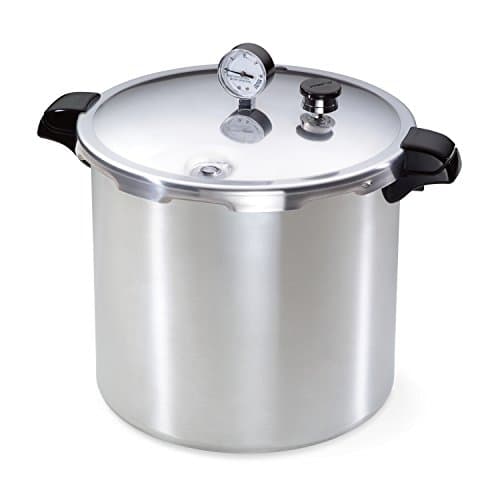
Presto 23-Quart Pressure Canner and Cooker (01781)
The default first pressure canner, and the one most beginners should buy: it takes a full seven-quart load, it doubles as a boiling-water canner for pints and half-pints, and it costs a fraction of a cast-aluminum canner. The dial gauge is the catch, and it is a real one.
Published specs
- Liquid capacity
- 23 quarts (21.8 liters)
- Jar capacity
- 26 half-pints, 20 pints, 7 quarts
- Material
- Warp-resistant aluminum
- Gauge
- Dial gauge
- Ranges
- Regular and smooth-top
- Burner limit
- 12,000 BTUs or less
- Also
- Doubles as a boiling-water canner
- Warranty
- 12-year limited
- Base diameter
- Not published by Presto
What works
- Seven quart jars is the standard batch size every tested NCHFP recipe is written around, so you are never processing a half load
- Doubles as a boiling-water canner for pints and half-pints, which means one pot covers the jam-and-pickles year as well as the beans
- Presto sells a replacement dial gauge and sealing ring separately, so a decade-old canner is a repair rather than a replacement
What to know first
- A dial gauge should be checked for accuracy every year — most extension offices do it free, and most owners never go. A weighted gauge needs no calibration at all
- Presto does not publish a base diameter, so you cannot check it against the NCHFP element rule without measuring the box yourself. See will it fit your stove
- Rated for burners of 12,000 BTUs or less, which rules out most outdoor propane burners and some high-output gas ranges
Specs from Presto, 23-Quart Pressure Canner and Cooker (01781). We have not handled this product — see how we pick.
Ball Secure-Grip Canning Utensil Set
The four tools that make canning a two-handed job instead of a three-handed one: a jar lifter, a wide-mouth funnel, a magnetic lid wand and a bubble remover with a headspace scale. Buying them together costs less than buying the lifter alone twice.
Published specs
- Contents
- Jar lifter, canning funnel, lid wand, bubble remover
- Fits
- Regular and wide mouth jars
- The essential one
- The jar lifter
What works
- The jar lifter alone justifies the set — tongs slip on a wet jar and a dropped hot quart is a genuine burn
- The bubble remover doubles as a headspace gauge, which is the measurement beginners most often eyeball wrong
- Everything is dishwasher-safe and stores inside the canner
What to know first
- The magnetic lid wand is the one piece you can genuinely skip — clean fingers work
- Plastic tools stain with tomato and turmeric, permanently and harmlessly
- If you already own a lifter, buying the set again is redundant
Specs from NCHFP, Recommended Canners. We have not handled this product — see how we pick.
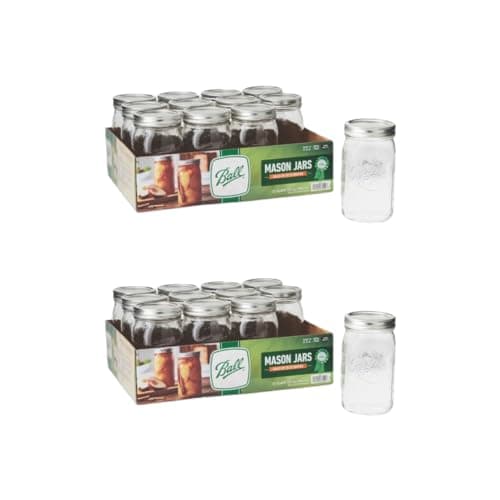
Ball Wide Mouth Quart Jars (32 oz)
The jar to buy when you are packing peach halves, pickle spears or anything you have to reach into. The wider 86 mm mouth is easier to fill and far easier to clean, and quarts are the standard size for tomatoes.
Published specs
- Volume
- 32 oz / 4 cups
- Mouth
- Wide, about 86 mm lid diameter
- Inner mouth diameter
- About 76 mm
- Jar dimensions
- About 6 1/2" tall x 3 1/4" wide
What works
- You can get a hand and a jar funnel into it, which turns packing peaches from a chore into a task
- Quart is the size the tomato and peach processing times in tested recipes are written around
- Much easier to wash by hand than a regular mouth quart
What to know first
- Wide mouth lids cost more than regular mouth and disappear from shelves first in peak season
- Seven quarts is a full canner load, so a quart-jar day is a longer day per jar of finished food
- A quart of anything low-acid still needs a pressure canner, and quarts take the longest processing times
Specs from Ball, Mason Jars & Lids, Wide Mouth. We have not handled this product — see how we pick.
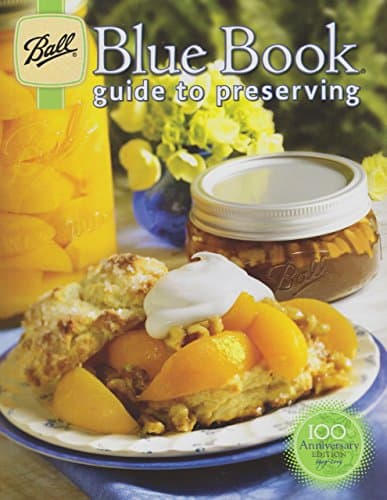
Ball Blue Book Guide to Preserving
The cheap, thin one that has been in kitchens for a century, and the one to buy first. Every recipe in it is tested, which is the only property that matters — a canning recipe is a validated process, not a suggestion.
Published specs
- Publisher
- Ball / Newell Brands
- Content
- Tested water bath and pressure canning recipes
- Why it matters
- A tested source you can hold while your hands are wet
What works
- Tested recipes, which is the entire point of buying a canning book rather than reading a blog
- Cheap enough to buy alongside your first case of jars without thinking about it
- Compact and spill-tolerant in a way a laptop on a counter is not
What to know first
- Recipe range is narrower than the bigger books — this is a foundation, not a library
- Editions change; a very old copy may predate current guidance and should be cross-checked against the NCHFP
- Not a technique manual. It tells you what to do, less about why
Specs from NCHFP, Recommended Canners. We have not handled this product — see how we pick.
What the process adds over a water bath
Three steps that do not exist in water bath canning, and all three are places to slow down. Venting: you let steam flow steadily from the open vent for the full time your manual specifies, usually 10 minutes, to drive the air out. Trapped air lowers the temperature at a given pressure, which is exactly the failure you are trying to avoid. Holding pressure: the pressure must stay at or above the required figure for the entire time, and if it drops you bring it back up and start timing again. Natural cool-down: the canner depressurizes on its own. Do not run it under water, do not lift the weight early.
Next stepLook up your altitude adjustmentCommon questions
Do I need to test a dial gauge every year?
How long do I vent a pressure canner?
Can I cool a pressure canner faster with cold water?
Does an All American need a gasket?
What pressure should I use?
Sources
- NCHFP — Recommended Canners
- Penn State Extension — Buying a Pressure Canner
- Presto — 23-Quart Pressure Canner (01781)
Product specifications are taken from each manufacturer’s own published page, cited on the product. We have not handled these products — how we pick.