What equipment do you need for canning?
The full list, sorted into essential and optional, with the reasoning attached so you can disagree with us knowingly.
Disclosure: we earn a commission on purchases made through links on this page, at no extra cost to you. It does not change what we recommend — see how we pick and our affiliate disclosure.
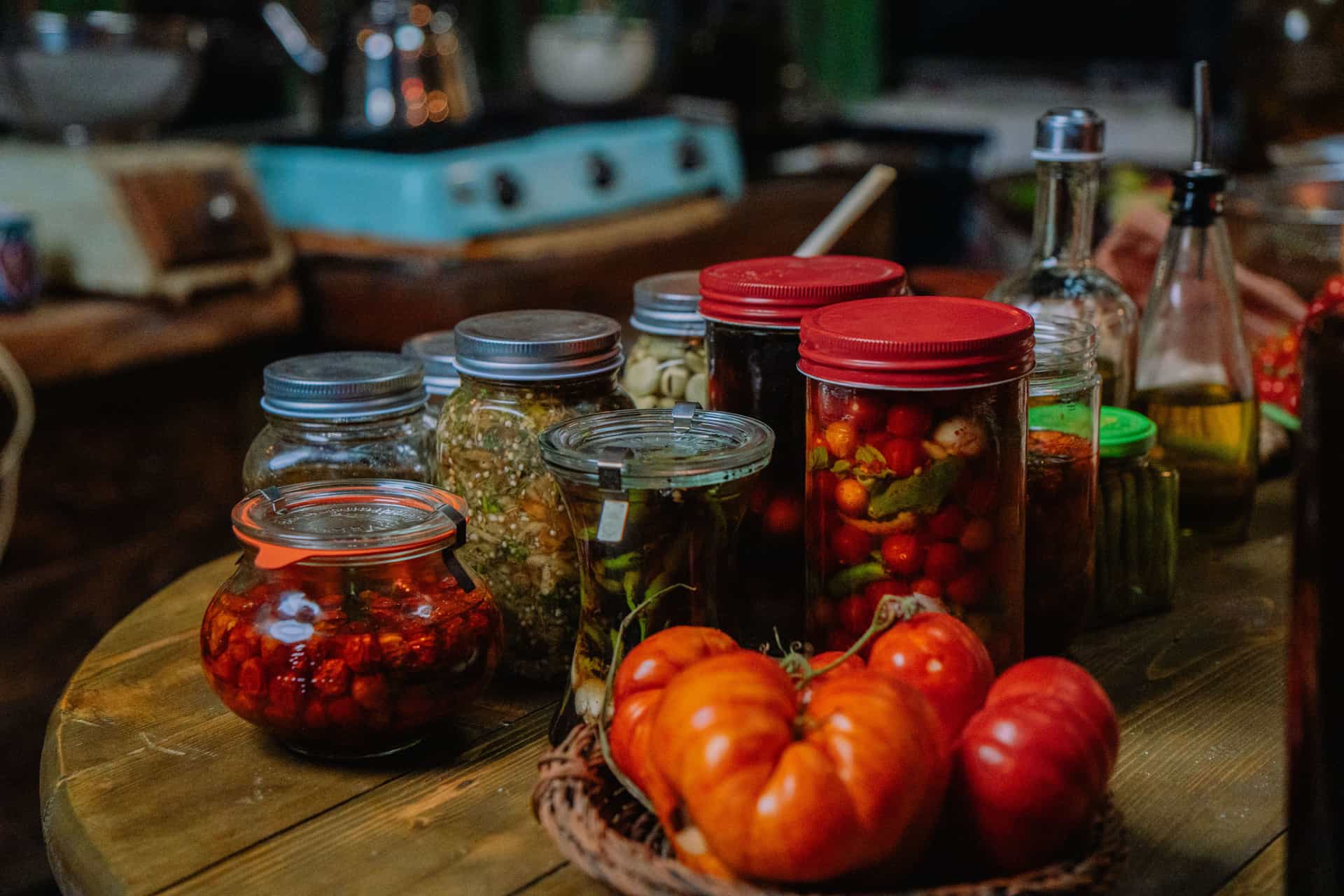
The essential canning equipment is a canner with a rack, jars, new flat lids, a jar lifter, a funnel and a tested recipe source. Everything else — lid wands, specialty racks, extra tools — is optional. The canner must match your food's acidity: boiling water for high-acid, pressure for low-acid.
Essential
| Item | Why it is essential |
|---|---|
| Canner with rack | Deep enough for an inch of boiling water over the jars; the rack keeps jars off the base. Water bath for high-acid, pressure for low-acid |
| Jars | Made for canning, with an undamaged sealing rim. Commercial food jars do not qualify |
| New flat lids | Single-use by design. The one true consumable in the whole process |
| Screw bands | Reusable for years. They hold the lid until the vacuum forms, then they come off |
| Jar lifter | Lifts a hot jar level out of boiling water. Kitchen tongs slip |
| Canning funnel | Keeps food off the sealing rim, the top cause of failed seals |
| Tested recipe source | A canning recipe is a validated process. This is the item with the largest effect on your results |
| A timer | Processing time is the process. Not an estimate, not a guess |
| Your altitude figure | Above 1,000 feet, times and pressures change. It is part of the tested process |
Worth having
| Item | What it buys you |
|---|---|
| Bubble remover with headspace scale | Releases trapped air and measures the one thing beginners most often eyeball |
| Clean cloths for wiping rims | Four seconds per jar, and the cheapest improvement to your seal rate |
| Bottled lemon juice or citric acid | Required by tested tomato recipes. Bottled, not fresh — the acidity is standardized |
| Canning salt | No iodine, no anti-caking agents, so brines stay clear. See canning salt |
| Labels or a marker | Contents and date. Unlabelled jars become mystery jars by February |
| A second large pot | For cooking the food while the canner heats. Most people already own one |
Optional, and honestly skippable
| Item | Why you can skip it |
|---|---|
| Magnetic lid wand | Comes in every kit. Clean fingers do the same job |
| Jar wrench | Bands go on fingertip tight. If you need a wrench, you have over-tightened |
| Specialty racks | The rack that came with the canner is fine |
| A dedicated canning thermometer | Water bath canning is judged by the boil; pressure canning by the gauge |
| Pectin calculators and gadgets | The recipe already tells you |
| Decorative jar covers | Charming, and they do nothing |
Quick picks
Every pick below is screened against the National Center for Home Food Preservation’s published canner rules first. Tap a row for the full write-up.
| # | Product | Best for | Key spec | Price |
|---|---|---|---|---|
| 1 |  Granite Ware 21.5-Quart Water Bath Canner with RackThe canner almost everyone starts with, and there is very little wrong with that. Porcelain enamel on steel, a rack that holds a full seven-quart load, light enough to lift full, and cheap enough that it is not the thing standing between you and a first batch. | A first water bath canner | 7 quarts / 9 pints | $79.99 · View on Amazon#ad we earn a commission · price as of October 18, 2026 |
| 2 | Ball Secure-Grip Canning Utensil SetThe four tools that make canning a two-handed job instead of a three-handed one: a jar lifter, a wide-mouth funnel, a magnetic lid wand and a bubble remover with a headspace scale. Buying them together costs less than buying the lifter alone twice. | The whole tool problem, once | Lifter, funnel, wand, tool | Check price on Amazon#ad we earn a commission · live price pending |
| 3 |  Ball Regular Mouth Pint Jars (16 oz)If you buy one case of jars this season, buy this one. Pints are the size most tested recipes are written for, regular-mouth lids are the cheapest and most available lid on any shelf, and the jars are reusable indefinitely. | The default first case | 70 mm mouth, 16 oz | $36.99 · View on Amazon#ad we earn a commission · price as of October 18, 2026 |
| 4 |  Ball Regular Mouth Canning LidsThe lid every tested recipe assumes. Single-use by design — the sealing compound is meant to compress once — and cheap enough that reusing one to save a few cents is a bad trade against losing a jar of food. | The default lid | 70 mm, single use | $22.99 · View on Amazon#ad we earn a commission · price as of October 18, 2026 |
| 5 | 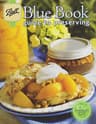 Ball Blue Book Guide to PreservingThe cheap, thin one that has been in kitchens for a century, and the one to buy first. Every recipe in it is tested, which is the only property that matters — a canning recipe is a validated process, not a suggestion. | The first book to own | Tested recipes, cheap | $29.99 · View on Amazon#ad we earn a commission · price as of October 18, 2026 |
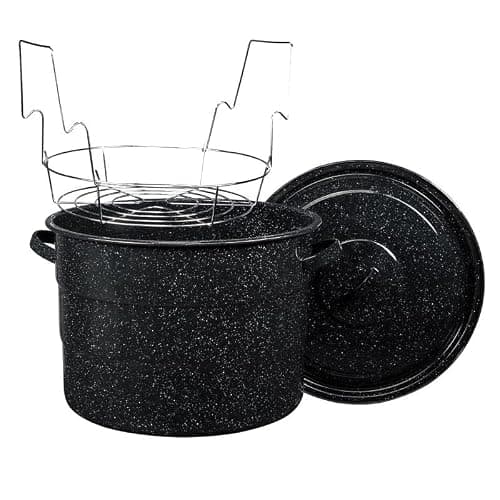
Granite Ware 21.5-Quart Water Bath Canner with Rack
The canner almost everyone starts with, and there is very little wrong with that. Porcelain enamel on steel, a rack that holds a full seven-quart load, light enough to lift full, and cheap enough that it is not the thing standing between you and a first batch.
Published specs
- Capacity
- 21.5 quarts
- Rack capacity
- 7 quart jars, 9 pints, or 12 half-pints
- Material
- Porcelain enamel on steel
- Dimensions
- Height 9.75", depth 16.25", width 14.25"
- Weight
- About 4 lb empty
- Included
- Pot, lid and jar rack
- Base diameter
- Not published by Granite Ware
What works
- Light. Four pounds empty means you can move it full of hot water without a second person
- The enamel surface is non-reactive, so tomatoes and vinegar brines do not pick up a metallic edge
- Deep enough to cover quart jars with the 1 inch of briskly boiling water the NCHFP requires, which a stockpot often is not
What to know first
- Enamel chips if you knock it, and a chipped rim will rust. It is cookware to be careful with, not to stack things on
- The base diameter is not published, so on an electric range you have to measure it against your element yourself
- Thin steel heats fast and loses heat fast — expect to ride the burner a little to hold a steady boil
Specs from NCHFP, Recommended Canners. We have not handled this product — see how we pick.
Ball Secure-Grip Canning Utensil Set
The four tools that make canning a two-handed job instead of a three-handed one: a jar lifter, a wide-mouth funnel, a magnetic lid wand and a bubble remover with a headspace scale. Buying them together costs less than buying the lifter alone twice.
Published specs
- Contents
- Jar lifter, canning funnel, lid wand, bubble remover
- Fits
- Regular and wide mouth jars
- The essential one
- The jar lifter
What works
- The jar lifter alone justifies the set — tongs slip on a wet jar and a dropped hot quart is a genuine burn
- The bubble remover doubles as a headspace gauge, which is the measurement beginners most often eyeball wrong
- Everything is dishwasher-safe and stores inside the canner
What to know first
- The magnetic lid wand is the one piece you can genuinely skip — clean fingers work
- Plastic tools stain with tomato and turmeric, permanently and harmlessly
- If you already own a lifter, buying the set again is redundant
Specs from NCHFP, Recommended Canners. We have not handled this product — see how we pick.
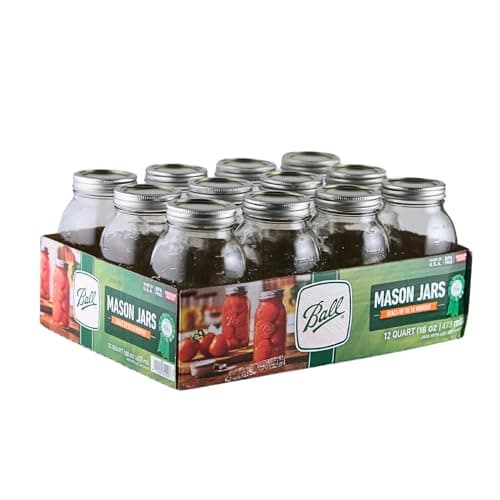
Ball Regular Mouth Pint Jars (16 oz)
If you buy one case of jars this season, buy this one. Pints are the size most tested recipes are written for, regular-mouth lids are the cheapest and most available lid on any shelf, and the jars are reusable indefinitely.
Published specs
- Volume
- 16 oz / 2 cups
- Mouth
- Regular, about 70 mm lid diameter
- Inner mouth diameter
- About 60 mm
- Jar dimensions
- About 5" tall x 2 3/4" wide
- Reuse
- Jars and rings reusable; flat lids are single-use
What works
- Pints fit both a water bath canner and a pressure canner comfortably, so the case is not stranded when you move up to beans
- Regular-mouth lids are the most stocked size in the country, which matters in September when shelves empty out
- The jars outlive everything else in this list. The consumable is the flat lid, not the glass
What to know first
- The narrower 60 mm opening is fiddly for whole peaches or large pickle spears — that is what wide mouth is for
- Regular and wide mouth lids are not interchangeable, so mixing both means stocking two lid sizes
- Glass. Handle the case like glass
Specs from Ball, Mason Jars & Lids, Regular Mouth. We have not handled this product — see how we pick.
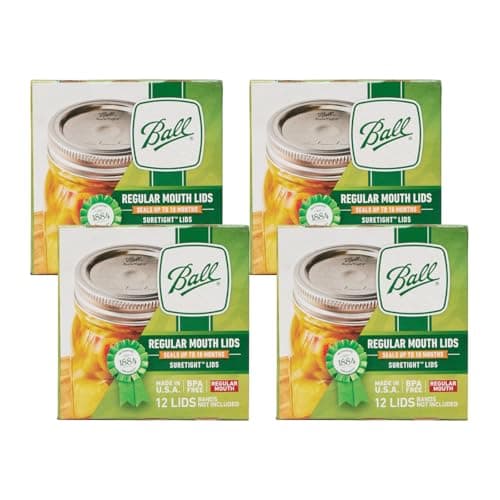
Ball Regular Mouth Canning Lids
The lid every tested recipe assumes. Single-use by design — the sealing compound is meant to compress once — and cheap enough that reusing one to save a few cents is a bad trade against losing a jar of food.
Published specs
- Size
- Regular mouth, about 70 mm
- Use
- Flat lid single-use; band reusable
- Compatibility
- Ball and Kerr regular mouth jars
What works
- The most widely stocked lid in the country, which is the thing that matters in September
- What every NCHFP and Ball tested recipe is written around, so nothing about your process needs adapting
- Bands are reusable indefinitely as long as they are not bent or rusted
What to know first
- Single use. The flat lid goes in the recycling after one seal
- Sells out first in peak season — buy your lids in July, not September
- Does not fit wide mouth jars, and there is no adapter
Specs from Ball, Mason Jars & Lids, Regular Mouth. We have not handled this product — see how we pick.
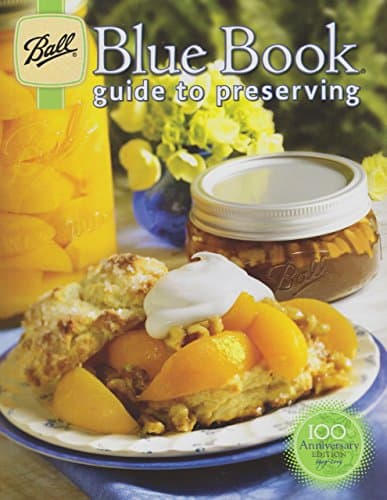
Ball Blue Book Guide to Preserving
The cheap, thin one that has been in kitchens for a century, and the one to buy first. Every recipe in it is tested, which is the only property that matters — a canning recipe is a validated process, not a suggestion.
Published specs
- Publisher
- Ball / Newell Brands
- Content
- Tested water bath and pressure canning recipes
- Why it matters
- A tested source you can hold while your hands are wet
What works
- Tested recipes, which is the entire point of buying a canning book rather than reading a blog
- Cheap enough to buy alongside your first case of jars without thinking about it
- Compact and spill-tolerant in a way a laptop on a counter is not
What to know first
- Recipe range is narrower than the bigger books — this is a foundation, not a library
- Editions change; a very old copy may predate current guidance and should be cross-checked against the NCHFP
- Not a technique manual. It tells you what to do, less about why
Specs from NCHFP, Recommended Canners. We have not handled this product — see how we pick.
The one measurement to take first
Before buying a canner, measure the element you will cook on. The NCHFP's rule for electric ranges is that the canner should be no more than 4 inches wider in diameter than the element. That number eliminates several popular canners, and finding out afterwards costs a return. Will it fit your stove does the arithmetic.
What changes when you move to pressure canning
Not much equipment, but one obligation. The canner replaces the water bath pot, everything else transfers unchanged, and you take on an annual gauge accuracy test if your canner has a dial gauge. The full list is in what you need for pressure canning.
Next stepCheck your element size firstCommon questions
What is the minimum equipment for canning?
Do I need a special pot to cook the food in?
Can I skip the jar lifter?
Do I need a thermometer?
What extra equipment does pressure canning need?
Sources
Product specifications are taken from each manufacturer’s own published page, cited on the product. We have not handled these products — how we pick.