Electric vs stovetop canners
One removes your stove from the equation and costs several times as much. Whether that is worth it depends entirely on your stove.
Disclosure: we earn a commission on purchases made through links on this page, at no extra cost to you. It does not change what we recommend — see how we pick and our affiliate disclosure.
A countertop electric canner holds its own temperature and does not use your stove, which solves small elements, glass tops and ranges that cannot sustain a rolling boil — the one we have looked at in most detail is the Presto Precise digital canner. A stovetop canner is cheaper, holds more jars, and has nothing electronic to fail. The deciding factor is almost always the stove, not the canner.
This comparison is usually framed as old versus new. It is not. It is a question about which constraint is binding in your kitchen, and for most people the answer is obvious within a minute of measuring their stove element.
The comparison
| Countertop electric | Stovetop | |
|---|---|---|
| Uses your stove | No | Yes, one large element for hours |
| Cost | Several times a stovetop canner | Lowest in the category |
| Capacity | Smaller. The Presto Precise 12-quart takes 5 quart jars | A 21.5-quart canner takes 7 quart jars |
| Holds temperature | By itself, via a sensor | You ride the burner |
| Altitude | Handled automatically on the Presto Precise | You adjust manually |
| Heat-up time | Generally slower | Depends entirely on your element |
| What can fail | Electronics, sensor, control board | A gasket, or a dial gauge going out of calibration |
| Kitchen heat | Contained | Two hours of a boiling pot in the room |
| Lifespan | An appliance lifespan | Decades |
When electric is genuinely the right answer
- Your element is small. Under the NCHFP 4-inch rule, a 6-inch element caps you at a 10-inch canner, and most full-size canners are wider than that.
- You have a glass or ceramic top and your range manufacturer warns against heavy canners, or you are worried about the weight and the thermal cycling.
- Your range cannot hold a rolling boil under a full canner. Some ranges cycle their elements and simply cannot sustain it.
- You are canning in a kitchen you cannot heat up — a small apartment in August is a real argument.
- You want the altitude adjustment done for you, which is a genuine reduction in what can go wrong.
When stovetop wins easily
- You have a gas range or a full-size electric element. The problem electric solves does not exist for you.
- You are canning in volume. Seven quarts a load against five adds up fast across a harvest.
- You want the thing to last decades. A canner is a pot. An appliance has a control board.
- Budget matters, and it usually does in a first season, where the money is better spent on jars and lids.
Quick picks
Every pick below is screened against the National Center for Home Food Preservation’s published canner rules first. Tap a row for the full write-up.
| # | Product | Best for | Key spec | Price |
|---|---|---|---|---|
| 1 |  Presto Precise 12-Quart Digital Pressure Canner (02144)The one electric appliance in this category that Presto states meets USDA home-canning guidelines for low-acid foods, and it holds the temperature itself — including at altitude, with no adjustment. It is also a countertop appliance, so it sidesteps the stove-fit question entirely. | Glass tops, and altitude | 5 quarts, no altitude math | |
| 2 |  Granite Ware 21.5-Quart Water Bath Canner with RackThe canner almost everyone starts with, and there is very little wrong with that. Porcelain enamel on steel, a rack that holds a full seven-quart load, light enough to lift full, and cheap enough that it is not the thing standing between you and a first batch. | A first water bath canner | 7 quarts / 9 pints | $79.99 · View on Amazon#ad we earn a commission · price as of October 18, 2026 |
| 3 |  Presto 23-Quart Pressure Canner and Cooker (01781)The default first pressure canner, and the one most beginners should buy: it takes a full seven-quart load, it doubles as a boiling-water canner for pints and half-pints, and it costs a fraction of a cast-aluminum canner. The dial gauge is the catch, and it is a real one. | A first pressure canner | 7 quarts / 20 pints |
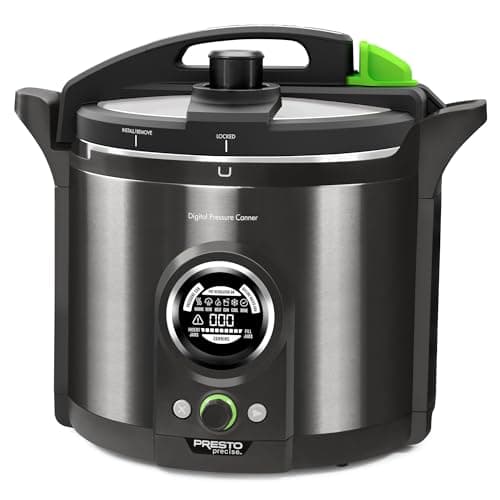
Presto Precise 12-Quart Digital Pressure Canner (02144)
The one electric appliance in this category that Presto states meets USDA home-canning guidelines for low-acid foods, and it holds the temperature itself — including at altitude, with no adjustment. It is also a countertop appliance, so it sidesteps the stove-fit question entirely.
Published specs
- Liquid capacity
- 12 quarts
- Jar capacity
- 10 half-pints, 8 pints, 5 quarts
- Boiling-water use
- Pints and half-pints only
- Power
- 120 volts AC, 1,485 watts (Presto)
- USDA
- Presto states it meets USDA guidelines for meat, poultry, fish and vegetables
- Altitude
- No adjustment needed — the sensor handles it
What works
- Removes the two things beginners get wrong most often: holding pressure steady, and adjusting for altitude
- Countertop, so your stove element size stops mattering — the single most common reason a canner does not work out
- The built-in timer will not start counting until the canner is genuinely at temperature, which is exactly the mistake a nervous first-timer makes
What to know first
- Five quart jars per load against seven in a 23-quart stovetop, so a heavy day is more batches
- It is an appliance with electronics. A stovetop canner has a gauge and a gasket and will outlive it
- Most electric multi-cookers are NOT safe for pressure canning — this one is specified for it and generic pressure cookers are not. Do not generalize from it
Specs from Presto, Precise 12-Quart Digital Pressure Canner (02144). We have not handled this product — see how we pick.
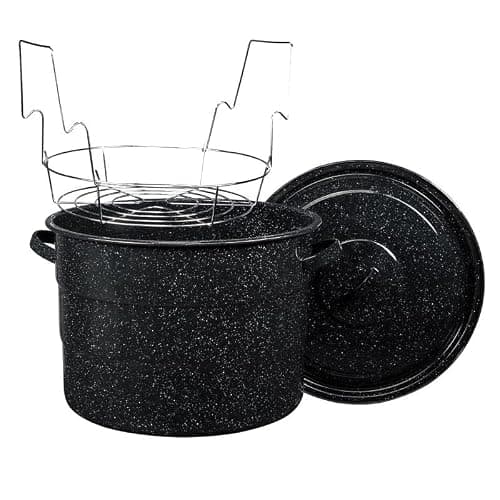
Granite Ware 21.5-Quart Water Bath Canner with Rack
The canner almost everyone starts with, and there is very little wrong with that. Porcelain enamel on steel, a rack that holds a full seven-quart load, light enough to lift full, and cheap enough that it is not the thing standing between you and a first batch.
Published specs
- Capacity
- 21.5 quarts
- Rack capacity
- 7 quart jars, 9 pints, or 12 half-pints
- Material
- Porcelain enamel on steel
- Dimensions
- Height 9.75", depth 16.25", width 14.25"
- Weight
- About 4 lb empty
- Included
- Pot, lid and jar rack
- Base diameter
- Not published by Granite Ware
What works
- Light. Four pounds empty means you can move it full of hot water without a second person
- The enamel surface is non-reactive, so tomatoes and vinegar brines do not pick up a metallic edge
- Deep enough to cover quart jars with the 1 inch of briskly boiling water the NCHFP requires, which a stockpot often is not
What to know first
- Enamel chips if you knock it, and a chipped rim will rust. It is cookware to be careful with, not to stack things on
- The base diameter is not published, so on an electric range you have to measure it against your element yourself
- Thin steel heats fast and loses heat fast — expect to ride the burner a little to hold a steady boil
Specs from NCHFP, Recommended Canners. We have not handled this product — see how we pick.
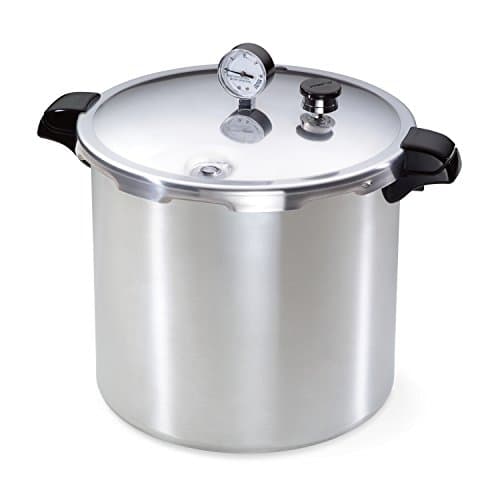
Presto 23-Quart Pressure Canner and Cooker (01781)
The default first pressure canner, and the one most beginners should buy: it takes a full seven-quart load, it doubles as a boiling-water canner for pints and half-pints, and it costs a fraction of a cast-aluminum canner. The dial gauge is the catch, and it is a real one.
Published specs
- Liquid capacity
- 23 quarts (21.8 liters)
- Jar capacity
- 26 half-pints, 20 pints, 7 quarts
- Material
- Warp-resistant aluminum
- Gauge
- Dial gauge
- Ranges
- Regular and smooth-top
- Burner limit
- 12,000 BTUs or less
- Also
- Doubles as a boiling-water canner
- Warranty
- 12-year limited
- Base diameter
- Not published by Presto
What works
- Seven quart jars is the standard batch size every tested NCHFP recipe is written around, so you are never processing a half load
- Doubles as a boiling-water canner for pints and half-pints, which means one pot covers the jam-and-pickles year as well as the beans
- Presto sells a replacement dial gauge and sealing ring separately, so a decade-old canner is a repair rather than a replacement
What to know first
- A dial gauge should be checked for accuracy every year — most extension offices do it free, and most owners never go. A weighted gauge needs no calibration at all
- Presto does not publish a base diameter, so you cannot check it against the NCHFP element rule without measuring the box yourself. See will it fit your stove
- Rated for burners of 12,000 BTUs or less, which rules out most outdoor propane burners and some high-output gas ranges
Specs from Presto, 23-Quart Pressure Canner and Cooker (01781). We have not handled this product — see how we pick.
What we would tell a friend
Measure your element. If it clears the canner you want under the 4-inch rule and your range holds a boil, buy the pot — it is cheaper, bigger, and will outlive the appliance. If your element does not clear it, do not fight your stove for the next decade; buy the countertop appliance and stop thinking about it. Run your own numbers on will it fit your stove.
Next stepCheck whether a canner fits your elementCommon questions
Do electric canners reach a full boil?
Is an electric canner safe for low-acid food?
How many jars does an electric canner hold?
Which uses less energy?
Can I run an electric canner on a countertop all day?
Sources
Product specifications are taken from each manufacturer’s own published page, cited on the product. We have not handled these products — how we pick.