Electric pressure canners
A canning button is not a validation. Here is what the difference actually is, and the one appliance category that clears it.
Disclosure: we earn a commission on purchases made through links on this page, at no extra cost to you. It does not change what we recommend — see how we pick and our affiliate disclosure.
Most electric multi-cookers are not safe for pressure canning, including many with a canning preset — the research behind that is in canning in an Instant Pot. The exception is a small number of purpose-built digital pressure canners whose manufacturer states in writing that the model meets USDA home-canning guidelines for low-acid foods. If that statement is absent, treat the preset as marketing.
This is the page where we are least willing to be diplomatic, because the failure mode is botulism in a low-acid food and the marketing in this category is genuinely misleading. The good news is that the test for a buyer is simple and it does not require any expertise.
The test: what the manufacturer says, in writing
A validated appliance's manufacturer states plainly that the model meets USDA guidelines for pressure canning low-acid foods. Presto states exactly that for its Precise digital pressure canner. That sentence is the whole test. An appliance whose documentation does not contain it has not been through the work, whatever the box says.
| Signal | What it means |
|---|---|
| Manufacturer states it meets USDA canning guidance | Validated. This is the one that counts |
| A "Canning" button or preset | Nothing on its own. A preset is a heating program, not a validation |
| Reaches high pressure | Not sufficient. Tested times assume a specific vessel and thermal behavior |
| Under seven quart jars of capacity | Excluded. The NCHFP does not recommend small-capacity pressure saucepans for canning |
| Recipes on a blog or a forum thread | Not a source. Ask who tested it and where you can read the study |
Why a small pot cannot just be a small canner
Tested processing times are not simply "how long at 240°F." They assume a particular mass of jars, water and metal that heats and cools at a known rate, because the food keeps receiving lethal heat during the come-up and cool-down as well as at pressure. A small vessel cools far faster, so the same clock time delivers less total heat to the food.
That is why the NCHFP writes that "pressure saucepans with smaller volume capacities are not recommended for use in canning," and it is why capacity is a safety specification rather than a convenience one.
Quick picks
Every pick below is screened against the National Center for Home Food Preservation’s published canner rules first. Tap a row for the full write-up.
| # | Product | Best for | Key spec | Price |
|---|---|---|---|---|
| 1 |  Presto Precise 12-Quart Digital Pressure Canner (02144)The one electric appliance in this category that Presto states meets USDA home-canning guidelines for low-acid foods, and it holds the temperature itself — including at altitude, with no adjustment. It is also a countertop appliance, so it sidesteps the stove-fit question entirely. | Glass tops, and altitude | 5 quarts, no altitude math | |
| 2 |  Presto 23-Quart Pressure Canner and Cooker (01781)The default first pressure canner, and the one most beginners should buy: it takes a full seven-quart load, it doubles as a boiling-water canner for pints and half-pints, and it costs a fraction of a cast-aluminum canner. The dial gauge is the catch, and it is a real one. | A first pressure canner | 7 quarts / 20 pints | |
| 3 | Small pressure cookers and multi-cookers sold as cannersSkipSkip anything under the seven-quart-jar mark, and skip every electric multi-cooker with a canning button that is not specifically specified for pressure canning. The NCHFP is explicit: pressure saucepans with smaller volume capacities are not recommended for canning. | Nothing — skip these | Excluded by NCHFP | Check price on Amazon#ad we earn a commission · live price pending |
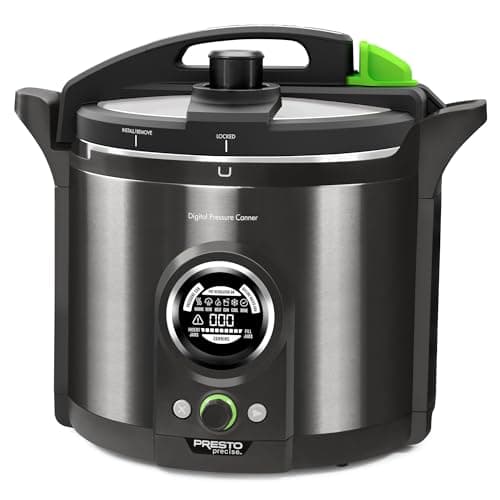
Presto Precise 12-Quart Digital Pressure Canner (02144)
The one electric appliance in this category that Presto states meets USDA home-canning guidelines for low-acid foods, and it holds the temperature itself — including at altitude, with no adjustment. It is also a countertop appliance, so it sidesteps the stove-fit question entirely.
Published specs
- Liquid capacity
- 12 quarts
- Jar capacity
- 10 half-pints, 8 pints, 5 quarts
- Boiling-water use
- Pints and half-pints only
- Power
- 120 volts AC, 1,485 watts (Presto)
- USDA
- Presto states it meets USDA guidelines for meat, poultry, fish and vegetables
- Altitude
- No adjustment needed — the sensor handles it
What works
- Removes the two things beginners get wrong most often: holding pressure steady, and adjusting for altitude
- Countertop, so your stove element size stops mattering — the single most common reason a canner does not work out
- The built-in timer will not start counting until the canner is genuinely at temperature, which is exactly the mistake a nervous first-timer makes
What to know first
- Five quart jars per load against seven in a 23-quart stovetop, so a heavy day is more batches
- It is an appliance with electronics. A stovetop canner has a gauge and a gasket and will outlive it
- Most electric multi-cookers are NOT safe for pressure canning — this one is specified for it and generic pressure cookers are not. Do not generalize from it
Specs from Presto, Precise 12-Quart Digital Pressure Canner (02144). We have not handled this product — see how we pick.
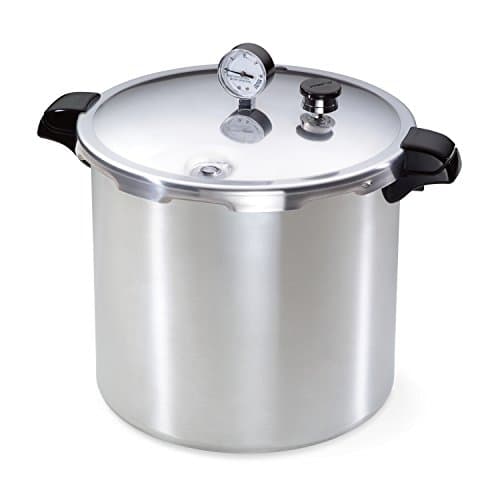
Presto 23-Quart Pressure Canner and Cooker (01781)
The default first pressure canner, and the one most beginners should buy: it takes a full seven-quart load, it doubles as a boiling-water canner for pints and half-pints, and it costs a fraction of a cast-aluminum canner. The dial gauge is the catch, and it is a real one.
Published specs
- Liquid capacity
- 23 quarts (21.8 liters)
- Jar capacity
- 26 half-pints, 20 pints, 7 quarts
- Material
- Warp-resistant aluminum
- Gauge
- Dial gauge
- Ranges
- Regular and smooth-top
- Burner limit
- 12,000 BTUs or less
- Also
- Doubles as a boiling-water canner
- Warranty
- 12-year limited
- Base diameter
- Not published by Presto
What works
- Seven quart jars is the standard batch size every tested NCHFP recipe is written around, so you are never processing a half load
- Doubles as a boiling-water canner for pints and half-pints, which means one pot covers the jam-and-pickles year as well as the beans
- Presto sells a replacement dial gauge and sealing ring separately, so a decade-old canner is a repair rather than a replacement
What to know first
- A dial gauge should be checked for accuracy every year — most extension offices do it free, and most owners never go. A weighted gauge needs no calibration at all
- Presto does not publish a base diameter, so you cannot check it against the NCHFP element rule without measuring the box yourself. See will it fit your stove
- Rated for burners of 12,000 BTUs or less, which rules out most outdoor propane burners and some high-output gas ranges
Specs from Presto, 23-Quart Pressure Canner and Cooker (01781). We have not handled this product — see how we pick.
Small pressure cookers and multi-cookers sold as canners
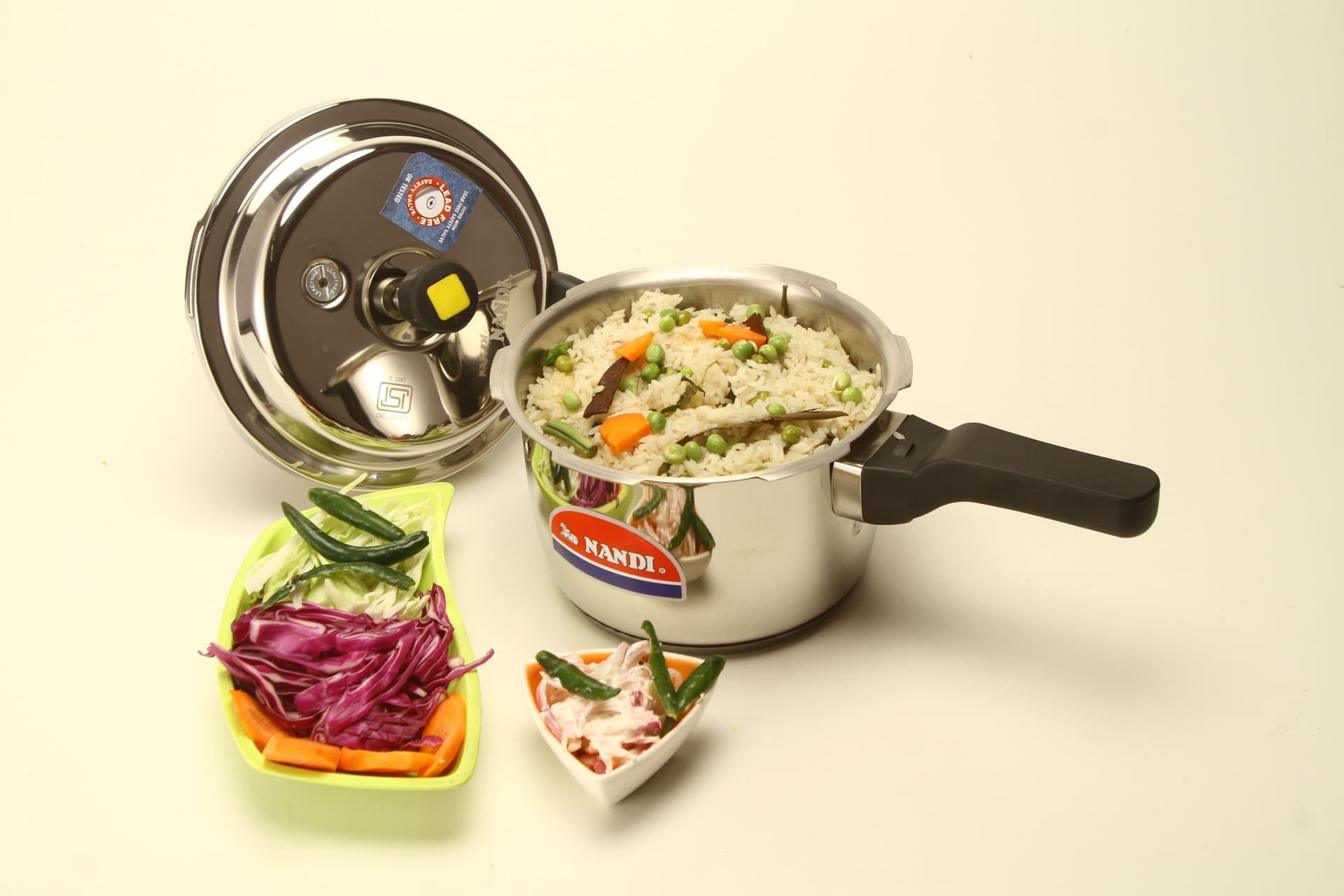
Skip anything under the seven-quart-jar mark, and skip every electric multi-cooker with a canning button that is not specifically specified for pressure canning. The NCHFP is explicit: pressure saucepans with smaller volume capacities are not recommended for canning.
Published specs
- NCHFP position
- "Pressure saucepans with smaller volume capacities are not recommended for use in canning"
- Required capacity
- Enough for seven quart jars or eight to nine pints
- Required approval
- UL approval
What works
- There is no upside worth listing. This entry exists so you can recognize the category and walk past it
What to know first
- Too small to hold heat the way tested processing times assume, so the times on a tested recipe do not transfer
- A "canning" preset on a multi-cooker is a marketing label, not a validation. Only appliances specified for pressure canning, like the Presto Precise, have been through that work
- This is the failure mode with the worst consequences in the whole category — under-processed low-acid food is where botulism comes from
Specs from NCHFP, Recommended Canners. We have not handled this product — see how we pick.
What an electric canner is genuinely good at
- It removes the stove from the equation. No element diameter, no 4-inch rule, no glass-top weight worry. For a lot of kitchens this is the entire argument and it is decisive.
- It handles altitude by itself. Presto states its Precise canner needs no altitude adjustment, which removes one of the two most common sources of under-processing.
- It holds temperature without supervision, rather than asking you to ride a burner for ninety minutes.
- The timer will not start early, which is the other most common beginner error.
And what it is not
- Not a big-batch tool. Five quart jars a load against seven on a stovetop adds up quickly.
- Not a lifetime object. A control board is a control board. A stovetop canner is a pot with a gasket.
- Not a license to improvise. It is validated for tested recipes and tested times, exactly like a stovetop canner.
Common questions
Can I pressure can in an Instant Pot?
Which electric pressure canners are safe?
Why does capacity matter for safety?
Do electric canners need altitude adjustment?
How many jars does an electric pressure canner hold?
Sources
- NCHFP — Recommended Canners
- Presto — Precise Digital Pressure Canner (02144)
- National Center for Home Food Preservation
Product specifications are taken from each manufacturer’s own published page, cited on the product. We have not handled these products — how we pick.