What size water bath canner do you need?
A standard canner takes 7 quarts, 9 pints or 12 half-pints. Depth decides more than capacity, and the rule changes for long processes.
Disclosure: we earn a commission on purchases made through links on this page, at no extra cost to you. It does not change what we recommend — see how we pick and our affiliate disclosure.
A standard 21.5-quart water bath canner holds 7 quart jars, 9 pints or 12 half-pints in a single layer. The NCHFP describes boiling water canners as designed to hold seven quart jars or eight to nine pints. Depth matters more than volume: at least 1 inch of briskly boiling water must cover the jar tops, and 2 inches for processes over 30 minutes.
Water bath canners are sold by liquid capacity, and liquid capacity is not the number you need. What you actually want to know is how many jars go in, whether your jars will be covered properly once they are in there, and whether the thing will fit your stove. Only the last of those tracks the number on the box.
The short version is that this category is far less varied than pressure canners. Most water bath canners sold in the US are one size, that size holds a standard tested batch, and the interesting decisions are about depth and stove fit rather than capacity.
How many jars fit
For the standard 21.5-quart canner, the rack capacity is published by the manufacturers and it is consistent across brands. Granite Ware and McSunley both state the same figures for their 21.5-quart racks:
| Jar size | Standard 21.5-qt canner | Notes |
|---|---|---|
| Quart (32 oz) | 7 | The batch size tested recipes are written around |
| Pint (16 oz) | 9 | NCHFP describes canners as holding eight to nine pints |
| Half-pint (8 oz) | 12 | Single layer, sitting in the rack |
| Quarter-pint (4 oz) | Not published | More than 12, but no manufacturer states a figure |
| Half-gallon (64 oz) | Depends on canner depth | Very acid juices only, per NCHFP |
So the direct answer to the question people actually type: twelve half-pints fit in a standard water bath canner, in one layer, in the rack it came with. That is a large batch of jam — more than most single-fruit recipes yield — which is why half-pint canning is rarely capacity-limited.
Depth is the real specification
This is the part that catches people, and it is the reason a pot with the right volume can still be the wrong canner. The NCHFP requirement is that at least 1 inch of briskly boiling water will be over the tops of jars during processing. Not level with the tops. An inch above them, for the whole time, while the water is at a rolling boil and losing volume to steam.
There is a second rule that almost nobody mentions and that changes the arithmetic for a lot of recipes: for processing times exceeding 30 minutes, the water level should be at least 2 inches above the tops of the jars. Plenty of tested recipes run past 30 minutes — many tomato and pickle processes do — so this is not an edge case.
Stack that up for a quart jar and you can see why depth decides it. A quart jar is roughly 6 1/2 to 6 3/4 inches tall. Add 2 inches of water above it for a long process, then room for a rolling boil that does not slop over the rim, and you need meaningfully more than 9 inches of usable interior depth. A pot that clears a pint comfortably can fail on a quart.
How we screened these
We have not used any of these canners. What we did was check each against the published NCHFP requirements and pull jar capacities from the manufacturers' own pages rather than from another roundup. The method is on how we pick.
- Published rack capacity — an actual manufacturer figure, not an inference from liquid volume.
- Usable depth — can it cover a quart jar with the inch the NCHFP requires, and the 2 inches a long process requires?
- Does it come with a rack — the NCHFP describes removable perforated racks as standard equipment, and a canner without one is not ready to use.
- Base type — the NCHFP is explicit that a flat bottom must be used on an electric range. Material is a separate question: stainless vs enamel.
- Whether it also pressure cans — because that changes the sizing question entirely.
Quick picks
Every pick below is screened against the National Center for Home Food Preservation’s published canner rules first. Tap a row for the full write-up.
| # | Product | Best for | Key spec | Price |
|---|---|---|---|---|
| 1 |  Granite Ware 21.5-Quart Water Bath Canner with RackThe canner almost everyone starts with, and there is very little wrong with that. Porcelain enamel on steel, a rack that holds a full seven-quart load, light enough to lift full, and cheap enough that it is not the thing standing between you and a first batch. | A first water bath canner | 7 quarts / 9 pints | $79.99 · View on Amazon#ad we earn a commission · price as of October 18, 2026 |
| 2 |  Prep-N-Cook by McSunley 21.5-Quart Stainless Steel Water Bath CannerA stainless water bath canner with a flat encapsulated base, which is the construction induction actually wants. If jam, pickles, fruit and acidified tomatoes are the whole plan, this does the job for less than the induction pressure canner and it is a much lighter pot to own. | Water bath only, on induction | 7 quarts / 9 pints | $74.99 · View on Amazon#ad we earn a commission · price as of October 18, 2026 |
| 3 |  Presto 23-Quart Pressure Canner and Cooker (01781)The default first pressure canner, and the one most beginners should buy: it takes a full seven-quart load, it doubles as a boiling-water canner for pints and half-pints, and it costs a fraction of a cast-aluminum canner. The dial gauge is the catch, and it is a real one. | A first pressure canner | 7 quarts / 20 pints | |
| 4 |  Victorio VKP1054 Steam CannerA researched, sanctioned alternative to a water bath for high-acid foods only, and genuinely faster because it heats two and a half quarts of water instead of twenty. The 45-minute processing ceiling is the rule that decides whether it fits your recipes. | High-acid batches, fast | 2.5 qt water, 45-min cap | $67.99 · View on Amazon#ad we earn a commission · price as of October 18, 2026 |
| 5 | Shallow pots sold as canning potsSkipSkip any pot that cannot keep an inch of briskly boiling water over the tops of your jars. Plenty of pots are sold with a canning rack and a canning name while being an inch or two too short for quart jars, and that inch is the requirement, not a target. | Nothing - skip these | Too shallow for quarts | Check price on Amazon#ad we earn a commission · live price pending |
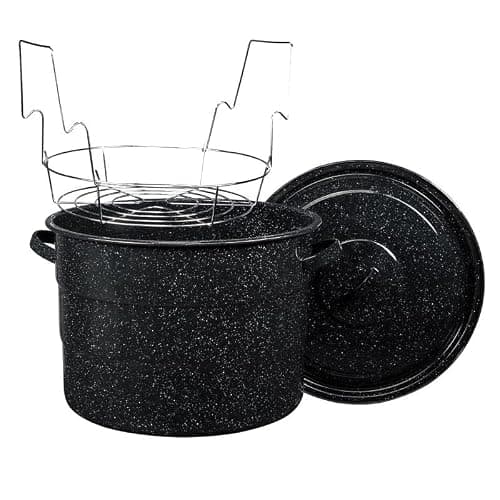
Granite Ware 21.5-Quart Water Bath Canner with Rack
The canner almost everyone starts with, and there is very little wrong with that. Porcelain enamel on steel, a rack that holds a full seven-quart load, light enough to lift full, and cheap enough that it is not the thing standing between you and a first batch.
Published specs
- Capacity
- 21.5 quarts
- Rack capacity
- 7 quart jars, 9 pints, or 12 half-pints
- Material
- Porcelain enamel on steel
- Dimensions
- Height 9.75", depth 16.25", width 14.25"
- Weight
- About 4 lb empty
- Included
- Pot, lid and jar rack
- Base diameter
- Not published by Granite Ware
What works
- Light. Four pounds empty means you can move it full of hot water without a second person
- The enamel surface is non-reactive, so tomatoes and vinegar brines do not pick up a metallic edge
- Deep enough to cover quart jars with the 1 inch of briskly boiling water the NCHFP requires, which a stockpot often is not
What to know first
- Enamel chips if you knock it, and a chipped rim will rust. It is cookware to be careful with, not to stack things on
- The base diameter is not published, so on an electric range you have to measure it against your element yourself
- Thin steel heats fast and loses heat fast — expect to ride the burner a little to hold a steady boil
Specs from NCHFP, Recommended Canners. We have not handled this product — see how we pick.
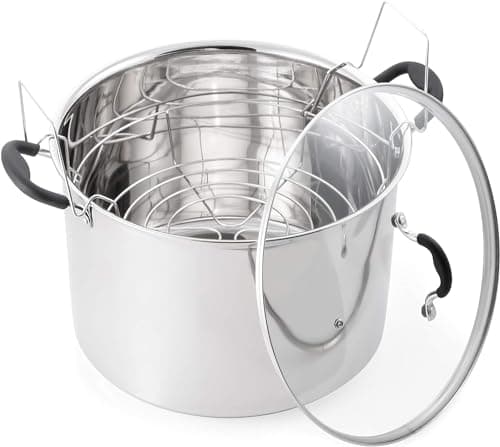
Prep-N-Cook by McSunley 21.5-Quart Stainless Steel Water Bath Canner
A stainless water bath canner with a flat encapsulated base, which is the construction induction actually wants. If jam, pickles, fruit and acidified tomatoes are the whole plan, this does the job for less than the induction pressure canner and it is a much lighter pot to own.
Published specs
- Capacity
- 21.5 quarts
- Rack capacity
- 7 quart, 9 pint or 12 half-pint jars
- Material
- Heavy-duty stainless steel
- Base
- Flat, encapsulated base
- Cooktops
- All cooktops, including induction and glass top
- Dimensions
- 14" x 18" x 11.75" (pot height 9.5")
- Weight
- 8.9 pounds
- Included
- Pot, lid and easy-lift jar rack
- Base diameter
- Not published by McSunley
What works
- The manufacturer states it works on all cooktops including induction, which is a sentence almost no water bath canner comes with
- An encapsulated base is thick where thin enamelware is not, which is what a cooktop's pan detection is looking for and what stops hot spots forming under the rack
- A 9.5-inch pot height clears a quart jar with the inch of briskly boiling water the NCHFP requires, so it is a real canner rather than a tall stockpot
What to know first
- 8.9 pounds empty against about 4 pounds for an enamel canner. Loaded with water and seven quart jars that is a genuinely heavy lift, and it is sitting on a glass surface
- Water bath only. Green beans, corn, meat and plain vegetables still need a pressure canner, and this pot will never do them
- No published base diameter, so you still have to measure it against your cooktop's ring marking yourself
Specs from McSunley, Prep-N-Cook Stainless Steel Water Bath Canner, NCHFP, Recommended Canners. We have not handled this product — see how we pick.
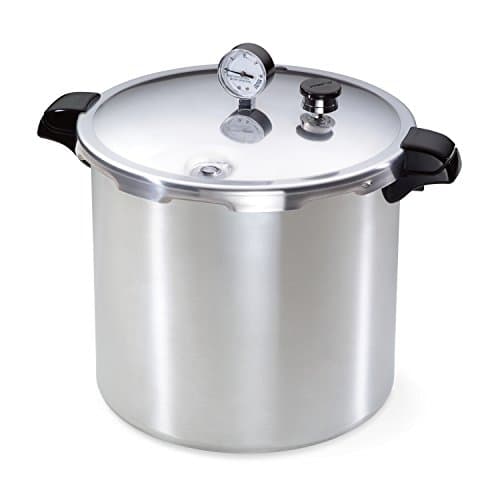
Presto 23-Quart Pressure Canner and Cooker (01781)
The default first pressure canner, and the one most beginners should buy: it takes a full seven-quart load, it doubles as a boiling-water canner for pints and half-pints, and it costs a fraction of a cast-aluminum canner. The dial gauge is the catch, and it is a real one.
Published specs
- Liquid capacity
- 23 quarts (21.8 liters)
- Jar capacity
- 26 half-pints, 20 pints, 7 quarts
- Material
- Warp-resistant aluminum
- Gauge
- Dial gauge
- Ranges
- Regular and smooth-top
- Burner limit
- 12,000 BTUs or less
- Also
- Doubles as a boiling-water canner
- Warranty
- 12-year limited
- Base diameter
- Not published by Presto
What works
- Seven quart jars is the standard batch size every tested NCHFP recipe is written around, so you are never processing a half load
- Doubles as a boiling-water canner for pints and half-pints, which means one pot covers the jam-and-pickles year as well as the beans
- Presto sells a replacement dial gauge and sealing ring separately, so a decade-old canner is a repair rather than a replacement
What to know first
- A dial gauge should be checked for accuracy every year — most extension offices do it free, and most owners never go. A weighted gauge needs no calibration at all
- Presto does not publish a base diameter, so you cannot check it against the NCHFP element rule without measuring the box yourself. See will it fit your stove
- Rated for burners of 12,000 BTUs or less, which rules out most outdoor propane burners and some high-output gas ranges
Specs from Presto, 23-Quart Pressure Canner and Cooker (01781). We have not handled this product — see how we pick.
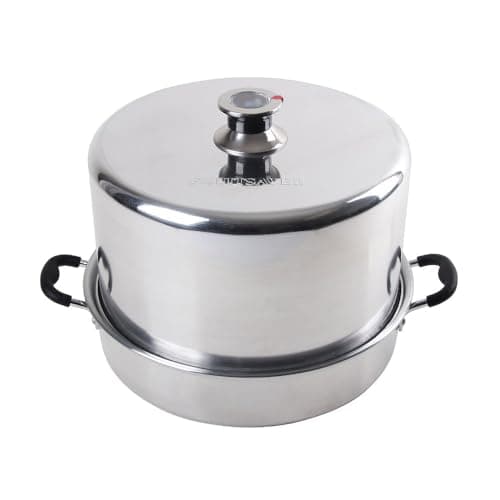
Victorio VKP1054 Steam Canner
A researched, sanctioned alternative to a water bath for high-acid foods only, and genuinely faster because it heats two and a half quarts of water instead of twenty. The 45-minute processing ceiling is the rule that decides whether it fits your recipes.
Published specs
- Jar capacity
- 7 quarts or 8 pints
- Water used
- 2.5 quarts
- Body dimensions
- Depth 13.25", width 13.25"
- Rack diameter
- 11 5/8 inches
- Foods
- Acid and properly acidified foods only
- Processing limit
- Total time including altitude adjustment must be under 45 minutes
- Warranty
- 2 years
What works
- Comes to temperature far faster than a full water bath, because there is a fraction of the water to heat
- Uses much less water and much less energy, which is a real difference over a long harvest week
- The temperature indicator gives you an unambiguous start signal instead of a judgment call about what a rolling boil looks like
What to know first
- High-acid foods only. It cannot pressure can, so beans, corn, meat and plain vegetables are out entirely
- Total processing time including altitude adjustment must stay under 45 minutes, because the canner cannot be opened to add water and can boil dry
- Will not take half-gallon jars
Specs from Victorio, VKP1054 Aluminum Steam Canner instruction manual, NCHFP, Recommended Canners. We have not handled this product — see how we pick.
Shallow pots sold as canning pots
Skip any pot that cannot keep an inch of briskly boiling water over the tops of your jars. Plenty of pots are sold with a canning rack and a canning name while being an inch or two too short for quart jars, and that inch is the requirement, not a target.
Published specs
- NCHFP requirement
- "The canner must be deep enough so that at least 1 inch of briskly boiling water will be over the tops of jars during processing"
- The test
- Jar height + 1 inch of water + room for a rolling boil
- Common shortfall
- Quart jars, which are about 6 1/2 to 6 3/4 inches tall
What works
- There is no upside. This entry is here so you can recognize the problem before it is in your kitchen
What to know first
- Water that stops covering the jars mid-boil means the tops of the jars are processing in air, not water, and the tested time no longer applies
- The shortfall is invisible in a product photo and only shows up when the jars are already in
- Cheap pots in this category often have no rack at all, and a jar sitting on a hot base can crack
Specs from NCHFP, Recommended Canners. We have not handled this product — see how we pick.
When a smaller canner is the right answer
Bigger is not automatically better here, and the reasons to go smaller are real rather than budgetary.
- You only make jam and jelly. If everything you can lives in half-pints and you make four jars at a time, a full 21.5-quart canner means heating around 20 quarts of water for four jars. That is a lot of time and fuel for a small batch.
- Weight. A canner full of water and seven quart jars is one of the heaviest things in the kitchen, and it is at boiling point. If lifting is difficult, a smaller pot you will actually use beats a larger one you avoid.
- Storage. A 21.5-quart canner lives in a cupboard for eleven months of the year.
- Your element is small. The NCHFP's 4-inch rule caps canner diameter against your element, and a narrower canner is sometimes the only one that clears it.
What is not a good reason is expecting small batches forever. Batch size is set by the harvest in front of you rather than by intention, and a large canner runs a small load perfectly well — it just takes longer to heat. The reverse is not true.
The stove constraint, which can override capacity
The NCHFP's rule for electric ranges is that the canner should be no more than 4 inches wider in diameter than the element it is heated on. Household elements are commonly 6 to 9 inches, which caps the canner at 10 to 13 inches whatever capacity you wanted. It also states plainly that a flat bottom must be used on an electric range, while either a flat or ridged bottom can be used on a gas burner — which matters, because some traditional enamel canners have ridged bases.
Do this arithmetic before the capacity arithmetic, not after. Measure your largest element, then run it through will it fit your stove. If you are on induction the question changes again, because the base has to be magnetic before anything else matters — that is canning on an induction cooktop.
Buy in canner loads, not in cases
One practical consequence of the capacity table worth acting on. Because a standard canner takes 7 quarts, 9 pints or 12 half-pints, buying jars in those multiples means every batch fills the canner. A case of twelve pints is one comfortable nine-jar load with three spares; a case of twelve half-pints is exactly one load.
Processing a half-empty canner costs the same water, the same fuel and the same 20 minutes of come-up time as a full one. Over a harvest week that adds up to real hours. The jar dimensions and sizes behind this are in canning jar sizes.
If you already own a pressure canner
Then you may not need a water bath canner at all. Most stovetop pressure canners double as boiling water canners with the lid off or unlatched, which makes buying a second pot unnecessary. The catch is height: shorter models are only tall enough to cover pints and half-pints with the required water, so check yours before assuming it covers quarts.
That works in the other direction too. If you are about to buy a water bath canner and you already suspect you will want green beans or stock within a year, buying the pressure canner first is frequently the cheaper total path — it is the point made in best water bath canners, and the pressure-side sizing is in what size pressure canner do you need.
The decision, in one paragraph
For most people the answer is the standard 21.5-quart canner: it takes 7 quarts, 9 pints or 12 half-pints, which is the batch size tested recipes assume, and it is deep enough for quart jars with the water cover the NCHFP requires. Go smaller only if your element is small, the weight is a genuine problem, or you truly only ever make a few half-pints at a time. Check the element rule before you check anything else, and if you already own a stovetop pressure canner, try it with the lid off before buying anything.
Next stepThe canners worth buyingCommon questions
How many half pints fit in a water bath canner?
How many quart jars fit in a water bath canner?
How many pint jars fit in a water bath canner?
How deep does a water bath canner need to be?
Can you stack jars in two layers in a water bath canner?
Is a 21.5-quart canner too big for small batches?
Can I use my pressure canner as a water bath canner?
Do you earn a commission on these?
Sources
- NCHFP — Recommended Canners
- National Center for Home Food Preservation
- McSunley — Prep-N-Cook Stainless Steel Water Bath Canner
- SDSU Extension — Water Bathing vs Pressure Canning
Product specifications are taken from each manufacturer’s own published page, cited on the product. We have not handled these products — how we pick.