Half-gallon canning jars
A useful jar with one narrow canning use. Buy it for juice and dry storage, not as a large-batch shortcut.
Disclosure: we earn a commission on purchases made through links on this page, at no extra cost to you. It does not change what we recommend — see how we pick and our affiliate disclosure.
The NCHFP permits half-gallon jars for canning very acid juices only — apple and grape juice are the standard examples. There is no tested process for half-gallon jars of sauce, vegetables, meat or anything else, so for everything bigger than a quart the answer is two quart jars rather than one half gallon.
Half-gallon jars are genuinely useful objects and they are sold everywhere, which is exactly why this page exists. The size looks like an obvious efficiency — fewer jars, fewer lids, fewer rims to wipe — and for almost everything you would want to put in it, there is no tested process behind that efficiency.
The rule, stated plainly
The NCHFP lists home canning jars in half-pint, pint, 1½ pint, quart and half-gallon sizes, and then it qualifies the largest one: half-gallon jars may be used for canning very acid juices. That is the permitted use. It is not a suggestion about what works best; it is the extent of what has been tested.
The reason is heat penetration. Processing times are validated by measuring how long heat takes to reach the slowest-heating point at the center of a filled jar. Double the volume and that center is further from the glass in every direction, so a time validated for a quart does not transfer. Juice is the exception because it is thin, it convects as it heats, and it is very acid — three things that together make the heating behavior predictable.
What that leaves the jar for
Two genuinely good uses, and they are both real reasons to own a few:
- Very acid juice. If you press apple or grape juice, this is the correct jar rather than a workaround, and it halves the number of jars a juice day produces. For juice in that volume, a steam juicer is the tool built for the job.
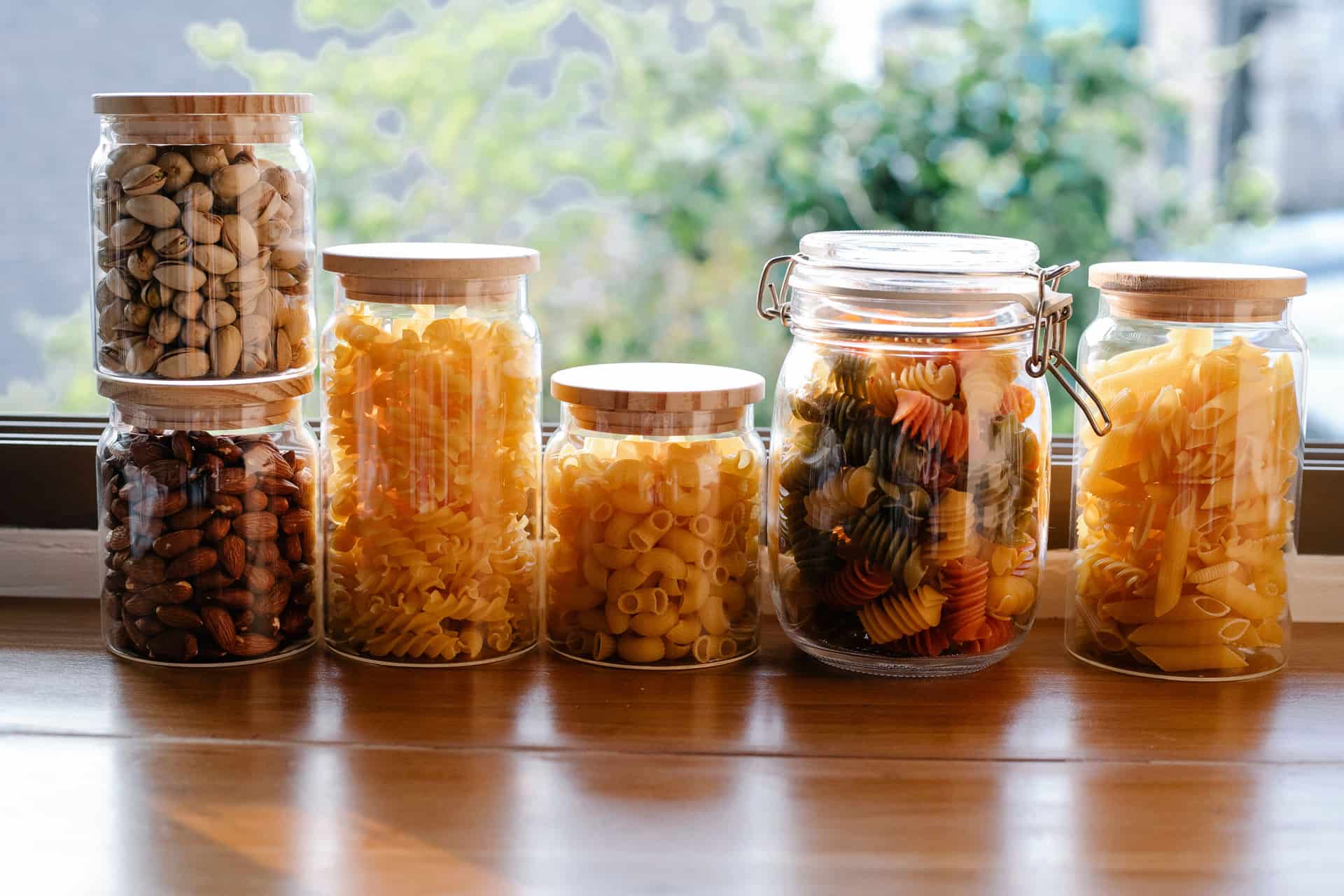
- Everything that is not canning. Flour, rice, dried beans, pasta, sugar, oats — and a jar vacuum sealer if you want the air out of them. A wide-mouth half gallon takes a scoop, seals against pantry moths and stacks on a shelf. This is where most half-gallon jars in most kitchens actually spend their lives, and there is nothing second-best about it.
What to use instead for everything else
Quart jars. It is not a compromise — the quart is the largest size with tested processes across the full range of canned foods, which is precisely why tested recipes are written around seven of them. A standard canner takes seven quarts in one load, so "two quarts instead of one half gallon" costs you one extra rim to wipe and buys you a process somebody actually validated.
There is also a practical argument that has nothing to do with safety. A half-gallon jar of anything is a half gallon you have to finish once it is opened. For a household of one or two, a quart is already a stretch on some foods.
Quick picks
Every pick below is screened against the National Center for Home Food Preservation’s published canner rules first. Tap a row for the full write-up.
| # | Product | Best for | Key spec | Price |
|---|---|---|---|---|
| 1 |  Ball Wide Mouth Half-Gallon Jars, 64 oz (set of 5)A genuinely useful jar with one genuinely narrow canning use. The NCHFP permits half-gallon jars for canning very acid juices and nothing else, so this is an apple and grape juice jar that spends the rest of the year holding flour. | Very acid juices, and dry storage | 64 oz, juice only for canning | $32.19 · View on Amazon#ad we earn a commission · price as of October 18, 2026 |
| 2 |  Ball Wide Mouth Quart Jars (32 oz)The jar to buy when you are packing peach halves, pickle spears or anything you have to reach into. The wider 86 mm mouth is easier to fill and far easier to clean, and quarts are the standard size for tomatoes. | Whole fruit and packing by hand | 86 mm mouth, 32 oz | |
| 3 | Reused commercial food jarsSkipSkip pasta sauce, pickle and mayonnaise jars. They are manufactured to be filled once in a factory, not heated and cooled repeatedly, and their rims are not made to the standard a two-piece canning lid seals against. | Nothing - skip these | Not made for canning | Check price on Amazon#ad we earn a commission · live price pending |
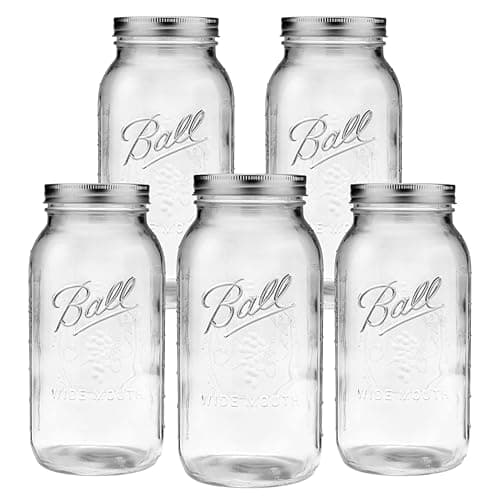
Ball Wide Mouth Half-Gallon Jars, 64 oz (set of 5)
A genuinely useful jar with one genuinely narrow canning use. The NCHFP permits half-gallon jars for canning very acid juices and nothing else, so this is an apple and grape juice jar that spends the rest of the year holding flour.
Published specs
- Volume
- 64 oz (half gallon)
- Mouth
- Wide, about 3 inches
- Pack
- 5 jars with lids and bands
- NCHFP canning use
- Half-gallon jars may be used for canning very acid juices
- Everything else
- Not a tested jar size — use quarts
What works
- The only jar size the NCHFP names for very acid juices, so if you press apple or grape juice this is the correct jar rather than a shortcut
- Wide mouth makes it genuinely good at the non-canning jobs — flour, rice, dried beans, pasta — where a 64 oz jar earns its shelf space
- Takes standard wide-mouth lids and bands
What to know first
- Not a general-purpose canning jar. There is no tested process for half-gallon jars of anything except very acid juice, so using one for sauce or vegetables puts you outside every tested time
- Heavy and awkward when full, and a 64 oz jar of hot liquid is the one most likely to be dropped
- Takes up the depth of a canner without giving you a batch — most canners fit very few of these at once
Specs from NCHFP, Recommended Jars and Lids. We have not handled this product — see how we pick.
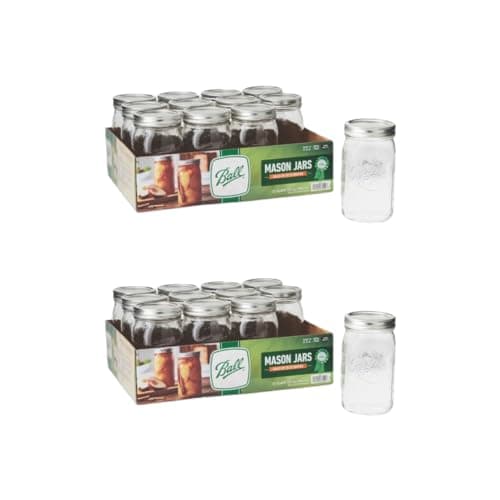
Ball Wide Mouth Quart Jars (32 oz)
The jar to buy when you are packing peach halves, pickle spears or anything you have to reach into. The wider 86 mm mouth is easier to fill and far easier to clean, and quarts are the standard size for tomatoes.
Published specs
- Volume
- 32 oz / 4 cups
- Mouth
- Wide, about 86 mm lid diameter
- Inner mouth diameter
- About 76 mm
- Jar dimensions
- About 6 1/2" tall x 3 1/4" wide
What works
- You can get a hand and a jar funnel into it, which turns packing peaches from a chore into a task
- Quart is the size the tomato and peach processing times in tested recipes are written around
- Much easier to wash by hand than a regular mouth quart
What to know first
- Wide mouth lids cost more than regular mouth and disappear from shelves first in peak season
- Seven quarts is a full canner load, so a quart-jar day is a longer day per jar of finished food
- A quart of anything low-acid still needs a pressure canner, and quarts take the longest processing times
Specs from Ball, Mason Jars & Lids, Wide Mouth. We have not handled this product — see how we pick.
Reused commercial food jars
Skip pasta sauce, pickle and mayonnaise jars. They are manufactured to be filled once in a factory, not heated and cooled repeatedly, and their rims are not made to the standard a two-piece canning lid seals against.
Published specs
- Thread standard
- Not guaranteed to match a canning lid
- Glass
- Not specified for repeated thermal cycling
- The alternative
- Jars sold specifically for home canning
What works
- They are free, which is the entire argument for them and it is not enough
What to know first
- A lid that appears to fit may not seal reliably against a rim that was not made for it
- Repeated heating and cooling is exactly the stress these jars were not designed for
- A jar that breaks in a canner is a burn hazard as well as a lost batch
Specs from NCHFP, Recommended Canners. We have not handled this product — see how we pick.
The canner problem nobody mentions
Even where the jar is permitted, it has to fit. A half-gallon jar is meaningfully taller than a quart, and the NCHFP requirement is at least 1 inch of briskly boiling water over the tops of the jars — 2 inches for processing times over 30 minutes — plus room for a rolling boil that does not empty itself over the side.
Many standard canners are not deep enough to do that with half-gallon jars, and a canner that covers a quart comfortably can fail on a half gallon. Measure before you commit to the size; what size water bath canner do you need works through the depth arithmetic.
Buying them anyway
Which is a perfectly reasonable thing to do. Buy wide mouth, because the non-canning uses are the ones you will actually get value from and a 3-inch opening takes a measuring cup. Buy a small set rather than a case, because five or six jars is enough for a juice run and more than enough for dry goods. And take standard wide-mouth lids and bands, which these do, so you are not stocking another size.
What "very acid" actually means here
The permission is narrow and the wording is doing work. "Very acid juices" in practice means apple juice and grape juice — fruit juices that are naturally well below the pH 4.6 line with margin to spare, and that are thin enough to heat by convection rather than by slow conduction through a dense pack.
It does not stretch to tomato juice, which sits on the acidity boundary and requires added acid even in quart jars. It does not stretch to a juice you have sweetened, diluted or blended with something less acid. And it does not stretch to fruit in juice, because the moment there is solid fruit in the jar you are back to a dense pack with a slow-heating center. If your tested recipe does not name the half-gallon jar, the half-gallon jar is not part of that process.
Why people want them anyway
It is worth naming the appeal rather than pretending it is irrational, because the appeal is real. Half the work of a canning day is per-jar work: filling, removing air bubbles, wiping rims, placing lids, setting bands. Halving the number of jars halves that work, and after four hours of it the arithmetic is very attractive.
The other pull is storage. Twelve half-gallon jars hold what twenty-four quarts hold and take up less shelf. For anyone canning a large harvest in a small house, that is not nothing.
Neither of those is a safety argument, which is the whole problem. The reason the tested processes stop at quarts is not that nobody thought of bigger jars — it is that heat penetration was measured and the numbers do not work. Convenience does not move that.
If you genuinely need bigger batches
The answer is a bigger canner, not a bigger jar. A 23-quart pressure canner takes twenty pints in two layers against seven quarts, so switching jar size downward and stacking gets you far more food per session than a half-gallon jar ever could — and every bit of it is inside a tested process.
The other lever is batching differently. Two full canner loads of quarts in an afternoon is more food than one awkward load of half gallons, because the half-gallon jars are tall enough that most canners fit very few at a time. The size that looks like an efficiency often costs you capacity. Both routes are worked through in what size pressure canner do you need.
As a storage jar, it is genuinely excellent
This is where most half-gallon jars in most kitchens end up, and there is nothing second-best about it. A wide-mouth 64 oz jar holds about five pounds of flour, takes a measuring cup without a funnel, seals well enough to keep pantry moths out, and lets you see what is in it — which is more than a bag clipped shut does.
- Flour, sugar, rice, oats and pasta — the standard use, and the jars stack on a shelf better than bags slump.
- Dried beans and lentils, where seeing the level tells you when to restock.
- Bulk spices and grains bought in quantity.
- Cold brew and infusions in the refrigerator, where no seal is doing preservation work.
The decision, in one paragraph
Buy half-gallon jars if you press very acid juice, or if you want excellent dry-goods storage — both are good reasons. Do not buy them to can sauce, vegetables, meat or anything else in bigger batches, because no tested process exists for that and no amount of extra time creates one. For every other food, two quart jars is the answer, and the full size chart is in canning jar sizes.
Next stepWhich jar size fits which foodCommon questions
Can you can in half-gallon jars?
Why can't you can vegetables in half-gallon jars?
Can I just process a half-gallon jar for longer?
What are half-gallon jars good for?
Will half-gallon jars fit my canner?
Do half-gallon jars use special lids?
Can I ferment or store dry goods in half-gallon jars?
Why do stores sell half-gallon jars as canning jars?
Do you earn a commission on these?
Sources
- NCHFP — Recommended Jars and Lids
- NCHFP — Recommended Canners
- National Center for Home Food Preservation
Product specifications are taken from each manufacturer’s own published page, cited on the product. We have not handled these products — how we pick.