Stainless steel vs enamel canner
Same job, same rules, very different pots. Weight, chipping and your cooktop decide this one.
Disclosure: we earn a commission on purchases made through links on this page, at no extra cost to you. It does not change what we recommend — see how we pick and our affiliate disclosure.
Neither material is safer — the NCHFP requirements are depth for an inch of boiling water over the jars and a rack, and both meet them. Enamel-on-steel is lighter and cheaper; stainless is heavier, will not chip and is the only one of the two that works on an induction cooktop.
This is a genuinely low-stakes decision that gets treated as a high-stakes one. Both pots do the same job by the same mechanism, both are held to the same published rules, and a jar of jam cannot tell which one it was processed in. What differs is what the pot is like to own.
There is exactly one situation where the answer is forced rather than preferred, and it is worth getting out of the way first: induction.
The rules both have to meet
Before any comparison, the requirements are the same for both and come from the NCHFP. The canner must be deep enough that at least 1 inch of briskly boiling water covers the jar tops for the whole processing time — 2 inches once a process runs past 30 minutes — and it needs a rack so jars sit off the base and water circulates underneath.
Material is not in that list. A pot that meets both requirements is a canner; a pot that does not is not one, whatever it is made of. The depth arithmetic is in what size water bath canner do you need.
Side by side
| Enamel on steel | Stainless steel | |
|---|---|---|
| Typical weight, empty | About 4 lb | About 9 lb |
| Induction | Usually not reliable | Yes, if the base is magnetic |
| Gas and electric coil | Yes | Yes |
| Smooth top | Check the base is flat | Yes, with a flat encapsulated base |
| Durability | Enamel chips, and a chipped rim rusts | No coating to chip |
| Reactivity | Non-reactive porcelain surface | Non-reactive |
| Heat behavior | Thin steel: heats fast, loses heat fast | Encapsulated base: steadier, slower |
| Cost | The cheaper of the two | Meaningfully dearer |
| Doubles as a stockpot | Yes | Yes, and better at it |
Induction is the one forced answer
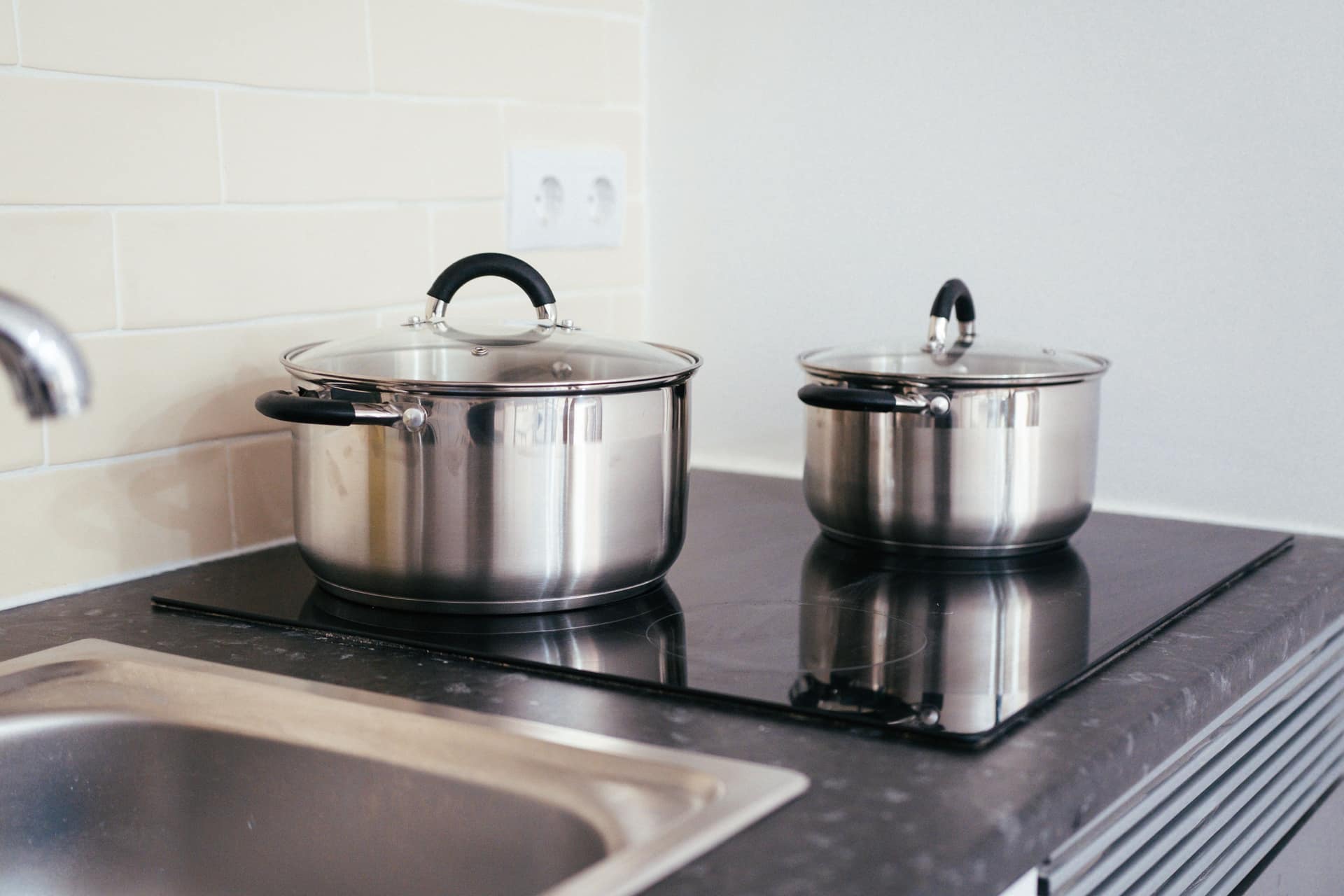
Induction heats by inducing a current in ferrous metal, so the base has to be magnetic and the cooktop has to detect it. A stainless canner with a flat encapsulated base is built for exactly that, and the McSunley states compatibility with all cooktops including induction in writing.
Enamel-on-steel has a steel core, so a magnet will often stick — but the metal is thin, and thin enamelware can fall below the minimum a cooktop needs to detect a pan at all. We could not find a published induction statement from Granite Ware, and we are not going to supply one on their behalf. If induction is your cooktop and you are buying new, buy the one that states it. The whole picture is in canning on an induction cooktop.
Quick picks
Every pick below is screened against the National Center for Home Food Preservation’s published canner rules first. Tap a row for the full write-up.
| # | Product | Best for | Key spec | Price |
|---|---|---|---|---|
| 1 |  Granite Ware 21.5-Quart Water Bath Canner with RackThe canner almost everyone starts with, and there is very little wrong with that. Porcelain enamel on steel, a rack that holds a full seven-quart load, light enough to lift full, and cheap enough that it is not the thing standing between you and a first batch. | A first water bath canner | 7 quarts / 9 pints | $79.99 · View on Amazon#ad we earn a commission · price as of October 18, 2026 |
| 2 |  Prep-N-Cook by McSunley 21.5-Quart Stainless Steel Water Bath CannerA stainless water bath canner with a flat encapsulated base, which is the construction induction actually wants. If jam, pickles, fruit and acidified tomatoes are the whole plan, this does the job for less than the induction pressure canner and it is a much lighter pot to own. | Water bath only, on induction | 7 quarts / 9 pints | $74.99 · View on Amazon#ad we earn a commission · price as of October 18, 2026 |
| 3 | Granite Ware Enamel-on-Steel Canner KitThe canner, the rack and the tool set in one box. It works out cheaper than buying the pieces separately and, more usefully, means nothing is missing on the morning you actually start. | Canner and tools together | Canner, rack and tools | Check price on Amazon#ad we earn a commission · live price pending |
| 4 | Shallow pots sold as canning potsSkipSkip any pot that cannot keep an inch of briskly boiling water over the tops of your jars. Plenty of pots are sold with a canning rack and a canning name while being an inch or two too short for quart jars, and that inch is the requirement, not a target. | Nothing - skip these | Too shallow for quarts | Check price on Amazon#ad we earn a commission · live price pending |
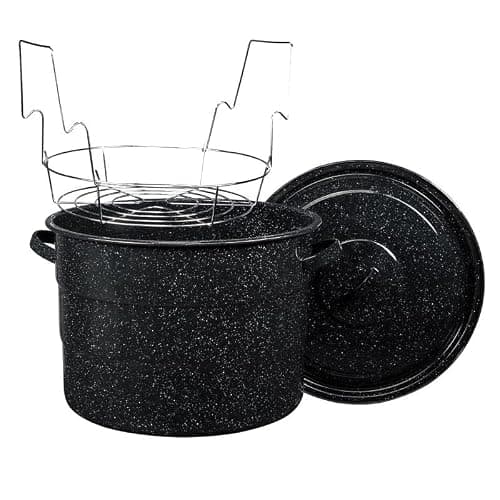
Granite Ware 21.5-Quart Water Bath Canner with Rack
The canner almost everyone starts with, and there is very little wrong with that. Porcelain enamel on steel, a rack that holds a full seven-quart load, light enough to lift full, and cheap enough that it is not the thing standing between you and a first batch.
Published specs
- Capacity
- 21.5 quarts
- Rack capacity
- 7 quart jars, 9 pints, or 12 half-pints
- Material
- Porcelain enamel on steel
- Dimensions
- Height 9.75", depth 16.25", width 14.25"
- Weight
- About 4 lb empty
- Included
- Pot, lid and jar rack
- Base diameter
- Not published by Granite Ware
What works
- Light. Four pounds empty means you can move it full of hot water without a second person
- The enamel surface is non-reactive, so tomatoes and vinegar brines do not pick up a metallic edge
- Deep enough to cover quart jars with the 1 inch of briskly boiling water the NCHFP requires, which a stockpot often is not
What to know first
- Enamel chips if you knock it, and a chipped rim will rust. It is cookware to be careful with, not to stack things on
- The base diameter is not published, so on an electric range you have to measure it against your element yourself
- Thin steel heats fast and loses heat fast — expect to ride the burner a little to hold a steady boil
Specs from NCHFP, Recommended Canners. We have not handled this product — see how we pick.
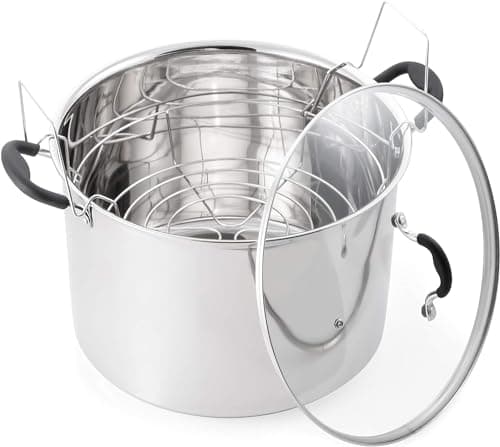
Prep-N-Cook by McSunley 21.5-Quart Stainless Steel Water Bath Canner
A stainless water bath canner with a flat encapsulated base, which is the construction induction actually wants. If jam, pickles, fruit and acidified tomatoes are the whole plan, this does the job for less than the induction pressure canner and it is a much lighter pot to own.
Published specs
- Capacity
- 21.5 quarts
- Rack capacity
- 7 quart, 9 pint or 12 half-pint jars
- Material
- Heavy-duty stainless steel
- Base
- Flat, encapsulated base
- Cooktops
- All cooktops, including induction and glass top
- Dimensions
- 14" x 18" x 11.75" (pot height 9.5")
- Weight
- 8.9 pounds
- Included
- Pot, lid and easy-lift jar rack
- Base diameter
- Not published by McSunley
What works
- The manufacturer states it works on all cooktops including induction, which is a sentence almost no water bath canner comes with
- An encapsulated base is thick where thin enamelware is not, which is what a cooktop's pan detection is looking for and what stops hot spots forming under the rack
- A 9.5-inch pot height clears a quart jar with the inch of briskly boiling water the NCHFP requires, so it is a real canner rather than a tall stockpot
What to know first
- 8.9 pounds empty against about 4 pounds for an enamel canner. Loaded with water and seven quart jars that is a genuinely heavy lift, and it is sitting on a glass surface
- Water bath only. Green beans, corn, meat and plain vegetables still need a pressure canner, and this pot will never do them
- No published base diameter, so you still have to measure it against your cooktop's ring marking yourself
Specs from McSunley, Prep-N-Cook Stainless Steel Water Bath Canner, NCHFP, Recommended Canners. We have not handled this product — see how we pick.
Granite Ware Enamel-on-Steel Canner Kit
The canner, the rack and the tool set in one box. It works out cheaper than buying the pieces separately and, more usefully, means nothing is missing on the morning you actually start.
Published specs
- Contents
- Enamel water bath canner, jar rack and canning tools
- Canner material
- Porcelain enamel on steel
- Covers
- High-acid foods only — this is not a pressure canner
What works
- One purchase and you can start, which is worth more than the money it saves
- The enamel canner is the same one most people buy on its own
- Nothing in the box is a piece you will later replace as inadequate, except possibly the lid wand
What to know first
- Water bath only. Beans, corn, meat and plain vegetables still need a pressure canner
- Kit contents vary between sellers — check the tool list before you buy
- If you already own a stockpot deep enough, you are buying a rack and tools at a canner's price
Specs from NCHFP, Recommended Canners. We have not handled this product — see how we pick.
Shallow pots sold as canning pots
Skip any pot that cannot keep an inch of briskly boiling water over the tops of your jars. Plenty of pots are sold with a canning rack and a canning name while being an inch or two too short for quart jars, and that inch is the requirement, not a target.
Published specs
- NCHFP requirement
- "The canner must be deep enough so that at least 1 inch of briskly boiling water will be over the tops of jars during processing"
- The test
- Jar height + 1 inch of water + room for a rolling boil
- Common shortfall
- Quart jars, which are about 6 1/2 to 6 3/4 inches tall
What works
- There is no upside. This entry is here so you can recognize the problem before it is in your kitchen
What to know first
- Water that stops covering the jars mid-boil means the tops of the jars are processing in air, not water, and the tested time no longer applies
- The shortfall is invisible in a product photo and only shows up when the jars are already in
- Cheap pots in this category often have no rack at all, and a jar sitting on a hot base can crack
Specs from NCHFP, Recommended Canners. We have not handled this product — see how we pick.
Weight, which cuts both ways
About four pounds against about nine, empty. That sounds like a clear win for enamel until you remember what else is in the pot: twenty quarts of water and seven full quart jars. Against that load, the five-pound difference in the pot itself is a smaller fraction of the total than it first appears.
Where it does matter is handling the empty pot — lifting it down from a high shelf, carrying it to the sink, tipping it out. If that is the part you find difficult, enamel is genuinely easier to live with, and that is a legitimate reason to choose it.
Chipping is how enamel canners actually die
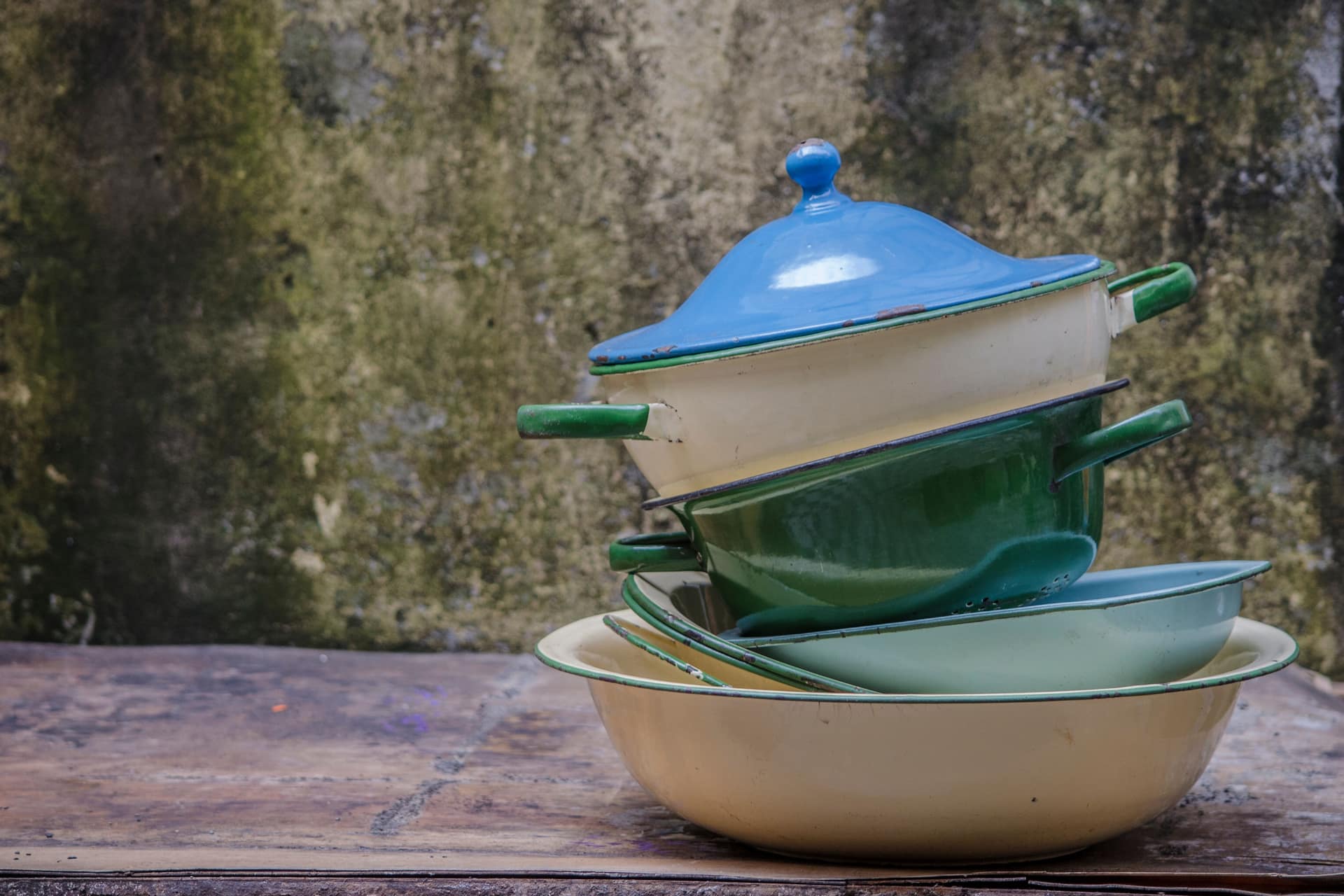
This is the enamel trade-off and it is a real one. Porcelain enamel is glass fused to steel, and glass chips. A chip on the outside is cosmetic. A chip on the rim, where the lid sits and where the pot gets knocked, exposes bare steel that then rusts.
It is cookware to be a bit careful with rather than to stack things on or drop in the sink. Stainless has no coating to chip, which is most of why it costs more and most of why it outlasts.
How they behave on the stove
Thin enamel-on-steel heats quickly and loses heat quickly, so expect to ride the burner a little to hold a steady boil, and expect the temperature to drop noticeably the moment cold jars go in. A stainless canner with an encapsulated base is slower to come up and steadier once there, which on a long process is the more restful behavior.
Neither difference changes the process. You start timing at a full rolling boil either way, and you hold that boil for the tested time either way.
Cost, honestly
Enamel is the cheaper pot and it is not close. For a first canner that is a real argument — the cheapest honest path into water bath canning matters more than durability you may never need, and plenty of people find out in year one that they make jam twice a season.
The case for spending more is that you already know you will keep canning, you are on induction, or you want a large pot that is also a genuinely good stockpot for the other eleven months. The broader spend picture is in what canning costs to start.
Caring for each
The maintenance differs more than the cooking does, and it is the part that decides how long each pot lasts.
Enamel wants gentleness rather than effort. Do not knock it against the tap, do not stack heavy things inside it, and do not scour the interior with anything abrasive — the enamel is glass and scratches become chips. Dry it before it goes away, and store the lid off or with something soft between lid and rim, because rim-on-rim contact in a cupboard is how the most damaging chips happen.
Stainless wants the opposite: it tolerates scrubbing but shows water. Hard-water scale and the faint rainbow tint that appears after long boiling are both cosmetic and both come off with an acid — a vinegar soak or a dedicated stainless cleaner. Neither affects performance, and neither is a sign the pot is failing.
If your enamel canner is already chipped
The question is where. A chip on the outside wall is cosmetic and the pot carries on. A chip on the interior below the water line is not ideal but is rarely urgent, because the exposed steel spends most of its life dry. A chip on the rim is the one that retires the pot, because that is where water sits, where the lid contacts, and where rust then creeps under the surrounding enamel and lifts it.
There is no repair worth attempting — enamel is fired glass and touch-up products are not food-safe cookware coatings. Once rust is spreading from a rim chip, the pot becomes a bucket and a new canner goes on the list. That is the moment a lot of people move to stainless, and it is a reasonable time to do it.
What about aluminum?
Worth addressing because aluminum pots are common and cheap. Plain aluminum is reactive, which means acidic foods — exactly what a water bath canner processes — can pick up a metallic edge and can pit the surface over time. Neither enamel nor stainless has that problem.
The nuance is that most aluminum canners are pressure canners rather than water bath pots, and in a pressure canner the food is inside sealed jars and never touches the metal. That is why an aluminum pressure canner is fine and an aluminum open pot for acidic water bath work is a poorer choice. Aluminum also will not work on induction at all, which is covered in canning on an induction cooktop.
The decision, in one paragraph
On induction, buy stainless with a stated flat encapsulated base — that is the only one of the two that reliably works. Otherwise buy enamel for a first canner: it meets exactly the same published requirements, it is lighter to handle empty, and it costs a fraction. Move to stainless when you know canning has stuck, when you have chipped an enamel rim, or when you want the pot to earn its shelf space year-round. Our picks in both materials are in best water bath canners.
Next stepThe canners worth buyingCommon questions
Is a stainless canner better than an enamel one?
Can you use an enamel canner on induction?
Does the canner material affect the food?
Is enamel safe if it chips?
Which heats faster?
Which should I buy as my first canner?
Do you earn a commission on these?
Sources
- NCHFP — Recommended Canners
- McSunley — Prep-N-Cook Stainless Steel Water Bath Canner
- National Center for Home Food Preservation
Product specifications are taken from each manufacturer’s own published page, cited on the product. We have not handled these products — how we pick.