What does it cost to start canning?
The gear is mostly a one-time purchase. Only one item is a genuine yearly consumable, and it is the cheapest thing on the list.
Disclosure: we earn a commission on purchases made through links on this page, at no extra cost to you. It does not change what we recommend — see how we pick and our affiliate disclosure.
Water bath canning needs a deep pot with a rack, jars, new flat lids and a jar lifter. Almost all of it is a one-time purchase that lasts decades; only the flat lids are a genuine yearly consumable. Pressure canning costs more because the canner itself is the expensive item.
We are not going to quote you numbers on this page. Prices move, and a page that anchors you to last season's figure is worse than useless — every buy button on this site shows a live price or says plainly that it cannot. What we can do, and what actually answers the question, is tell you the shape of the spend: what you must buy, what you can skip, what lasts forever, and what you will buy again every August.
That shape is the genuinely useful thing, because the common mistake is not overspending. It is buying the wrong things in the wrong order.
The one-time list versus the yearly list
This distinction does more work than any budget figure, and almost nobody explains it before you have already bought things.
| Item | How often you buy it | Notes |
|---|---|---|
| The canner | Once, realistically for life | Enamel canners last decades; a Presto is repairable by part number |
| Jars | Once — they outlive you | Chips at the rim are the only thing that retires a jar |
| Screw bands | Once, then occasionally | Reusable indefinitely until they rust or distort |
| Flat lids | Every single use | The only true consumable — worth [buying a season ahead](/jars-and-lids/buying-canning-jars-in-bulk) |
| Jar lifter | Once | The cheapest tool whose absence causes burns |
| Funnel | Once | Genuinely useful, especially on regular-mouth jars |
| Bubble remover / headspace tool | Once | A plastic ruler does the job if you would rather not |
| A tested recipe source | Once | A current edition, then leave it on the shelf |
So the honest framing of the cost question is that canning is front-loaded. The first season looks expensive and every season after it is jars you already own plus a box of lids. That is a very different proposition from a hobby with a running cost, and it is why the people who quit usually quit in year one.
Three starting points
In increasing order. Pick by what you actually intend to put in jars, not by what looks most thorough.
1. The near-zero start
If you own a tall stockpot, you may be able to water bath pints today for the price of jars and lids. The pot has to be deep enough to keep an inch of briskly boiling water over the jar tops with room for the boil, and you need something to keep jars off the base. That is the entire requirement. What qualifies and what does not is in canning without a canner.
This is a genuinely legitimate route and not a compromise for the broke. Plenty of experienced canners never buy a dedicated water bath canner. The reason most people eventually do is depth — stockpots are usually an inch or two short for quart jars, and that inch is a requirement rather than a target.
2. The standard water bath start
A 21.5-quart enamel canner with a rack, a dozen jars with lids and bands, and a jar lifter. This covers jam, jelly, pickles, fruit, salsa and acidified tomatoes — which is most of what a first harvest actually is. A starter kit bundles the canner and tools, and usually costs less than assembling the pieces, though the real advantage is that nothing is missing on the morning you start.
This is the recommendation for most people reading this. It is the smallest spend that leaves nothing important out.
3. The pressure canning start
If green beans, corn, carrots, plain tomatoes without added acid, meat or stock are on your list, none of the above will do the job and you need a pressure canner. This is where the cost genuinely jumps, because the canner is the expensive item rather than an accessory.
The one piece of good news is that the 23-quart Presto doubles as a boiling water canner for pints and half-pints, so it is one purchase rather than two. Whether you need it at all is decided by the food, not by ambition — what foods need pressure canning settles that in a list.
Quick picks
Every pick below is screened against the National Center for Home Food Preservation’s published canner rules first. Tap a row for the full write-up.
| # | Product | Best for | Key spec | Price |
|---|---|---|---|---|
| 1 | Granite Ware Enamel-on-Steel Canner KitThe canner, the rack and the tool set in one box. It works out cheaper than buying the pieces separately and, more usefully, means nothing is missing on the morning you actually start. | Canner and tools together | Canner, rack and tools | Check price on Amazon#ad we earn a commission · live price pending |
| 2 |  Granite Ware 21.5-Quart Water Bath Canner with RackThe canner almost everyone starts with, and there is very little wrong with that. Porcelain enamel on steel, a rack that holds a full seven-quart load, light enough to lift full, and cheap enough that it is not the thing standing between you and a first batch. | A first water bath canner | 7 quarts / 9 pints | $79.99 · View on Amazon#ad we earn a commission · price as of October 18, 2026 |
| 3 |  Ball Regular Mouth Pint Jars (16 oz)If you buy one case of jars this season, buy this one. Pints are the size most tested recipes are written for, regular-mouth lids are the cheapest and most available lid on any shelf, and the jars are reusable indefinitely. | The default first case | 70 mm mouth, 16 oz | $36.99 · View on Amazon#ad we earn a commission · price as of October 18, 2026 |
| 4 |  Ball Regular Mouth Canning LidsThe lid every tested recipe assumes. Single-use by design — the sealing compound is meant to compress once — and cheap enough that reusing one to save a few cents is a bad trade against losing a jar of food. | The default lid | 70 mm, single use | $22.99 · View on Amazon#ad we earn a commission · price as of October 18, 2026 |
| 5 | Ball Premium Jar Lifter (10731)If you buy exactly one canning tool, buy this. Rubberized jaws shaped to a jar shoulder, lifting a hot quart straight up out of boiling water without tilting it. Kitchen tongs do not do this and the failure mode is a burn. | The one tool to buy first | Fits regular and wide | Check price on Amazon#ad we earn a commission · live price pending |
| 6 |  Presto 23-Quart Pressure Canner and Cooker (01781)The default first pressure canner, and the one most beginners should buy: it takes a full seven-quart load, it doubles as a boiling-water canner for pints and half-pints, and it costs a fraction of a cast-aluminum canner. The dial gauge is the catch, and it is a real one. | A first pressure canner | 7 quarts / 20 pints |
Granite Ware Enamel-on-Steel Canner Kit
The canner, the rack and the tool set in one box. It works out cheaper than buying the pieces separately and, more usefully, means nothing is missing on the morning you actually start.
Published specs
- Contents
- Enamel water bath canner, jar rack and canning tools
- Canner material
- Porcelain enamel on steel
- Covers
- High-acid foods only — this is not a pressure canner
What works
- One purchase and you can start, which is worth more than the money it saves
- The enamel canner is the same one most people buy on its own
- Nothing in the box is a piece you will later replace as inadequate, except possibly the lid wand
What to know first
- Water bath only. Beans, corn, meat and plain vegetables still need a pressure canner
- Kit contents vary between sellers — check the tool list before you buy
- If you already own a stockpot deep enough, you are buying a rack and tools at a canner's price
Specs from NCHFP, Recommended Canners. We have not handled this product — see how we pick.
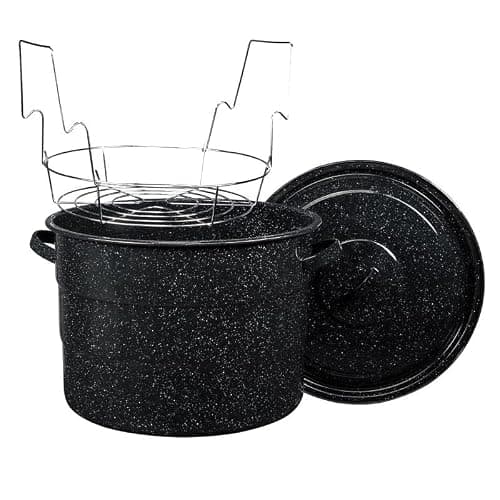
Granite Ware 21.5-Quart Water Bath Canner with Rack
The canner almost everyone starts with, and there is very little wrong with that. Porcelain enamel on steel, a rack that holds a full seven-quart load, light enough to lift full, and cheap enough that it is not the thing standing between you and a first batch.
Published specs
- Capacity
- 21.5 quarts
- Rack capacity
- 7 quart jars, 9 pints, or 12 half-pints
- Material
- Porcelain enamel on steel
- Dimensions
- Height 9.75", depth 16.25", width 14.25"
- Weight
- About 4 lb empty
- Included
- Pot, lid and jar rack
- Base diameter
- Not published by Granite Ware
What works
- Light. Four pounds empty means you can move it full of hot water without a second person
- The enamel surface is non-reactive, so tomatoes and vinegar brines do not pick up a metallic edge
- Deep enough to cover quart jars with the 1 inch of briskly boiling water the NCHFP requires, which a stockpot often is not
What to know first
- Enamel chips if you knock it, and a chipped rim will rust. It is cookware to be careful with, not to stack things on
- The base diameter is not published, so on an electric range you have to measure it against your element yourself
- Thin steel heats fast and loses heat fast — expect to ride the burner a little to hold a steady boil
Specs from NCHFP, Recommended Canners. We have not handled this product — see how we pick.
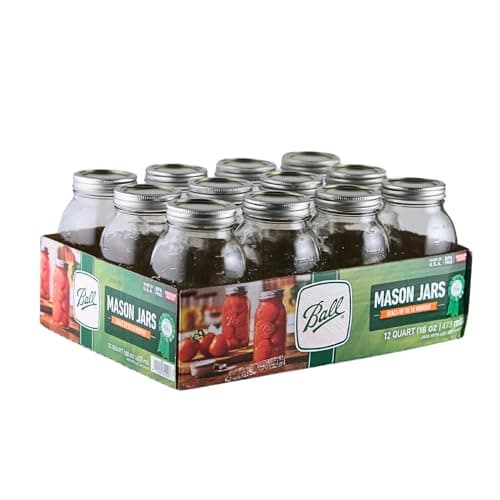
Ball Regular Mouth Pint Jars (16 oz)
If you buy one case of jars this season, buy this one. Pints are the size most tested recipes are written for, regular-mouth lids are the cheapest and most available lid on any shelf, and the jars are reusable indefinitely.
Published specs
- Volume
- 16 oz / 2 cups
- Mouth
- Regular, about 70 mm lid diameter
- Inner mouth diameter
- About 60 mm
- Jar dimensions
- About 5" tall x 2 3/4" wide
- Reuse
- Jars and rings reusable; flat lids are single-use
What works
- Pints fit both a water bath canner and a pressure canner comfortably, so the case is not stranded when you move up to beans
- Regular-mouth lids are the most stocked size in the country, which matters in September when shelves empty out
- The jars outlive everything else in this list. The consumable is the flat lid, not the glass
What to know first
- The narrower 60 mm opening is fiddly for whole peaches or large pickle spears — that is what wide mouth is for
- Regular and wide mouth lids are not interchangeable, so mixing both means stocking two lid sizes
- Glass. Handle the case like glass
Specs from Ball, Mason Jars & Lids, Regular Mouth. We have not handled this product — see how we pick.
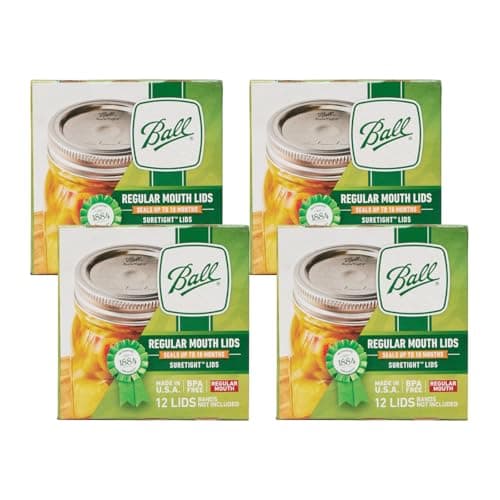
Ball Regular Mouth Canning Lids
The lid every tested recipe assumes. Single-use by design — the sealing compound is meant to compress once — and cheap enough that reusing one to save a few cents is a bad trade against losing a jar of food.
Published specs
- Size
- Regular mouth, about 70 mm
- Use
- Flat lid single-use; band reusable
- Compatibility
- Ball and Kerr regular mouth jars
What works
- The most widely stocked lid in the country, which is the thing that matters in September
- What every NCHFP and Ball tested recipe is written around, so nothing about your process needs adapting
- Bands are reusable indefinitely as long as they are not bent or rusted
What to know first
- Single use. The flat lid goes in the recycling after one seal
- Sells out first in peak season — buy your lids in July, not September
- Does not fit wide mouth jars, and there is no adapter
Specs from Ball, Mason Jars & Lids, Regular Mouth. We have not handled this product — see how we pick.
Ball Premium Jar Lifter (10731)
If you buy exactly one canning tool, buy this. Rubberized jaws shaped to a jar shoulder, lifting a hot quart straight up out of boiling water without tilting it. Kitchen tongs do not do this and the failure mode is a burn.
Published specs
- Fits
- Regular and wide mouth jars
- Grip
- Rubberized jaws
- Why it matters
- Lifts a jar level, without tilting the seal
What works
- Lifts a jar straight up rather than pinching it, which keeps water off the sealing surface
- The rubber grip holds on a wet jar, which is the exact moment tongs fail
- Costs less than a case of jars and prevents the most common kitchen injury in this hobby
What to know first
- Only does one job. Everything else in a tool set is still missing
- Nearly always cheaper bought inside a set than alone
- The rubber degrades over years of boiling water; it is not a lifetime tool
Specs from NCHFP, Recommended Canners. We have not handled this product — see how we pick.
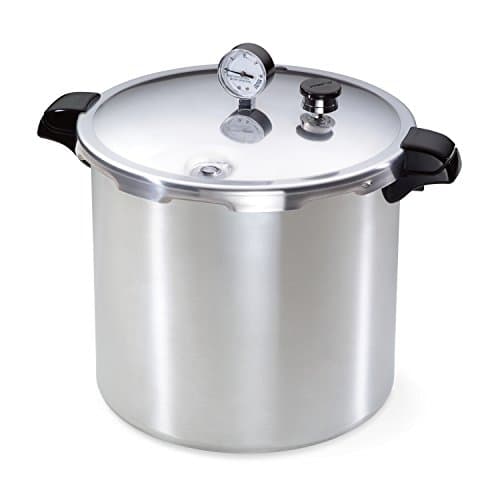
Presto 23-Quart Pressure Canner and Cooker (01781)
The default first pressure canner, and the one most beginners should buy: it takes a full seven-quart load, it doubles as a boiling-water canner for pints and half-pints, and it costs a fraction of a cast-aluminum canner. The dial gauge is the catch, and it is a real one.
Published specs
- Liquid capacity
- 23 quarts (21.8 liters)
- Jar capacity
- 26 half-pints, 20 pints, 7 quarts
- Material
- Warp-resistant aluminum
- Gauge
- Dial gauge
- Ranges
- Regular and smooth-top
- Burner limit
- 12,000 BTUs or less
- Also
- Doubles as a boiling-water canner
- Warranty
- 12-year limited
- Base diameter
- Not published by Presto
What works
- Seven quart jars is the standard batch size every tested NCHFP recipe is written around, so you are never processing a half load
- Doubles as a boiling-water canner for pints and half-pints, which means one pot covers the jam-and-pickles year as well as the beans
- Presto sells a replacement dial gauge and sealing ring separately, so a decade-old canner is a repair rather than a replacement
What to know first
- A dial gauge should be checked for accuracy every year — most extension offices do it free, and most owners never go. A weighted gauge needs no calibration at all
- Presto does not publish a base diameter, so you cannot check it against the NCHFP element rule without measuring the box yourself. See will it fit your stove
- Rated for burners of 12,000 BTUs or less, which rules out most outdoor propane burners and some high-output gas ranges
Specs from Presto, 23-Quart Pressure Canner and Cooker (01781). We have not handled this product — see how we pick.
Two places to deliberately spend less
Not everything rewards buying the better version, and being clear about that is more useful than a shopping list.
- The bubble remover. A flat plastic stick with a notch. A clean plastic ruler or chopstick does the same job. Buy it if it comes in a kit; do not buy it on its own.
- The magnetic lid wand. It lifts lids out of hot water. Clean tongs work. This is the item in most kits that people quietly stop using.
And one place not to save: the jar lifter. It is the cheapest real tool in canning and the one whose absence produces burns, because the alternative is oven mitts on a wet, hot, slippery jar. Buy the lifter.
What you do not need to buy at all
A thermometer, for either method — water bath canning is judged by a full rolling boil and pressure canning by the gauge or the rocking weight. A separate pot to cook the food in, since any large non-reactive pot works. A dishwasher with a sanitize cycle. Special jars beyond standard Mason-type ones. And, for most recipes, canning salt: in most water bath recipes salt is for flavor and ordinary salt is fine, though in fermented pickles the type and amount do matter — see canning salt.
The honest answer, in one paragraph
If you own a deep stockpot, your first season can cost little more than jars and lids. If you buy the standard water bath setup, you are making a one-time purchase that will still be in your kitchen in twenty years, and your recurring cost after that is a box of flat lids each season. Pressure canning is a real step up in cost and is decided by the food you want to put up rather than by how serious you are. Whatever you buy, spend on the canner, the jars and the lifter, and be relaxed about the rest. The full list is in the first harvest checklist.
Next stepThe checklist, in buying orderCommon questions
Is canning cheaper than buying canned food?
What do I actually have to buy to start canning?
What is the only thing I buy every year?
Can I start canning with a pot I already own?
Is a starter kit worth it?
How much more does pressure canning cost?
Why do you not list prices on this page?
Do you earn a commission on these?
Sources
- NCHFP — Recommended Canners
- National Center for Home Food Preservation
- SDSU Extension — Water Bathing vs Pressure Canning
Product specifications are taken from each manufacturer’s own published page, cited on the product. We have not handled these products — how we pick.