Canning jar bands and rings
The only part of the two-piece lid you are supposed to reuse — and the one most people store wrong.
Disclosure: we earn a commission on purchases made through links on this page, at no extra cost to you. It does not change what we recommend — see how we pick and our affiliate disclosure.
Bands hold the flat lid on during processing and do nothing afterward — the vacuum holds the lid. Turn them fingertip tight (NDSU: to resistance, then a quarter turn more), never retighten after processing, and take them off for storage. They are reusable for years; replace when rusty, bent or dented.
The screw band is the least interesting object in canning and the one most surrounded by folklore. It is also the only part of the two-piece system you are meant to keep, which makes "when do I throw one away" a real question with a boring answer.
What follows is what the bands actually do, the two ways of getting them wrong, and where to buy them on their own — which is harder than it should be, because the biggest brand does not sell them that way.
What a band is for, and when it stops mattering
During processing the band holds the flat lid against the rim while air escapes from the jar. After the jar cools, the seal is a vacuum and the band is redundant. That is why the NCHFP says plainly: "Screw bands are not needed on stored jars."
Bernardin — Newell's own brand, the same lid system as Ball and Kerr — gives the clearest account of why tension matters during that window: "Heat causes expansion of food and gases inside the jar during processing... Glass does not expand, so the pressure needs an outlet. When lids are applied fingertip tight the excess gasses (or pressure) can escape. This action is called 'venting'. If lids are applied too tightly 'venting' is prevented."
| Band tension | What happens |
|---|---|
| Too loose | NCHFP: "liquid may escape from jars during processing, and seals may fail" |
| Fingertip tight | Air vents during processing; vacuum forms as the jar cools |
| Too tight | NCHFP: "air cannot vent during processing, and food will discolor during storage. Over tightening also may cause lids to buckle and jars to break" |
How tight is fingertip tight?
NDSU Extension gives the only definition with a number in it: "place the screw band on the jar, turn it just until you feel resistance, then turn the band one-quarter turn more." Bernardin's version is to screw the band down with your fingers only "until you meet a point of resistance" and not to use the full force of your hand or a utensil.
Two techniques that circulate and should not. Bernardin retires the first by name: "Applying screw bands very tightly, then backing them off a quarter turn is an outdated method that does not work successfully." And the second is retightening after processing, which every source forbids — the NCHFP's wording is "Do not retighten lids after processing jars," because the contents are contracting and pulling the lid down as they cool.
How we screened these
We have not torque-tested bands. What we checked is which makers publish anything at all about material and fit, what counts as a reusable band per extension guidance, and which packs match how bands are actually bought — as replacements, or alongside a bulk jar purchase. The method is on how we pick.
- Correct mouth size. Regular is 70 mm, wide is 86 mm, and bands are not interchangeable.
- Count that matches the need. A top-up after a rusty season, or a hundred to go with a pallet of jars.
- Threads that turn cleanly. The one quality variable that shows up on canning day.
- A published material spec, where one exists. Ball publishes tin-plated steel; most brands publish nothing.
- No unverifiable claims. See the note on stainless below.
Quick picks
Every pick below is screened against the National Center for Home Food Preservation’s published canner rules first. Tap a row for the full write-up.
| # | Product | Best for | Key spec | Price |
|---|---|---|---|---|
| 1 |  ForJars Canning Rings, Regular Mouth (100)A hundred regular-mouth bands in one box, which is the quantity that actually matches how bands get lost, rusted and left on jars. ForJars sells rings separately — something Ball does not do on its own site, where bands come bundled with lids you may not need. | Restocking a whole shelf | 100 rings, regular mouth | $31.90 · View on Amazon#ad we earn a commission · price as of October 18, 2026 |
| 2 |  Regular Mouth Canning Bands, 24-PackThe small box, for the household that has lost or rusted a dozen bands over a few seasons and does not need a hundred. Bands are the one part of the two-piece system that is genuinely reusable, so replacing a handful is usually all that is called for. | Replacing the rusted ones | 24 bands, 70 mm | $9.99 · View on Amazon#ad we earn a commission · price as of October 18, 2026 |
| 3 |  Regular Mouth Canning Rings, 100-PackThe bulk box, and the one that makes sense alongside a pallet of jars or a case of lids bought without bands. Nothing about a band is technical — it holds the lid on during processing and then comes off — so quantity and thread quality are the whole decision. | Outfitting a bulk jar buy | 100 rings, 70 mm | $29.99 · View on Amazon#ad we earn a commission · price as of October 18, 2026 |
| 4 | Leaving bands on jars in storageSkipNot a product, a habit — and the one that quietly costs people both bands and jars. The NCHFP is direct: "Screw bands are not needed on stored jars... If left on stored jars, they become difficult to remove, often rust, and may not work properly again." Worse, a band can hold a failed lid down so the jar looks sealed when it is not. | Nothing - take them off | Hides failed seals, rusts on | Check price on Amazon#ad we earn a commission · live price pending |
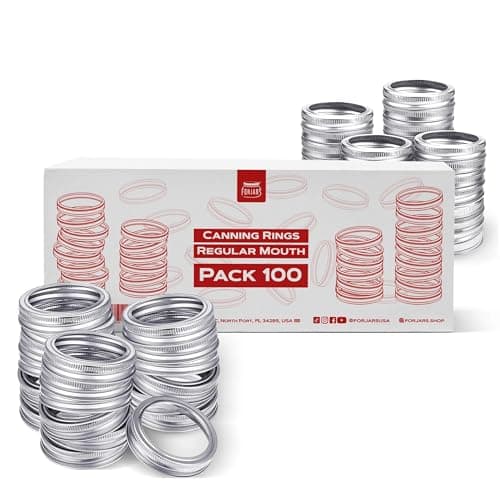
ForJars Canning Rings, Regular Mouth (100)
A hundred regular-mouth bands in one box, which is the quantity that actually matches how bands get lost, rusted and left on jars. ForJars sells rings separately — something Ball does not do on its own site, where bands come bundled with lids you may not need.
Published specs
- Count
- 100 rings, regular mouth
- Maker's material claim
- ForJars' own site says the rings are "made with high-quality metal" and does not publish a material spec
- Fit
- "Fits Regular Mouth Ball Jars" (ForJars)
- Use
- "Safe for boiling and pressure cooking" (ForJars)
- Guarantee
- "We offer a 90-day guarantee on our products" (ForJars)
What works
- Bands sold on their own, in a count that matches a real canning shelf rather than a 12-pack bundled with lids
- ForJars is one of the few lid-and-ring brands with a real company site publishing specifications and a guarantee
- Rings are reusable indefinitely in practice — NCHFP says they "may be used many times" if washed, dried and stored dry
What to know first
- The Amazon listing describes the rings as stainless steel; ForJars' own product page says only "high-quality metal", so treat the stainless claim as unverified by the maker
- No extension or NCHFP source addresses band material at all, so nobody independent has evaluated whether a stainless band outperforms tinplate
- A hundred bands is more than most households need — Ball's are tin-plated steel and last years if you take them off the jars
Specs from ForJars, 100 Regular Mouth Rings, NDSU Extension, Put a Lid On It!. We have not handled this product — see how we pick.
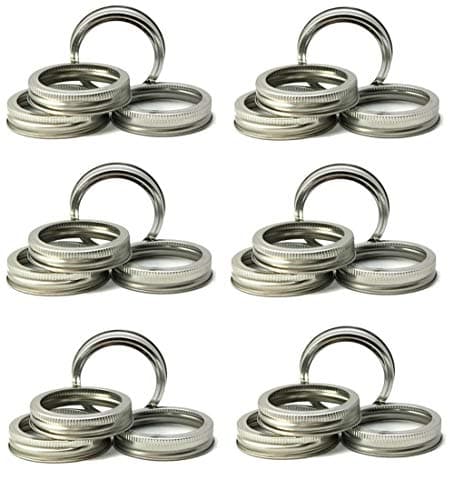
Regular Mouth Canning Bands, 24-Pack
The small box, for the household that has lost or rusted a dozen bands over a few seasons and does not need a hundred. Bands are the one part of the two-piece system that is genuinely reusable, so replacing a handful is usually all that is called for.
Published specs
- Count
- 24 bands, regular mouth (70 mm)
- What bands do
- Hold the flat lid in place during processing; they are not part of the seal afterwards
- When to replace
- Penn State: "The bands are reusable unless rusty, bent, or dented."
- Note
- Generic brand; specifications here come from the listing rather than a maker's page
What works
- The right quantity for a top-up, which is what band buying usually is
- Regular mouth is the size most households own most of, and bands are not interchangeable between mouth sizes
- Cheap enough that retiring a rusty band is an easy decision rather than a judgment call
What to know first
- No manufacturer page behind it — the listing calls the rings "Tinplate Metal" and "Durable & Rustproof", but there is no maker's site to check the coating claim against
- Bands vary in thread quality between generic runs; check that they turn smoothly onto your jars before canning day
- If yours are rusting quickly, the fix is usually storage — NDSU advises against washing bands in a dishwasher because it raises the rusting risk
Specs from Penn State Extension, Canning Jars and Lids - An Update, NDSU Extension, Put a Lid On It!. We have not handled this product — see how we pick.
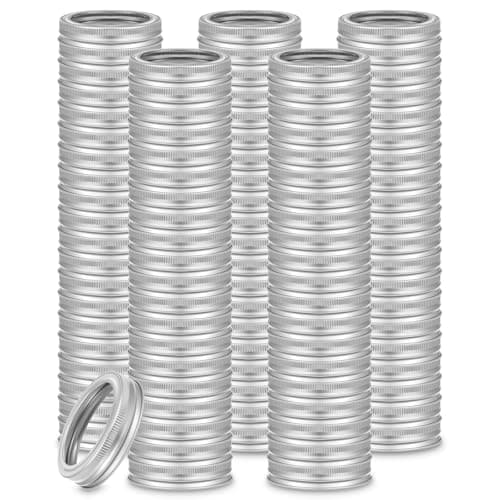
Regular Mouth Canning Rings, 100-Pack
The bulk box, and the one that makes sense alongside a pallet of jars or a case of lids bought without bands. Nothing about a band is technical — it holds the lid on during processing and then comes off — so quantity and thread quality are the whole decision.
Published specs
- Count
- 100 rings, regular mouth (70 mm)
- Fit
- Standard 70 mm regular mouth Mason-type jars
- Storage
- Remove after the jars seal, wash, dry, and store dry (NCHFP)
- Note
- Generic brand; specifications here come from the listing rather than a maker's page
What works
- Lowest cost per band of the options here, which matters if you are buying jars by the case
- Having spares means never leaving bands on stored jars because you needed them elsewhere
- Bands outlive flats many times over, so a bulk buy is a long-horizon purchase rather than a consumable
What to know first
- Unbranded, with no published material or coating
- A hundred bands take up real shelf space and you only need as many as you process at once
- Bands that arrive slightly out of round are a real nuisance on canning day — check a few before you need them
Specs from NCHFP, Using Boiling Water Canners, Penn State Extension, Canning Jars and Lids - An Update. We have not handled this product — see how we pick.
Leaving bands on jars in storage
Not a product, a habit — and the one that quietly costs people both bands and jars. The NCHFP is direct: "Screw bands are not needed on stored jars... If left on stored jars, they become difficult to remove, often rust, and may not work properly again." Worse, a band can hold a failed lid down so the jar looks sealed when it is not.
Published specs
- NCHFP
- "You can more easily detect some types of spoilage in jars stored without screw bands. Growth of spoilage bacteria and yeast produces gas which pressurizes the food, swells lids, and breaks jar seals."
- Penn State
- "Screw bands should be removed after the jars have sealed and cooled; do not leave the bands on the jars during storage."
- What to do instead
- Remove after 12-24 hours, wash, dry thoroughly, store in a dry place
- Also
- NCHFP: "Dampness may corrode metal lids, break seals, and allow recontamination and spoilage."
What works
- Leaving bands on does make jars easier to carry, which is the only argument for it and not a good enough one
What to know first
- A band can hold an unsealed lid in place, hiding exactly the failure you check the shelf for
- Bands rust onto jars and stop working, turning a reusable part into a consumable
- Moisture trapped under a band corrodes the lid, which NCHFP links to broken seals and spoilage
Specs from NCHFP, Using Boiling Water Canners, Penn State Extension, Canning Jars and Lids - An Update. We have not handled this product — see how we pick.
The stainless steel question
You will see bands advertised as stainless steel, usually at a premium, with the promise that they never rust. We could not verify that claim in any source we trust, and we looked hard.
- No extension source addresses band material at all. Not NCHFP, not Penn State, Iowa State, NDSU, Clemson, Utah State or Minnesota. The topic simply is not covered.
- Ball publishes tin-plated steel in its own specification table, and lists its lids and bands as not dishwasher safe.
- ForJars' own product page says its rings are "made with high-quality metal" and publishes no material spec, even though retail listings for the same rings say stainless.
- So treat "stainless" as a listing claim, not a verified specification, and certainly not as a safety difference — there is no tested-process reason to prefer one band material.
If your bands rust quickly, the likelier culprit is storage rather than metallurgy. NDSU advises washing bands by hand rather than in a dishwasher "because this can increase the risk of the metal pieces rusting", and Penn State says to dry them completely and keep them out of a humid basement.
When a band is finished
There is no service life in years or uses anywhere in the literature — every source gives a condition rule instead. Penn State: "The bands are reusable unless rusty, bent, or dented." The NCHFP: when removed, washed, dried and stored dry, "screw bands may be used many times." The NCHFP's own blog is the most relaxed of all: "bands can be used over and over until they rust or get bent."
What to look at before canning day, not during it: a band that will not turn smoothly onto a jar, one that is out of round after being pried off a stuck lid, and any rust on the threads or the flat top. A rusted band is not a contamination hazard so much as a torque problem — it will not tighten evenly, and even tension is the whole job.
Buying bands separately
This is oddly hard. Ball's own accessories category sells lids and bands together in twelve-packs and does not list a bands-only product, which means replacing a dozen rusty bands through the biggest brand also means buying a dozen flats you may not need. The brands that do sell rings alone — ForJars and Superb among them — are the practical answer.
- Match the mouth size to your jars, not to the box that looks cheapest.
- Buy in a count that matches your canner load, plus spares — seven quarts per load means seven bands in use at once.
- Keep them out of the dishwasher, per NDSU, and dry them before they go away.
- Store them off the jars, which is the whole point of the section above.
- Do not buy bands to fix a sealing problem — that is a lid, rim or headspace issue. The diagnosis is in canning lids not sealing.
The decision, in one paragraph
If you are replacing a handful, buy the 24-pack in your mouth size and move on. If you have just bought jars by the case or lids without bands, the 100-count boxes cost less per band than any other format — ForJars if you want a brand with a real company site and a guarantee behind it, the generic box if you do not. Then take them off your sealed jars, dry them, and they will outlast several seasons of flats.
Next stepChecking the seal once the band is offCommon questions
How tight should canning bands be?
Should you remove the bands after canning?
Can you reuse canning bands?
Should you retighten bands after processing?
Are stainless steel canning bands better?
What size bands do I need?
Can you put canning bands in the dishwasher?
Why did liquid escape from my jars during processing?
Do you earn a commission on these?
Sources
- NCHFP — Recommended Jars and Lids
- NCHFP — Using Boiling Water Canners
- NCHFP — Storing Home Canned Foods
- NDSU Extension — Put a Lid On It!
- Penn State Extension — Canning Jars and Lids, An Update
- Penn State Extension — Storing Canning Supplies
- Bernardin (Newell Brands) — Home Canning FAQ
- ForJars — Canning Rings
Product specifications are taken from each manufacturer’s own published page, cited on the product. We have not handled these products — how we pick.