Superb canning lids review
The lid brand that came out of the 2021 shortage with a thicker steel core and, unusually, a third-party lab report you can read.
Disclosure: we earn a commission on purchases made through links on this page, at no extra cost to you. It does not change what we recommend — see how we pick and our affiliate disclosure.
Superb lids are made in Sugarcreek, Ohio, with a steel core Superb describes as carrying "five layers of corrosion protection" and a wider sealing compound than the supermarket default. Unusually for this category, Superb publishes a UL Solutions lab report showing a pass on a simulated pressure-canning test and no corrosion afterward. No extension service endorses any lid brand, including this one.
We have not run a season of jars through these and will not write as though we have. What follows is what Superb publishes about its own lids, what the lab report they link actually tested, what extension services say about off-brand lids as a category, and what all that adds up to for someone deciding whether to move off Ball. Our method is on how we pick.
The reason this brand is worth a page is not the marketing. It is that Superb is the only lid brand we have found that publishes third-party test data at all.
Where these came from
Superb tells the story on its own About page: a manufacturing company started in a two-car garage in Ohio Amish country in 1986, which moved into canning lids during the shortage. "In 2021, supply chain disruptions resulted in our local Amish population facing a shortage of high-quality lids... We put our engineering minds to work and designed a lid with a more reliable seal, better quality assurance, and improved corrosion resistance."
That origin matters more than it sounds. The 2021 lid shortage is also when the counterfeit problem started, and Penn State Extension describes the aftermath bluntly: "Consumers have reported buying what they thought was a major lid brand online, only to discover they were counterfeit." A brand with a named factory in a named town is a partial answer to that problem.
What Superb publishes about the lid
- Construction: "a steel core with five layers of corrosion protection, creating a barrier that stands up to the high-heat, high-moisture environment of both boiling water bath and pressure canning."
- Sealing compound: "proprietary polymer that is food-safe, FDA-approved, and BPA-free." That is Superb's wording; the FDA does not approve food-contact materials in that sense, so read it as a food-safety compliance claim rather than an approval.
- Made in: Sugarcreek, Ohio — "a small town in the heart of Ohio's largest Amish community."
- Seal claim: "a seal that lasts up to 36 months."
- Reuse: Superb agrees with everyone else — "it is recommended that you don't reuse canning lids."
- Sizes: regular and wide mouth, in 12, 60 and 156 counts, plus lid-and-band combination packs.
The lab report, and what it actually covers
This is the part that sets Superb apart. Linked from their own site is a UL Solutions report, number ARHL1172745, issued June 2025, listing the client as Walmart USA and the supplier as Superb Sealing Solutions, LLC. The overall rating is "Pass."
What the test did is more interesting than the headline. It torqued rings to a specified tightness — 20 in-lb for regular mouth, 25 in-lb for wide — processed the jars in a pressure canner for 90 minutes, removed the rings after 12 hours, and then checked sealing at 24 hours and 96 hours after the canner. It also checked for corrosion afterward, and recorded "Product demonstrates no corrosion following the pressure and sealing evaluations."
Two honest caveats. The report's own boilerplate says results "apply only to the specific materials, products or processes tested" and are not necessarily indicative of apparently identical products — normal language for lab work, and a reason not to read one report as a permanent guarantee. And the test was commissioned as a retail supplier qualification, not by an extension service or a university.
Quick picks
Every pick below is screened against the National Center for Home Food Preservation’s published canner rules first. Tap a row for the full write-up.
| # | Product | Best for | Key spec | Price |
|---|---|---|---|---|
| 1 |  Superb Canning Lids with Bands, Regular MouthThe lid brand that came out of the 2021 shortage and stayed. Superb is made in Sugarcreek, Ohio, publishes a UL Solutions lab report on its own site — pressure-canner simulated testing, pass on sealing and corrosion — and puts a thicker steel core and wider sealing compound on the lid than the supermarket default. It is the best-documented alternative to Ball we have found. | A thicker lid, made in Ohio | US-made, five-layer coating | |
| 2 |  Ball Regular Mouth Canning LidsThe lid every tested recipe assumes. Single-use by design — the sealing compound is meant to compress once — and cheap enough that reusing one to save a few cents is a bad trade against losing a jar of food. | The default lid | 70 mm, single use | $22.99 · View on Amazon#ad we earn a commission · price as of October 18, 2026 |
| 3 |  ForJars Canning LidsA widely available alternative for the weeks when the shelf is bare. Same single-use design and same standard sizes; buy it as a hedge against the September shortage rather than as an upgrade. | A stocked backup brand | Single use, 70 or 86 mm | $20.45 · View on Amazon#ad we earn a commission · price as of October 18, 2026 |
| 4 | Flat lids you have already usedSkipThe lid to skip is the one already in your drawer. A flat metal lid's sealing compound is designed to compress once against a jar rim. Used again it often appears to seal, then releases weeks later on a shelf - which is the worst possible time to find out. | Nothing - skip these | Single use by design | Check price on Amazon#ad we earn a commission · live price pending |
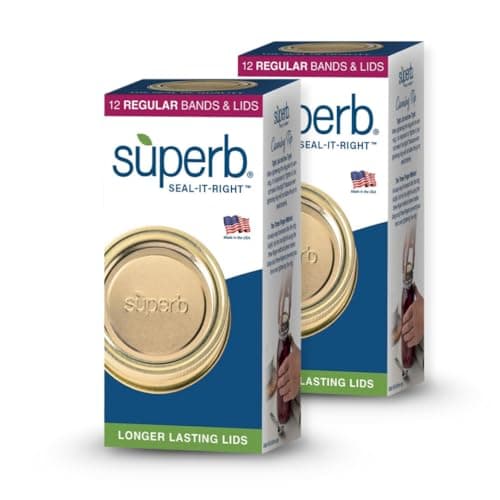
Superb Canning Lids with Bands, Regular Mouth
The lid brand that came out of the 2021 shortage and stayed. Superb is made in Sugarcreek, Ohio, publishes a UL Solutions lab report on its own site — pressure-canner simulated testing, pass on sealing and corrosion — and puts a thicker steel core and wider sealing compound on the lid than the supermarket default. It is the best-documented alternative to Ball we have found.
Published specs
- Made in
- Sugarcreek, Ohio (Superb)
- Construction
- "a steel core with five layers of corrosion protection" with a "high-grade sealing compound" (Superb)
- Sealing compound
- "proprietary polymer that is food-safe, FDA-approved, and BPA-free" (Superb's wording)
- Third-party testing
- UL Solutions report ARHL1172745 (June 2025): pressure canner simulated test "Pass", "no corrosion following the pressure and sealing evaluations"
- Seal life claim
- "a seal that lasts up to 36 months" (Superb)
- Reuse
- Superb: "it is recommended that you don't reuse canning lids"
What works
- A published third-party lab report is genuinely rare in this category — most lid brands publish nothing beyond marketing copy
- Made in the USA at a known address, which matters in a market Iowa State describes as "buyer beware" because of counterfeit lids
- Iowa State's AnswerLine has looked at the brand and its author wrote that the lids "appear to meet all qualifications for canning safety and integrity"
What to know first
- No extension service endorses any lid brand — Iowa State attaches an explicit disclaimer that it does "not recommend for (or against) any of these products"
- Superb publishes no shelf life for unused lids, where NCHFP says gaskets in unused lids "work well for at least 5 years from date of manufacture" and Ball's system is the one processing times were developed with
- "FDA-approved" is the company's own phrasing; the FDA does not approve food-contact materials in that sense
Specs from Superb Canning, canning lids, Iowa State University Extension, What About All the Different Brands of Canning Jars and Lids?. We have not handled this product — see how we pick.
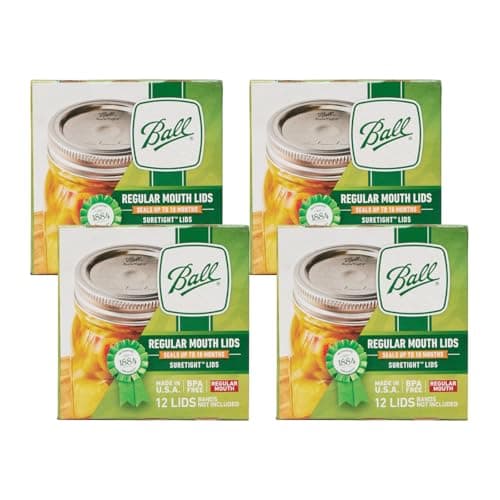
Ball Regular Mouth Canning Lids
The lid every tested recipe assumes. Single-use by design — the sealing compound is meant to compress once — and cheap enough that reusing one to save a few cents is a bad trade against losing a jar of food.
Published specs
- Size
- Regular mouth, about 70 mm
- Use
- Flat lid single-use; band reusable
- Compatibility
- Ball and Kerr regular mouth jars
What works
- The most widely stocked lid in the country, which is the thing that matters in September
- What every NCHFP and Ball tested recipe is written around, so nothing about your process needs adapting
- Bands are reusable indefinitely as long as they are not bent or rusted
What to know first
- Single use. The flat lid goes in the recycling after one seal
- Sells out first in peak season — buy your lids in July, not September
- Does not fit wide mouth jars, and there is no adapter
Specs from Ball, Mason Jars & Lids, Regular Mouth. We have not handled this product — see how we pick.
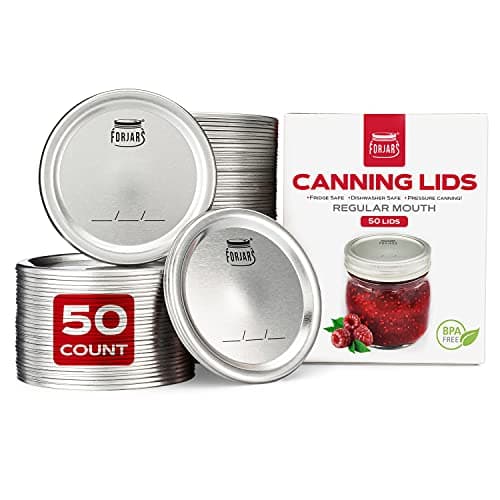
ForJars Canning Lids
A widely available alternative for the weeks when the shelf is bare. Same single-use design and same standard sizes; buy it as a hedge against the September shortage rather than as an upgrade.
Published specs
- Sizes
- Regular and wide mouth
- Use
- Single-use flat lids
- Compatibility
- Standard Ball and Kerr jar threads
What works
- Available online through the season when the big-box shelves are cleared out
- Standard sizing, so nothing about your process changes
- Usually sold in larger counts, which suits a heavy canning week
What to know first
- No published advantage over the Ball lid — the reason to buy it is availability
- Any lid brand you have not used before deserves a careful check of the seals after 24 hours
- Still a single-use consumable
Specs from NCHFP, Recommended Canners. We have not handled this product — see how we pick.
Flat lids you have already used
The lid to skip is the one already in your drawer. A flat metal lid's sealing compound is designed to compress once against a jar rim. Used again it often appears to seal, then releases weeks later on a shelf - which is the worst possible time to find out.
Published specs
- Design life
- One seal
- Reusable parts
- The jar and the screw band, indefinitely
- Cost of the mistake
- A jar of food, and the doubt about the rest of the batch
What works
- Saves a few cents per jar, which is the whole case and it does not survive contact with the cost of losing a jar
What to know first
- A false seal is invisible. The lid can be concave and firm and still fail later
- One failure casts doubt over the whole batch, because you cannot tell which other lids were reused
- Lids are the cheapest item in the entire process. This is not where the savings are
Specs from NCHFP, Recommended Canners. We have not handled this product — see how we pick.
What extension services will and will not say
Iowa State's AnswerLine is the only extension source we found that names this brand. Its round-up of jar and lid brands describes it: "USA made in Amish country Ohio. Jars and lids are safe for all types of canning. The lids offer more sealing power and are designed to prevent buckling; some users have noted that the lids are thicker and may require a slightly more tightening." In a follow-up comment, the same author wrote that "the Superb lids appear to meet all qualifications for canning safety and integrity."
Read alongside the disclaimer on the same page, which we would not want anyone to miss: "The USDA, National Center for Home Food Preservation (NCHFP), Iowa State University Extension and Outreach, or AnswerLine do not recommend for (or against) any of these products. The current recommendation is to use the tested two-piece metal lid system that has been the norm for many years and Mason jars specifically made for the rigors of canning."
As a category, Penn State is more cautious about off-brand lids than about any particular one: "Several off-brand lids are on the market. Some of these may create a vacuum seal. However, anecdotal reports from home canners tell us that many of these have higher seal failure rates." Their advice if you use one is to follow the manufacturer's directions and inspect the lid — is the sealing compound applied uniformly, is the disc symmetrical.
Superb vs Ball vs ForJars, on published facts
| Superb | Ball | ForJars | |
|---|---|---|---|
| Made in | Sugarcreek, Ohio | USA | China (per Iowa State) |
| Third-party test published | Yes — UL Solutions report on their site | None published | None published |
| Material claim | Steel core, five layers of corrosion protection | Tin-plated steel (Ball spec table) | "high-quality metal" with added stainless (per Iowa State) |
| Seal duration claim | Up to 36 months | Not published | Up to 18 months |
| Bands sold separately | Yes, 120-count | Not on Ball's own site | Yes, 100-count |
| Processing times developed with it | No | Yes — the tested system | No |
That last row is the one that should decide a nervous first-timer. Nothing here suggests Superb lids fail; the documentation is better than most. But the processing times in every tested recipe were validated with the standard two-piece system, and Ball is the version of it that every extension service assumes you are holding.
The thickness question
Iowa State's description mentions that users find these lids thicker and that they "may require a slightly more tightening." Superb's own guidance runs the other way — their blog argues for *less* torque, not more: "Let's reframe finger tight into something more helpful: finger light... Use just three fingers to tighten the ring."
If you switch brands, that is the thing to watch on your first batch. Band tension is the variable most likely to change when the lid changes, and both failure modes are real: too loose and liquid escapes, too tight and air cannot vent. What fingertip tight means, and what to do when seals fail, is in canning lids not sealing.
Who should buy them
- Buy Superb if you want a US-made lid from a company that publishes actual test data, and you are canning confidently enough to watch a new variable on the first batch.
- Buy Superb if Ball is out of stock where you are in August, which is the situation that created this brand.
- Stay with Ball if you are new to canning and want the exact system every tested recipe and every extension publication assumes.
- Either way, buy the year you will use them. NCHFP's five-year figure is for unused lids from date of manufacture, and Superb publishes no equivalent.
- Not reusable. Superb says so itself, as do the NCHFP and every extension service — see can you reuse canning lids.
The verdict
Superb is the best-documented alternative lid we have looked at: a real factory, a published lab report, an extension mention that stops just short of endorsement, and a brand that agrees with the safety literature on the points that matter. It is not the tested system — nothing except the standard Ball-style two-piece lid is — and no amount of lab work changes that for a recipe whose times were developed with that lid. Buy them as a confident canner's second source, not as a beginner's default.
Next stepThe whole lid category, comparedCommon questions
Are Superb canning lids any good?
Where are Superb lids made?
Are Superb lids approved by the USDA or NCHFP?
Can you reuse Superb lids?
Do Superb lids need to be tightened more because they are thicker?
How long do unused Superb lids last?
Are off-brand canning lids safe?
Do Superb lids come with bands?
Do you earn a commission on these?
Sources
- Superb Canning — canning lids
- Superb Canning — Canning Guide
- Superb Canning — About Superb
- UL Solutions — lab report ARHL1172745 (published by Superb)
- Iowa State University Extension — brands of canning jars and lids
- Penn State Extension — Canning Jars and Lids, An Update
- NCHFP — Recommended Jars and Lids
- NDSU Extension — Put a Lid On It!
Product specifications are taken from each manufacturer’s own published page, cited on the product. We have not handled these products — how we pick.