Buying canning jars in bulk
Jars are the one thing you buy once and own forever. Lids are the one thing you buy every year. Those two facts should drive the whole purchase.
Disclosure: we earn a commission on purchases made through links on this page, at no extra cost to you. It does not change what we recommend — see how we pick and our affiliate disclosure.
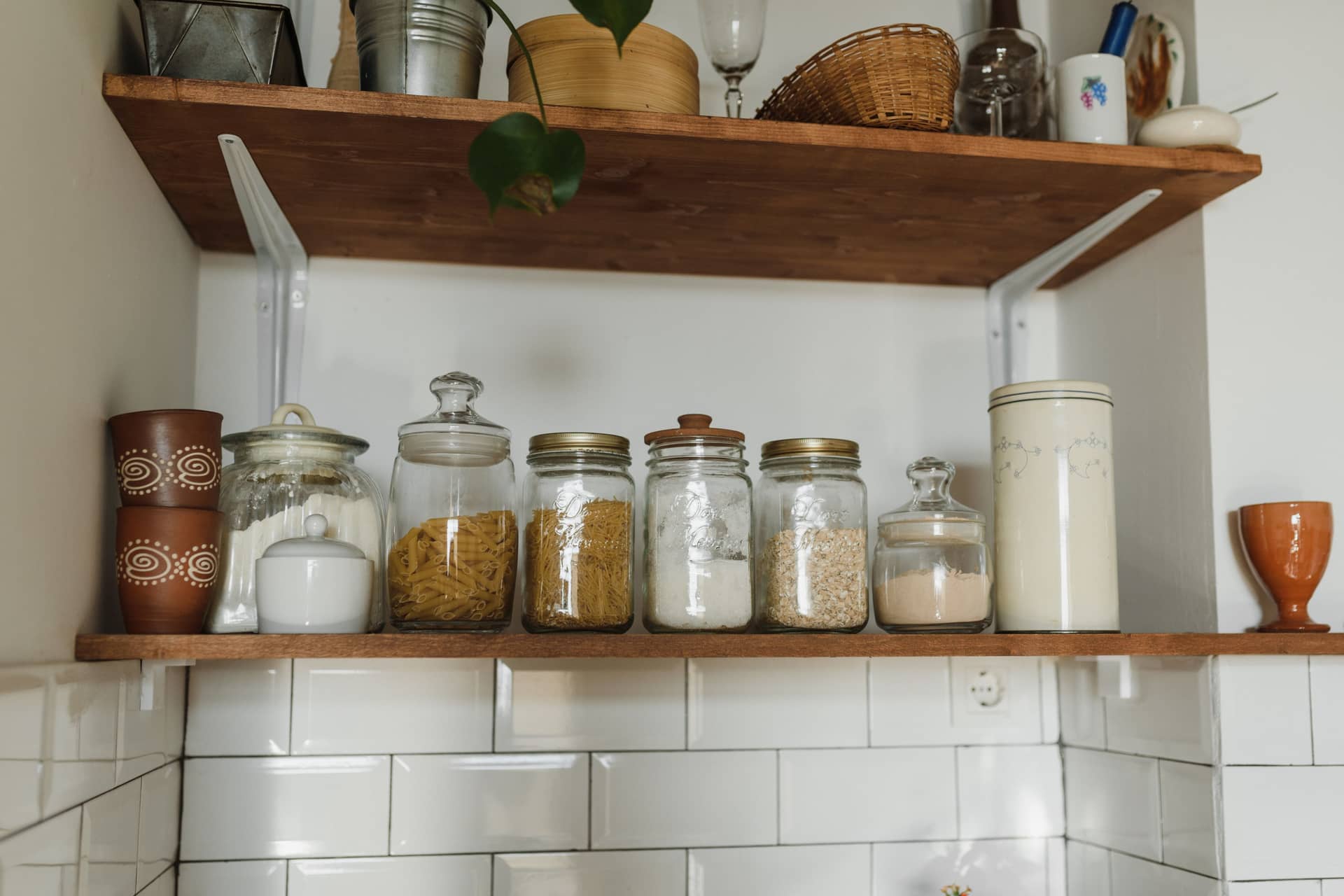
Buy jars in canner loads rather than in whatever pack is cheapest: a standard 21.5-quart canner takes 7 quarts, 9 pints or 12 half-pints, so a case of 24 pints is two full loads. Jars last decades and are not consumed; flat lids are single-use and are the item worth buying a season ahead.
This is the page where the money actually is, and it is not where most people look for it. The instinct is to hunt for the cheapest jar. The better move is to understand which parts of a canning shelf are permanent and which are consumed, because that changes what "cheap" even means.
One line in the spending splits it. Jars, bands, the canner and the tools are bought once. Flat lids are bought every single season. Almost every buying mistake in this category comes from treating those two groups the same way.
How we screened these
We have not used these products, and nothing here is ranked on feel. The screen is whether the pack size matches how canning actually works and whether the item is a permanent purchase or a consumable. The full method is on how we pick.
- Does the pack match a canner load? A canner takes 7 quarts, 9 pints or 12 half-pints. Packs that do not divide into those leave you processing a part batch.
- Is it consumed or kept? Money spent on jars comes back every season. Money spent on lids does not.
- Does buying ahead carry a risk? For jars and lids, stored dry, essentially none — which is unusual and worth exploiting.
- Is it a canning jar at all? The NCHFP names threaded Mason-type jars with two-piece self-sealing lids. Cheap glass that is not that is not a saving.
- Does the mouth size commit you? Wide-mouth lids cost more forever. A case is a long commitment to that.
Buy in canner loads, not in bargains
A standard 21.5-quart canner holds seven quart jars, nine pints or twelve half-pints. Those numbers should decide your pack sizes, because processing a half-empty canner costs the same water, the same fuel and the same twenty minutes of come-up time as a full one.
| You buy | Canner loads | Verdict |
|---|---|---|
| 12 pints | One load of 9, with 3 spare | Sensible starter quantity |
| 24 pints | Two full loads, with spares | The efficient case size |
| 12 quarts | One load of 7, with 5 spare | Fine, but 5 idle jars |
| 12 half-pints | Exactly one load of 12 | Ideal for a jam-only shelf |
| An odd lot from a sale | Whatever it happens to be | Where the saving disappears |
Quick picks
Every pick below is screened against the National Center for Home Food Preservation’s published canner rules first. Tap a row for the full write-up.
| # | Product | Best for | Key spec | Price |
|---|---|---|---|---|
| 1 |  Ball Wide Mouth Pint Jars, 16 oz (case of 24)The unit most people should actually be buying. Twenty-four wide-mouth pints is two full canner loads with spares, it is the pack size where the per-jar price starts to make sense, and jars are the one thing in canning you will still own in twenty years. | Buying a season at once | 24 jars per case | $69.99 · View on Amazon#ad we earn a commission · price as of October 18, 2026 |
| 2 |  ForJars Canning Lids, Regular Mouth (100-pack)Lids are the only true consumable in canning, they store indefinitely if kept dry, and they are the item that sells out regionally in August. Buying a season's worth in spring removes the one shortage that can stop you with produce already on the counter. | A season of lids in one box | 100 lids | $35.95 · View on Amazon#ad we earn a commission · price as of October 18, 2026 |
| 3 |  Ball Regular Mouth Pint Jars (16 oz)If you buy one case of jars this season, buy this one. Pints are the size most tested recipes are written for, regular-mouth lids are the cheapest and most available lid on any shelf, and the jars are reusable indefinitely. | The default first case | 70 mm mouth, 16 oz | $36.99 · View on Amazon#ad we earn a commission · price as of October 18, 2026 |
| 4 |  Ball Regular Mouth Canning LidsThe lid every tested recipe assumes. Single-use by design — the sealing compound is meant to compress once — and cheap enough that reusing one to save a few cents is a bad trade against losing a jar of food. | The default lid | 70 mm, single use | $22.99 · View on Amazon#ad we earn a commission · price as of October 18, 2026 |
| 5 | Reused commercial food jarsSkipSkip pasta sauce, pickle and mayonnaise jars. They are manufactured to be filled once in a factory, not heated and cooled repeatedly, and their rims are not made to the standard a two-piece canning lid seals against. | Nothing - skip these | Not made for canning | Check price on Amazon#ad we earn a commission · live price pending |
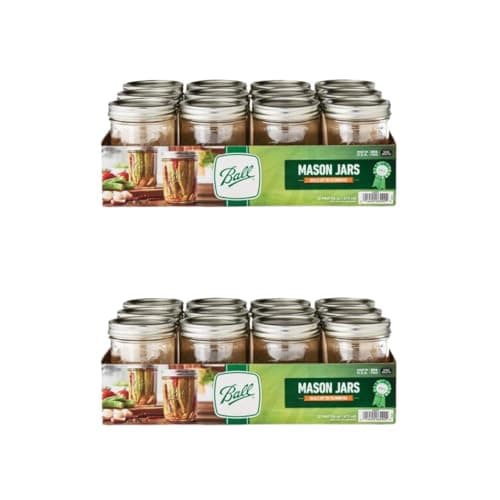
Ball Wide Mouth Pint Jars, 16 oz (case of 24)
The unit most people should actually be buying. Twenty-four wide-mouth pints is two full canner loads with spares, it is the pack size where the per-jar price starts to make sense, and jars are the one thing in canning you will still own in twenty years.
Published specs
- Volume
- 16 oz (pint)
- Mouth
- Wide, about 3 inches
- Pack
- 24 jars with lids and bands
- Canner loads
- About two full 9-pint loads, with spares
- Lids included
- Yes, one flat lid per jar — single use
What works
- Two canner loads in one purchase, so a heavy day does not stop because you ran out of glass at jar nineteen
- Wide mouth packs by hand and wipes clean, which is the difference that matters on a long session
- Per-jar cost falls meaningfully at case quantity, and unlike lids the jars are not consumed
What to know first
- Wide-mouth lids cost more than regular-mouth every single season, and a case of 24 commits you to buying them
- Twenty-four jars is a real amount of cupboard, and empty jars take the same space as full ones
- The included lids are single-use flat lids like any other — the case does not solve your lid supply past the first fill
Specs from NCHFP, Recommended Jars and Lids, Ball, Mason Jars & Lids, Regular Mouth. We have not handled this product — see how we pick.
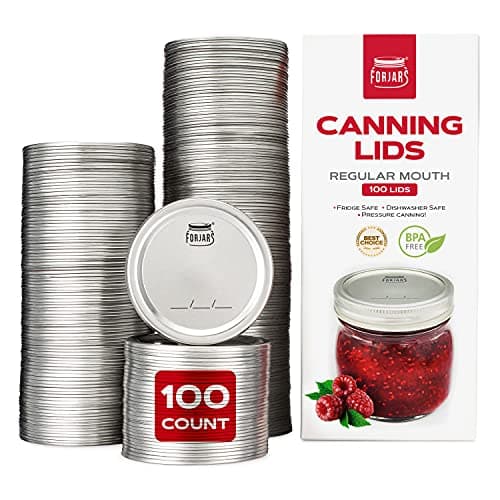
ForJars Canning Lids, Regular Mouth (100-pack)
Lids are the only true consumable in canning, they store indefinitely if kept dry, and they are the item that sells out regionally in August. Buying a season's worth in spring removes the one shortage that can stop you with produce already on the counter.
Published specs
- Pack
- 100 lids
- Mouth
- Regular
- Type
- Flat lids — single use, as all flat lids are
- Bands
- Not included in this pack
- Storage
- Indefinite if kept dry and undented
What works
- Removes the August supply problem entirely. Regular-mouth lids are the most widely stocked canning item in the country and therefore the first to sell out when a whole region cans at once
- Per-lid cost at 100 is meaningfully below a 12-count box, and there is no spoilage risk to buying ahead
- ForJars is a canning-specific brand rather than an unbranded marketplace lid, which is worth something on the one component whose job is the seal
What to know first
- No bands included, so this is a top-up for people who already own rings rather than a first purchase
- One hundred lids of one mouth size is a commitment — buy the size you actually use most, not a hedge
- A bulk box that gets stored damp is a bulk box of rusted lids. Keep it dry and flat
Specs from NCHFP, Recommended Jars and Lids. We have not handled this product — see how we pick.
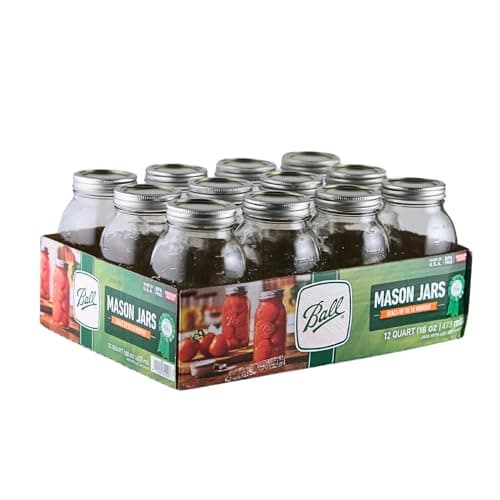
Ball Regular Mouth Pint Jars (16 oz)
If you buy one case of jars this season, buy this one. Pints are the size most tested recipes are written for, regular-mouth lids are the cheapest and most available lid on any shelf, and the jars are reusable indefinitely.
Published specs
- Volume
- 16 oz / 2 cups
- Mouth
- Regular, about 70 mm lid diameter
- Inner mouth diameter
- About 60 mm
- Jar dimensions
- About 5" tall x 2 3/4" wide
- Reuse
- Jars and rings reusable; flat lids are single-use
What works
- Pints fit both a water bath canner and a pressure canner comfortably, so the case is not stranded when you move up to beans
- Regular-mouth lids are the most stocked size in the country, which matters in September when shelves empty out
- The jars outlive everything else in this list. The consumable is the flat lid, not the glass
What to know first
- The narrower 60 mm opening is fiddly for whole peaches or large pickle spears — that is what wide mouth is for
- Regular and wide mouth lids are not interchangeable, so mixing both means stocking two lid sizes
- Glass. Handle the case like glass
Specs from Ball, Mason Jars & Lids, Regular Mouth. We have not handled this product — see how we pick.
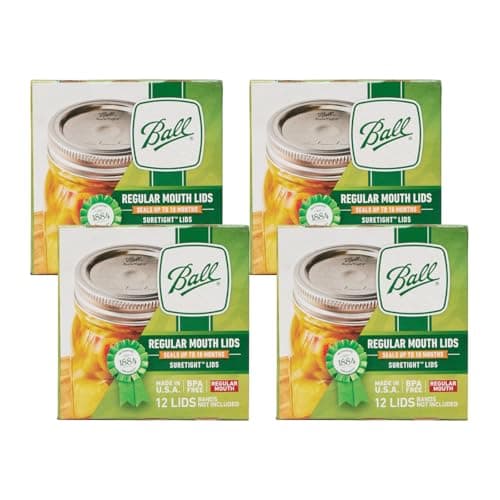
Ball Regular Mouth Canning Lids
The lid every tested recipe assumes. Single-use by design — the sealing compound is meant to compress once — and cheap enough that reusing one to save a few cents is a bad trade against losing a jar of food.
Published specs
- Size
- Regular mouth, about 70 mm
- Use
- Flat lid single-use; band reusable
- Compatibility
- Ball and Kerr regular mouth jars
What works
- The most widely stocked lid in the country, which is the thing that matters in September
- What every NCHFP and Ball tested recipe is written around, so nothing about your process needs adapting
- Bands are reusable indefinitely as long as they are not bent or rusted
What to know first
- Single use. The flat lid goes in the recycling after one seal
- Sells out first in peak season — buy your lids in July, not September
- Does not fit wide mouth jars, and there is no adapter
Specs from Ball, Mason Jars & Lids, Regular Mouth. We have not handled this product — see how we pick.
Reused commercial food jars
Skip pasta sauce, pickle and mayonnaise jars. They are manufactured to be filled once in a factory, not heated and cooled repeatedly, and their rims are not made to the standard a two-piece canning lid seals against.
Published specs
- Thread standard
- Not guaranteed to match a canning lid
- Glass
- Not specified for repeated thermal cycling
- The alternative
- Jars sold specifically for home canning
What works
- They are free, which is the entire argument for them and it is not enough
What to know first
- A lid that appears to fit may not seal reliably against a rim that was not made for it
- Repeated heating and cooling is exactly the stress these jars were not designed for
- A jar that breaks in a canner is a burn hazard as well as a lost batch
Specs from NCHFP, Recommended Canners. We have not handled this product — see how we pick.
Lids are the purchase that actually needs planning
Flat metal lids are single-use by design — the sealing compound is made to compress once against a rim. That makes them the only true consumable in canning, and it makes them the item most worth buying ahead.
The reason is supply rather than price. Regular-mouth lids are the most widely stocked canning item in the country, which also makes them the first to disappear when an entire region cans in the same three weeks. An unopened box of lids stored dry is as good next September as it is today. Buying a season's worth in spring removes the single shortage that can stop you with produce already on the counter.
What a cheap jar actually costs
Price per jar is the wrong denominator, because a canning jar is not consumed. A jar you buy this year is a jar you still own in twenty years unless you chip the rim, and a chipped rim is the only thing that really retires one. Spread across two decades of use, the gap between a cheap jar and a good one is close to nothing.
Where cheap glass does cost you is when it is not actually a canning jar. The NCHFP names regular and wide-mouth threaded Mason-type jars with self-sealing lids as the best choice, and it is specific about the alternative: commercial mayonnaise-type jars may be used with new two-piece lids for acid foods, but you should expect more seal failures and jar breakage, and they are not recommended for pressure canning because of excessive jar breakage.
That is the honest frame for bargain glass. A jar that breaks in a hot canner does not just cost you the jar — it costs you the batch around it and it is a burn risk while you fish it out.
Where bulk buying genuinely does not pay
Three cases, worth saying plainly on a page about buying more:
- A mouth size you have not committed to. Wide-mouth lids cost more every season forever. Buy a case of wide-mouth jars only once you know that is your default — the trade-off is in wide mouth vs regular mouth.
- Sizes you do not actually fill. Half-gallon jars are the classic. The NCHFP permits them for canning very acid juices only, so a case of them is a case of juice jars — see half-gallon canning jars.
- Bands, past a point. Screw bands are reusable indefinitely and most jar packs include them, so most people end up with more bands than they will ever need without buying a single one.
Storage, which is the part nobody plans for
Twenty-four empty jars take exactly as much room as twenty-four full ones, and they take it for the eleven months you are not canning. Before buying at case quantity, look at where the case will live — this is the most common reason people regret the bigger box, and it has nothing to do with money.
Lids store flat, dry and indefinitely. Discard any that are dented, rusted, or whose sealing compound looks cracked or uneven, and otherwise a box bought in April is as good in September. If Ball is sold out when you go looking, Superb is the alternative we have checked most closely. Plastic storage lids are a different purchase, and not a canning one.
Where case quantities actually come from
Jars are seasonal stock in most of the country, which shapes where you can buy them in quantity and when. Big-box and hardware chains bring canning supplies in around late spring and clear them out by late autumn, so the window for buying a case at a sensible price is roughly May to September — and the selection is best at the start of it, not the end.
Restaurant supply is the route people forget. Jars sold to food businesses come in case quantities by default, and the glass is the same glass. The catch is that cases are often sold without lids and bands, which is fine if you are stocking up on jars and buying lids separately anyway, and annoying if you expected a complete set.
Secondhand jars, and how to check them
Estate sales, thrift stores and the back of a relative's garage are where a lot of canning shelves actually come from, and free jars are genuinely free — the glass does not wear out. Two checks before you use any of them, and both take seconds.
- Run a fingertip right around the rim. A chip you cannot see you can usually feel, and a chipped rim will not seal reliably no matter what lid you put on it. This is the only thing that permanently retires a canning jar.
- Check it is a Mason-type canning jar, not a decorative or commercial jar that happens to look like one. Threaded neck, standard mouth, and a lid that sits flat on the rim.
Old bands can be reused indefinitely provided they are not bent or rusted. Old flat lids cannot be reused at all, whatever their age or apparent condition, because the sealing compound is designed to compress once.
The decision, in one paragraph
Pick one mouth size as your default, buy jars in case quantities that divide into canner loads, and buy a season of flat lids in spring rather than in August. Do not chase cheap glass that is not a Mason-type canning jar, and do not buy a case of a jar size you have not actually filled yet. The per-year cost of canning after the first season is mostly a box of lids — see what canning costs to start.
Next stepWhich jars are worth buyingCommon questions
Is it cheaper to buy canning jars in bulk?
How many canning jars should I buy to start?
Do canning lids expire?
Should I buy lids in bulk?
Can I use cheap jars from the supermarket for canning?
Do I need to buy bands separately?
Do you earn a commission on these?
Sources
Product specifications are taken from each manufacturer’s own published page, cited on the product. We have not handled these products — how we pick.