Granite Ware canner review
The cheapest legitimate way into water bath canning — with one unresolved question about the stove it sits on.
Disclosure: we earn a commission on purchases made through links on this page, at no extra cost to you. It does not change what we recommend — see how we pick and our affiliate disclosure.
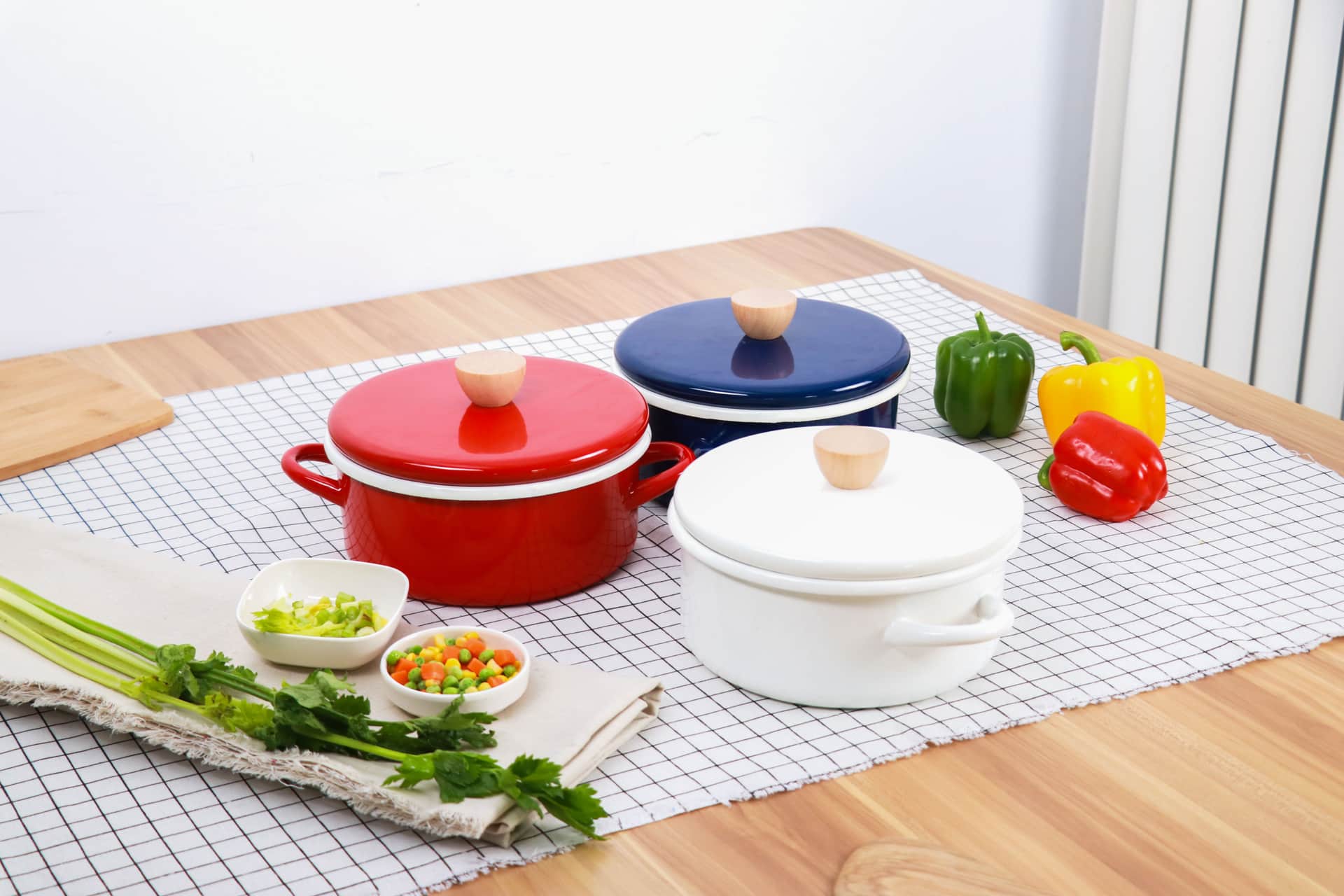
The Granite Ware 21.5-quart enamel canner holds 7 quart jars, comes with the rack the NCHFP requires, and is porcelain enamel over a carbon steel core. It is the cheapest canner worth owning — with one caveat the maker has not resolved: its own product page says "do not use on glass cooktop" while its brand site says Granite Ware can generally be used on smooth tops.
We have not run a season through this canner and will not pretend otherwise. What follows is what the manufacturer publishes, what extension services say about enamel canners on modern stoves, and where those two disagree. Our method is on how we pick.
It earns a review because it is the default. The speckled black pot is what most American canning starts in, it costs less than a case of jars, and for a gas range it is genuinely hard to argue with.
The specifications, as published
| Granite Ware 21.5 qt canner | |
|---|---|
| Capacity | 21.5 quarts (brand site); the manufacturer's own product page says 21 QT |
| Jar capacity | 7 quart jars |
| Construction | Carbon steel core bonded with porcelain enamel |
| Included (8-piece kit) | Canner, lid, jar rack and a 5-piece tool set |
| Made in | Mexico, by Cinsa |
| Warranty | 2 years on vitrified steel products |
| Smooth tops | Contested — see below |
The construction description is the useful part, because it explains both the price and the limits: "a strong, carbon steel core that provides excellent heat distribution and durability, permanently bonded with a layer of porcelain enamel," and the enamel is "inert, non-porous, and naturally non-stick." That is a thin steel pot with glass fused to it. Light, cheap, easy to clean, and chippable.
Does it meet the NCHFP's requirements for a boiling water canner?
On the things that matter, yes. The NCHFP's description of an acceptable boiling water canner names this material directly: "These canners are made of aluminum or porcelain-covered steel. They have removable perforated racks and fitted lids. The canner must be deep enough so that at least 1 inch of briskly boiling water will be over the tops of jars during processing."
- Rack: included, and required — UGA Extension notes the rack "keeps the jars from touching the bottom of the canner and allows water to circulate freely under the jars."
- Depth: adequate for quarts, which is what the 7-quart-jar rating means in practice, with the inch of water above them.
- Fitted lid: included.
- Two inches of water for long processes. The NCHFP: "For process times over 30 minutes, the water level should be at least 2 inches above the tops of the jars."
- Not a pressure canner, and Granite Ware never claims it is. Low-acid foods need a pressure canner, full stop.
Quick picks
Every pick below is screened against the National Center for Home Food Preservation’s published canner rules first. Tap a row for the full write-up.
| # | Product | Best for | Key spec | Price |
|---|---|---|---|---|
| 1 |  Granite Ware 8-Piece Water Bath Canning KitThe speckled enamel canner most American canning starts with, bundled with the rack and a five-piece tool set. Granite Ware publishes the number that matters — it holds seven quart jars — and the porcelain-on-steel construction is the cheapest legitimate route into water bath canning. The catch is the stovetop it sits on. | A first canner and tools together | 21.5 qt, 7 quart jars | $89.99 · View on Amazon#ad we earn a commission · price as of October 18, 2026 |
| 2 |  Granite Ware 21.5-Quart Water Bath Canner with RackThe canner almost everyone starts with, and there is very little wrong with that. Porcelain enamel on steel, a rack that holds a full seven-quart load, light enough to lift full, and cheap enough that it is not the thing standing between you and a first batch. | A first water bath canner | 7 quarts / 9 pints | $79.99 · View on Amazon#ad we earn a commission · price as of October 18, 2026 |
| 3 |  Prep-N-Cook by McSunley 21.5-Quart Stainless Steel Water Bath CannerA stainless water bath canner with a flat encapsulated base, which is the construction induction actually wants. If jam, pickles, fruit and acidified tomatoes are the whole plan, this does the job for less than the induction pressure canner and it is a much lighter pot to own. | Water bath only, on induction | 7 quarts / 9 pints | $74.99 · View on Amazon#ad we earn a commission · price as of October 18, 2026 |
| 4 | Shallow pots sold as canning potsSkipSkip any pot that cannot keep an inch of briskly boiling water over the tops of your jars. Plenty of pots are sold with a canning rack and a canning name while being an inch or two too short for quart jars, and that inch is the requirement, not a target. | Nothing - skip these | Too shallow for quarts | Check price on Amazon#ad we earn a commission · live price pending |
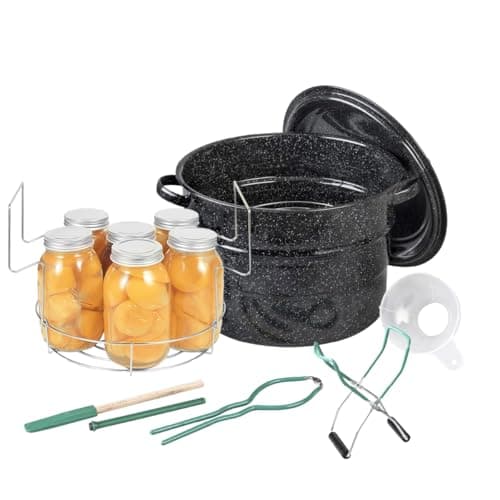
Granite Ware 8-Piece Water Bath Canning Kit
The speckled enamel canner most American canning starts with, bundled with the rack and a five-piece tool set. Granite Ware publishes the number that matters — it holds seven quart jars — and the porcelain-on-steel construction is the cheapest legitimate route into water bath canning. The catch is the stovetop it sits on.
Published specs
- Capacity
- 21.5 quarts; "Holds 7 quart jars" (Granite Ware)
- Included
- Canning pot, lid, jar rack and a 5-piece tool set (Granite Ware)
- Construction
- "a strong, carbon steel core... permanently bonded with a layer of porcelain enamel" (Granite Ware)
- Made in
- Mexico, by Cinsa (Granite Ware product listing)
- Warranty
- 2 years on vitrified steel products (Cinsa)
- Smooth tops
- Contested — see the review; the maker's own pages disagree with each other
What works
- Holds a full canner load of seven quart jars, and arrives with the rack that NCHFP requires and the tools a first-timer would otherwise buy separately
- Porcelain enamel over carbon steel is inert, cleans easily, and costs a fraction of stainless
- Light enough to lift full, which stainless canners of the same capacity often are not
What to know first
- The smooth-top question is genuinely unresolved: the manufacturer's own 21-quart product page says "do not use on glass cooktop" while its brand site says Granite Ware "can generally be used on glass or ceramic smooth-top cooktops"
- Clemson Extension is blunter: "Graniteware canners are ridged on the bottom and thus are not suitable for use on smooth top ranges"
- Enamel chips if you knock it, and the maker publishes no guidance on what to do when it does
Specs from Granite Ware, Canning, Clemson Cooperative Extension, Canning on Smooth Top Ranges. We have not handled this product — see how we pick.
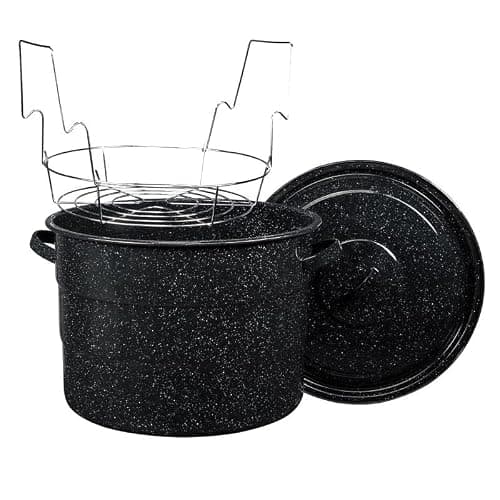
Granite Ware 21.5-Quart Water Bath Canner with Rack
The canner almost everyone starts with, and there is very little wrong with that. Porcelain enamel on steel, a rack that holds a full seven-quart load, light enough to lift full, and cheap enough that it is not the thing standing between you and a first batch.
Published specs
- Capacity
- 21.5 quarts
- Rack capacity
- 7 quart jars, 9 pints, or 12 half-pints
- Material
- Porcelain enamel on steel
- Dimensions
- Height 9.75", depth 16.25", width 14.25"
- Weight
- About 4 lb empty
- Included
- Pot, lid and jar rack
- Base diameter
- Not published by Granite Ware
What works
- Light. Four pounds empty means you can move it full of hot water without a second person
- The enamel surface is non-reactive, so tomatoes and vinegar brines do not pick up a metallic edge
- Deep enough to cover quart jars with the 1 inch of briskly boiling water the NCHFP requires, which a stockpot often is not
What to know first
- Enamel chips if you knock it, and a chipped rim will rust. It is cookware to be careful with, not to stack things on
- The base diameter is not published, so on an electric range you have to measure it against your element yourself
- Thin steel heats fast and loses heat fast — expect to ride the burner a little to hold a steady boil
Specs from NCHFP, Recommended Canners. We have not handled this product — see how we pick.
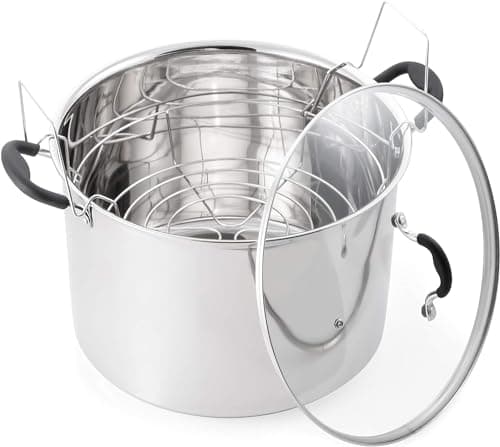
Prep-N-Cook by McSunley 21.5-Quart Stainless Steel Water Bath Canner
A stainless water bath canner with a flat encapsulated base, which is the construction induction actually wants. If jam, pickles, fruit and acidified tomatoes are the whole plan, this does the job for less than the induction pressure canner and it is a much lighter pot to own.
Published specs
- Capacity
- 21.5 quarts
- Rack capacity
- 7 quart, 9 pint or 12 half-pint jars
- Material
- Heavy-duty stainless steel
- Base
- Flat, encapsulated base
- Cooktops
- All cooktops, including induction and glass top
- Dimensions
- 14" x 18" x 11.75" (pot height 9.5")
- Weight
- 8.9 pounds
- Included
- Pot, lid and easy-lift jar rack
- Base diameter
- Not published by McSunley
What works
- The manufacturer states it works on all cooktops including induction, which is a sentence almost no water bath canner comes with
- An encapsulated base is thick where thin enamelware is not, which is what a cooktop's pan detection is looking for and what stops hot spots forming under the rack
- A 9.5-inch pot height clears a quart jar with the inch of briskly boiling water the NCHFP requires, so it is a real canner rather than a tall stockpot
What to know first
- 8.9 pounds empty against about 4 pounds for an enamel canner. Loaded with water and seven quart jars that is a genuinely heavy lift, and it is sitting on a glass surface
- Water bath only. Green beans, corn, meat and plain vegetables still need a pressure canner, and this pot will never do them
- No published base diameter, so you still have to measure it against your cooktop's ring marking yourself
Specs from McSunley, Prep-N-Cook Stainless Steel Water Bath Canner, NCHFP, Recommended Canners. We have not handled this product — see how we pick.
Shallow pots sold as canning pots
Skip any pot that cannot keep an inch of briskly boiling water over the tops of your jars. Plenty of pots are sold with a canning rack and a canning name while being an inch or two too short for quart jars, and that inch is the requirement, not a target.
Published specs
- NCHFP requirement
- "The canner must be deep enough so that at least 1 inch of briskly boiling water will be over the tops of jars during processing"
- The test
- Jar height + 1 inch of water + room for a rolling boil
- Common shortfall
- Quart jars, which are about 6 1/2 to 6 3/4 inches tall
What works
- There is no upside. This entry is here so you can recognize the problem before it is in your kitchen
What to know first
- Water that stops covering the jars mid-boil means the tops of the jars are processing in air, not water, and the tested time no longer applies
- The shortfall is invisible in a product photo and only shows up when the jars are already in
- Cheap pots in this category often have no rack at all, and a jar sitting on a hot base can crack
Specs from NCHFP, Recommended Canners. We have not handled this product — see how we pick.
The smooth-top contradiction
Here is the problem, and it is worth laying out in full because the buyer has to make a call the manufacturer has not made for them.
| Source | Says |
|---|---|
| Cinsa product page for the 21 QT canner (care instructions) | "do not use on glass cooktop" |
| Granite Ware brand site FAQ | "Granite Ware can generally be used on glass or ceramic smooth-top cooktops" — and calls the carbon steel core induction-compatible |
| Granite Ware brand site, other products | "Not for glass cooktops" / "Avoid glass cooktops" on the roaster and stock pot |
| Clemson Extension | "Graniteware canners are ridged on the bottom and thus are not suitable for use on smooth top ranges" |
| Penn State Extension | "Many canners do not have flat enough bottoms to be in complete contact with the burner on a smooth cooktop... Graniteware canners with ridged bottoms are an example" |
The resolution, as best we can offer one: look at the bottom of the specific pot you are buying. The extension objection is to *ridged* bottoms, which cannot make full contact with a smooth element. Granite Ware's current line includes flat-bottomed pots, and its heavy gauge range is marketed as induction compatible — but the canner page's own care text still says not to use it on glass.
If your range is smooth-top, that ambiguity is reason enough to buy a canner whose maker says yes without qualification. The NCHFP's other smooth-top rules apply regardless: the canner should be no more than 4 inches wider than the element, and you should check the range manufacturer's advice on canning before you start. Our element-size calculator does the first part.
What it is like to live with
Porcelain enamel's virtues are real: it heats reasonably evenly for a thin pot, it is inert, and it wipes clean. Its failure mode is equally real — chip it and the steel underneath is exposed. Granite Ware's own care advice is to "avoid hitting it against hard surfaces, and let it cool completely before cleaning," and to avoid overheating it empty.
Worth flagging honestly: the maker publishes no guidance on what to do when the enamel chips, and no rust advice. That is a gap. A chipped canner still boils water; a chipped area will eventually rust, and the usual verdict is to retire it once rust flakes appear where food or jars touch.
One thing that has changed and is worth knowing: Granite Ware is no longer an American product. The brand's current pages list it as made in Mexico by Cinsa, with a two-year warranty on vitrified steel. The 150-year heritage in the marketing is real; the manufacturing address is not what it was.
Who should buy something else
- Smooth-top or induction owners, for the reasons above — buy a canner whose maker states smooth-top suitability plainly, such as the stainless McSunley in our picks.
- Anyone who wants one pot for both jobs. A stovetop pressure canner doubles as a water bath canner; an enamel canner never becomes a pressure canner. That comparison is in what you need for pressure canning.
- Anyone canning only half-pints in small batches, who may be better served by a smaller canner or a deep stockpot with a rack — see canning without a canner.
- Anyone who hates chips. Stainless costs several times more and shrugs off the knocks that mark enamel; the trade-offs are in stainless vs enamel canner.
The verdict
On a gas range, the Granite Ware canner is close to unbeatable value: it meets every NCHFP requirement for a boiling water canner, holds a full seven-quart load, arrives with the rack and tools, and costs less than the jars that go in it. On a smooth top it is a coin toss the manufacturer has left unresolved and two extension services have called against. Buy it for gas or coil without hesitation; buy stainless for glass.
Next stepEnamel against stainless, in detailCommon questions
How many jars does a Granite Ware canner hold?
Can you use a Granite Ware canner on a glass top stove?
Is a Granite Ware canner a pressure canner?
Does it come with a rack?
Where is Granite Ware made?
What happens if the enamel chips?
How much water goes in it?
Is it big enough for quart jars?
Do you earn a commission on these?
Sources
- Granite Ware — Canning
- Granite Ware (Cinsa) — Enameled Steel Canner 21 Qt
- NCHFP — How to Use Boiling Water and Pressure Canners
- NCHFP — Using Boiling Water Canners
- UGA Extension — Using Boiling Water Canners (C1344-01)
- Clemson Cooperative Extension — Canning on Smooth Top Ranges
- Penn State Extension — Canning on Smooth Cooktops
Product specifications are taken from each manufacturer’s own published page, cited on the product. We have not handled these products — how we pick.