Can you can in the oven?
No. Dry air is the wrong heat, the jars are not rated for it, and a lid that pops down afterwards is not evidence of anything.
Disclosure: we earn a commission on purchases made through links on this page, at no extra cost to you. It does not change what we recommend — see how we pick and our affiliate disclosure.
No. The NCHFP's position is one sentence: "Open-kettle canning and the processing of freshly filled jars in conventional ovens, microwave ovens, and dishwashers are not recommended, because these practices do not prevent all risks of spoilage." Dry air transfers heat far worse than boiling water, the jar makers do not endorse baking in their jars, and a lid that seals as the jar cools is not evidence the food was preserved. Use a boiling-water canner for high-acid food and a pressure canner for low-acid food.
Oven canning keeps circulating because it sounds plausible and because it appears to work. You fill jars, you put them in a 250°F oven for an hour, you take them out, and over the next twenty minutes the lids ping down one after another. Every visible signal says success.
The signals are not measuring what you think they are measuring. This page is about what the oven actually does to a jar of food, what the seal does and does not prove, and what the tested alternative costs.
What the guidance says, in full
The NCHFP addresses this in two places and the wording is not hedged. On its list of equipment and methods it does not recommend: "the processing of freshly filled jars in conventional ovens, microwave ovens, and dishwashers are not recommended," because "these practices do not prevent all risks of spoilage."
Its canning FAQ is more specific and covers the three questions people actually arrive with:
- On the jars: "Manufacturers of canning jars do not recommend baking or oven canning in the jars," and "It is very risky with regard to causing jar breakage."
- On sterilizing: "There is no guarantee that the jars heated in this dry manner are sufficiently heated to sterilize them, as we do not have data on sterilizing jar surfaces by this dry-heating method."
- On spores: of the dry-oven procedures circulating, "these procedures will not destroy those spores for safe room temperature storage."
- On the research: "There is not sufficient, research-based documentation to support that 'canning' any food in a dry oven" is safe.
Ball says its own part in six words, on its use and care page: "Jars should not be used in the microwave or oven." That is the manufacturer of most of the jars in American kitchens declining to endorse the practice in its own product instructions.
Why dry heat is the wrong heat
This is the part worth understanding, because it generalises to every shortcut in home canning. The NCHFP states the principle in a blog post about a related practice: "It is well known that bacteria and bacterial spores are more sensitive to wet heat than dry heat." Spores die far more slowly in hot dry air than in hot water at the same temperature.
Then there is heat transfer. Water in contact with glass moves heat into a jar efficiently and evenly; 250°F air does not. The same NCHFP post, about dry canning raw vegetables, makes the mechanical point: "the liquid covering pieces of vegetables in the jars is required for the expected heat penetration." A tested process is a measurement of how long heat took to reach the coldest point in a specific jar. Change the medium and the measurement does not transfer.
And an oven thermostat is not a process control. It cycles around a set point, the air temperature at the top of the oven differs from the bottom, and the number on the dial tells you nothing about the temperature in the middle of the jar. A pressure canner's weight, by contrast, is a physical constant: 10 psi is 10 psi.
The low-acid version is the dangerous one
If someone oven-cans jam, the acidity is doing the preserving and the oven is mostly a waste of electricity and a breakage risk. If someone oven-cans beans, corn, carrots or meat, the failure mode is botulism, and the NCHFP describes the problem with it exactly: "Botulism toxin can be present in canned vegetables without any visual changes to the food or odors."
Boiling water tops out at 212°F. Destroying botulism spores needs about 240°F, which only a pressure canner reaches. An oven set to 250°F does not solve this, because the number that matters is the temperature inside the food for a measured time, not the temperature of the air around the glass. The whole argument is in botulism and home canning and the food list is in what foods need pressure canning.
The related practice of "dry canning" raw vegetables - jars filled with no liquid, then pressure canned for the normal time - fails for the same reason and NCHFP has a dedicated post ruling it out. It is worth knowing that one too, because it is often recommended in the same breath as oven canning.
The three things people are usually actually trying to do
| What you want | Does the oven do it? | What does |
|---|---|---|
| Preserve food for the pantry | No tested process exists | A boiling-water canner, or a pressure canner for low-acid food |
| Sterilize empty jars | No data on dry sterilizing | 10 minutes in boiling water, for processes under 10 minutes |
| Store dry goods - flour, nuts, beans | Not a science-based method | Airtight storage lids, or vacuum sealing, in a cool dark place |
| Bake something in a jar as a gift | Jar makers do not endorse it | Bake in a tin; gift in a jar afterwards |
On the dry-goods one: NCHFP also says heating dry foods in jars in an oven to store them is not a science-based method. If the goal is shelf-stable flour or nuts, the honest answer is an airtight lid in a cool dark place, and the vacuum question is covered in mason jar vacuum sealers.
On sterilizing: jars are sterilized in boiling water, and only need to be when the recipe's process time is under 10 minutes. The method is in how to sterilize canning jars.
Where this advice comes from, and why it keeps coming back
Old cookbooks. Oven canning sits in the same family as open-kettle canning, paraffin wax over jam and inverting jars to force a seal - practices that were printed in good faith decades ago and have since been tested and dropped. A vintage canning book is a lovely object and a poor instruction manual, which is why the best canning books is about editions rather than titles.
The four-question test for judging any recipe you find is in how to find safe canning recipes. Oven canning fails the first question, which is whether the source publishes a process developed from heat-penetration data.
The gear that replaces it
What to buy instead
The substitute for oven canning is not expensive. A water bath setup handles jam, pickles, fruit and acidified tomatoes - which is most of a first harvest - and costs less than a weekend.
- Water bath cannersFor anything high-acid. A deep pot with a rack, and no processing ceiling.
- Pressure cannersThe only tested route for beans, corn, carrots, meat and plain vegetables.
- Canning without a cannerIf a pot you already own is deep enough, you may not need to buy anything.
- A current recipe sourceThe part the oven method was never going to give you: a tested time.
Quick picks
Every pick below is screened against the National Center for Home Food Preservation’s published canner rules first. Tap a row for the full write-up.
| # | Product | Best for | Key spec | Price |
|---|---|---|---|---|
| 1 |  Granite Ware 21.5-Quart Water Bath Canner with RackThe canner almost everyone starts with, and there is very little wrong with that. Porcelain enamel on steel, a rack that holds a full seven-quart load, light enough to lift full, and cheap enough that it is not the thing standing between you and a first batch. | A first water bath canner | 7 quarts / 9 pints | $79.99 · View on Amazon#ad we earn a commission · price as of October 18, 2026 |
| 2 |  Presto 23-Quart Pressure Canner and Cooker (01781)The default first pressure canner, and the one most beginners should buy: it takes a full seven-quart load, it doubles as a boiling-water canner for pints and half-pints, and it costs a fraction of a cast-aluminum canner. The dial gauge is the catch, and it is a real one. | A first pressure canner | 7 quarts / 20 pints | |
| 3 |  Ball Blue Book Guide to PreservingThe cheap, thin one that has been in kitchens for a century, and the one to buy first. Every recipe in it is tested, which is the only property that matters — a canning recipe is a validated process, not a suggestion. | The first book to own | Tested recipes, cheap | $29.99 · View on Amazon#ad we earn a commission · price as of October 18, 2026 |
| 4 | Oven canning, and baking in a Mason jarSkipThere is no version of this that works. NCHFP rules out processing filled jars in a conventional oven, the jar makers rule out baking in their jars, and a lid that pops down afterwards is not evidence the food was preserved. Buy the pot the tested process was written for. | Nothing - no tested process exists | Not a canning method | Check price on Amazon#ad we earn a commission · live price pending |
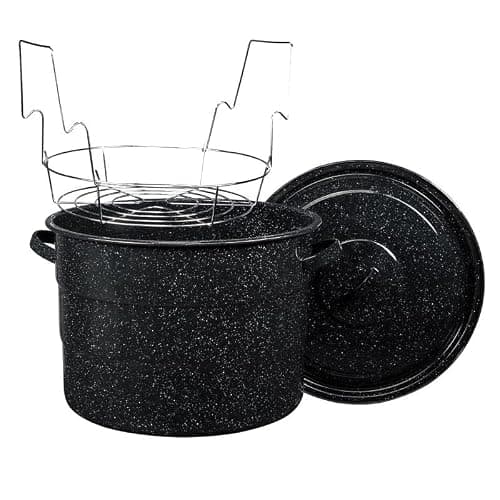
Granite Ware 21.5-Quart Water Bath Canner with Rack
The canner almost everyone starts with, and there is very little wrong with that. Porcelain enamel on steel, a rack that holds a full seven-quart load, light enough to lift full, and cheap enough that it is not the thing standing between you and a first batch.
Published specs
- Capacity
- 21.5 quarts
- Rack capacity
- 7 quart jars, 9 pints, or 12 half-pints
- Material
- Porcelain enamel on steel
- Dimensions
- Height 9.75", depth 16.25", width 14.25"
- Weight
- About 4 lb empty
- Included
- Pot, lid and jar rack
- Base diameter
- Not published by Granite Ware
What works
- Light. Four pounds empty means you can move it full of hot water without a second person
- The enamel surface is non-reactive, so tomatoes and vinegar brines do not pick up a metallic edge
- Deep enough to cover quart jars with the 1 inch of briskly boiling water the NCHFP requires, which a stockpot often is not
What to know first
- Enamel chips if you knock it, and a chipped rim will rust. It is cookware to be careful with, not to stack things on
- The base diameter is not published, so on an electric range you have to measure it against your element yourself
- Thin steel heats fast and loses heat fast — expect to ride the burner a little to hold a steady boil
Specs from NCHFP, Recommended Canners. We have not handled this product — see how we pick.
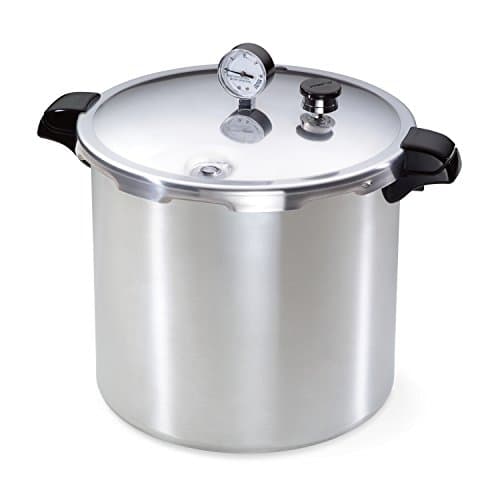
Presto 23-Quart Pressure Canner and Cooker (01781)
The default first pressure canner, and the one most beginners should buy: it takes a full seven-quart load, it doubles as a boiling-water canner for pints and half-pints, and it costs a fraction of a cast-aluminum canner. The dial gauge is the catch, and it is a real one.
Published specs
- Liquid capacity
- 23 quarts (21.8 liters)
- Jar capacity
- 26 half-pints, 20 pints, 7 quarts
- Material
- Warp-resistant aluminum
- Gauge
- Dial gauge
- Ranges
- Regular and smooth-top
- Burner limit
- 12,000 BTUs or less
- Also
- Doubles as a boiling-water canner
- Warranty
- 12-year limited
- Base diameter
- Not published by Presto
What works
- Seven quart jars is the standard batch size every tested NCHFP recipe is written around, so you are never processing a half load
- Doubles as a boiling-water canner for pints and half-pints, which means one pot covers the jam-and-pickles year as well as the beans
- Presto sells a replacement dial gauge and sealing ring separately, so a decade-old canner is a repair rather than a replacement
What to know first
- A dial gauge should be checked for accuracy every year — most extension offices do it free, and most owners never go. A weighted gauge needs no calibration at all
- Presto does not publish a base diameter, so you cannot check it against the NCHFP element rule without measuring the box yourself. See will it fit your stove
- Rated for burners of 12,000 BTUs or less, which rules out most outdoor propane burners and some high-output gas ranges
Specs from Presto, 23-Quart Pressure Canner and Cooker (01781). We have not handled this product — see how we pick.
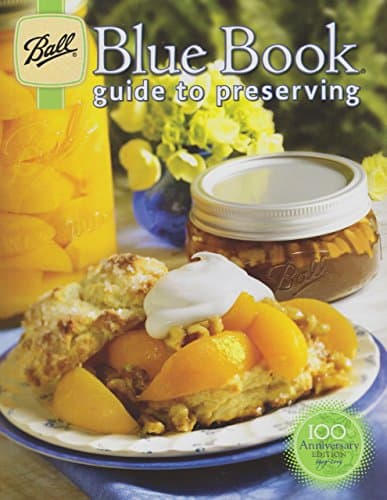
Ball Blue Book Guide to Preserving
The cheap, thin one that has been in kitchens for a century, and the one to buy first. Every recipe in it is tested, which is the only property that matters — a canning recipe is a validated process, not a suggestion.
Published specs
- Publisher
- Ball / Newell Brands
- Content
- Tested water bath and pressure canning recipes
- Why it matters
- A tested source you can hold while your hands are wet
What works
- Tested recipes, which is the entire point of buying a canning book rather than reading a blog
- Cheap enough to buy alongside your first case of jars without thinking about it
- Compact and spill-tolerant in a way a laptop on a counter is not
What to know first
- Recipe range is narrower than the bigger books — this is a foundation, not a library
- Editions change; a very old copy may predate current guidance and should be cross-checked against the NCHFP
- Not a technique manual. It tells you what to do, less about why
Specs from NCHFP, Recommended Canners. We have not handled this product — see how we pick.
Oven canning, and baking in a Mason jar
There is no version of this that works. NCHFP rules out processing filled jars in a conventional oven, the jar makers rule out baking in their jars, and a lid that pops down afterwards is not evidence the food was preserved. Buy the pot the tested process was written for.
Published specs
- NCHFP, on ovens
- "the processing of freshly filled jars in conventional ovens, microwave ovens, and dishwashers are not recommended"
- NCHFP, on why
- These practices "do not prevent all risks of spoilage"
- NCHFP, on jar makers
- "Manufacturers of canning jars do not recommend baking or oven canning in the jars"
- NCHFP, on breakage
- "It is very risky with regard to causing jar breakage"
- NCHFP, on dry heat
- "It is well known that bacteria and bacterial spores are more sensitive to wet heat than dry heat"
- Ball
- "Jars should not be used in the microwave or oven"
- Buy instead
- A boiling-water canner for high-acid food, a pressure canner for low-acid food
What works
- Nothing. The only thing to say for it is that it is cheap, and the saving is the price of a canner against the cost of a batch you cannot trust
What to know first
- Dry air transfers heat far worse than boiling water, so the jar's contents never reach the temperature the process assumed
- NCHFP says there is no evidence dry oven heat sterilizes jar surfaces, and no research-based documentation supporting canning any food in a dry oven
- The jars themselves are not rated for it, so breakage - in a hot oven, with hot contents - is a live risk and not a theoretical one
- A sealed lid proves a vacuum formed as the jar cooled. It proves nothing about whether spores were destroyed
Specs from NCHFP, Equipment and Methods Not Recommended, NCHFP, Canning FAQs, Ball, Use & Care - Canning. We have not handled this product — see how we pick.
The answer, in one paragraph
No tested process for canning food in a dry oven exists, the NCHFP says so in its own words, and the jar makers decline to endorse baking in their jars. The seal you get afterwards is a mechanical event during cooling and not a measurement of safety. For high-acid food buy a water bath canner - or check whether the stockpot in your cupboard is deep enough. For low-acid food, a pressure canner is the only tested route, and no oven temperature substitutes for it.
Next stepHow to judge the next recipe you findCommon questions
Is oven canning safe?
But my lids sealed - doesn't that mean it worked?
Why is dry heat worse than boiling water?
Can I sterilize jars in the oven?
Can I oven can dry goods like flour or beans?
Will the jars break in the oven?
What about canning butter or meat in the oven?
What is dry canning?
Sources
- NCHFP — Equipment and Methods Not Recommended
- NCHFP — Canning FAQs (oven canning, baking in jars, sterilizing)
- NCHFP — Dry Canning Raw Vegetables is an Unsafe Practice
- NCHFP — Recommended Canners
- Ball — Use & Care (canning jars, lids and bands)
Product specifications are taken from each manufacturer’s own published page, cited on the product. We have not handled these products — how we pick.