Mason jar vacuum sealers
Excellent for dry goods and the refrigerator. Not a canner, not a shortcut, and actively risky if you treat it as one.
Disclosure: we earn a commission on purchases made through links on this page, at no extra cost to you. It does not change what we recommend — see how we pick and our affiliate disclosure.
A jar sealer pulls the air out of a mason jar through a vacuum machine. It is genuinely good for dry goods, refrigerated leftovers and freezer storage — and it is not canning. The University of Minnesota Extension: mason jar vacuum sealers "cannot be used to preserve foods that would otherwise be canned and processed using a heat treatment." No heat, no shelf stability.
This is a genuinely useful gadget sold next to a genuinely dangerous idea. The gadget: a plastic dome that sits over a mason jar lid and lets a vacuum sealer suck the air out, leaving your rice, coffee or dried apples in an airless glass jar. The idea: that an airless jar is a preserved jar. It is not, and the gap between those two sentences is where people get hurt.
So this page does two jobs. It tells you what to buy for the real uses, and it is specific about the line you cannot cross with it.
Vacuum sealing is not canning
The clearest statement comes from the University of Minnesota Extension, which addresses jar sealers directly: "It is important to understand that vacuum sealing the jar does not result in the same shelf-stable canned food that canning and processing provide. When using a vacuum sealer device on a jar, no heat treatment occurs. The heat processing step in canning is important for destroying pathogens and creating an air-tight (hermetic) seal."
They add a second point that catches people out: "This seal may not be air-tight because the plastisol band on the lid is not heated." The compound on a canning lid is designed to soften with heat and set as the jar cools. A cold vacuum pulls the lid down without ever engaging that mechanism.
And the reassurance people reach for — the lid pulled down, so it sealed — is not evidence of anything. The NCHFP: "A sealed jar is not a sign of food being processed safely!" and "The heat required to form a vacuum seal with today's canning lids is much less than the heat needed to sterilize most foods."
What it is genuinely good for
All of which would be a reason to skip the gadget entirely, except that the legitimate uses are real and the NCHFP itself points at them. In its discussion of dry storage, it lists among the methods that "will preserve them safely and provide better food quality": "A vacuum sealing machine that has adapters for jars in addition to sealing bags if you want your food in jars. This vacuum packaging is done at room temperature without heating the food."
- Dried foods. The NCHFP's packaging guidance for dried foods says to store them in clean, dry home canning jars or freezer containers, and adds: "Vacuum packaging is also a good option."
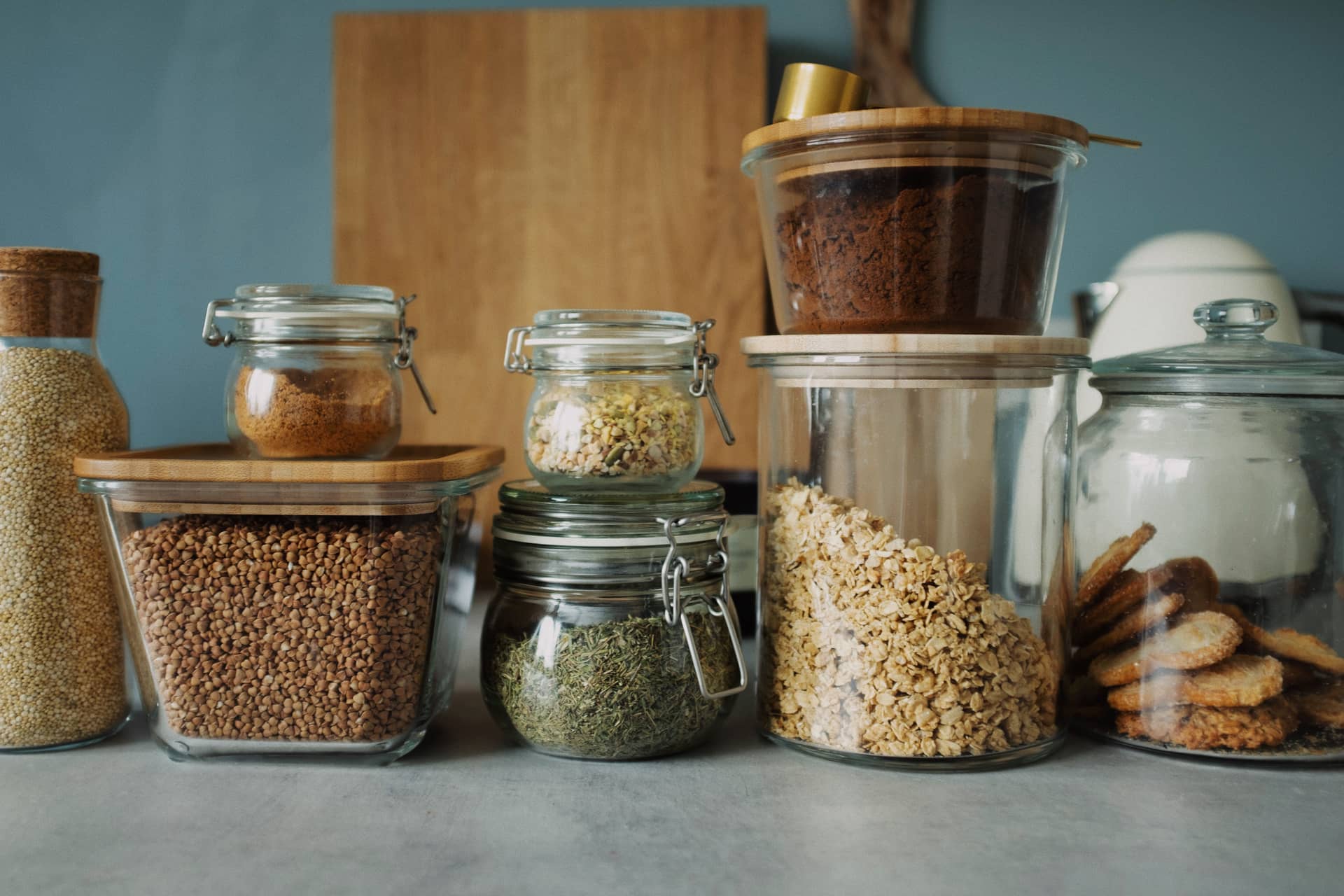
- Dry pantry staples. Missouri Extension lists the category: "dehydrated herbs, spices, grains, legumes, nuts, seeds and dried fruits and vegetables."
- Rancidity, not bacteria. Removing oxygen slows the oxidation that turns nuts and whole grains rancid. That is a quality benefit, and it is the honest one.
- Refrigerated and frozen food. UMN: it can store foods that require refrigeration — "once sealed, these foods must be kept in the refrigerator or freezer until use."
- Opened jars of anything. Coffee, brown sugar, an opened jar of your own pickles. This is the use that earns the attachment its shelf space.
One claim we will not make: that vacuum sealing deals with insect eggs in flour or grain. We could not find a Tier 1 source supporting it. What extension services do document is freezing — Utah State suggests freezing bags of rice for 3 days to kill any insects or larvae present — and oxygen absorbers, which the NCHFP says "can help preserve the quality of foods and also aid in insect control."
How we screened these
We have not run vacuum-decay tests on jar sealers. What we checked is what each maker publishes about fit and use, whether the product is honest about not being for canning, and what else you need to own before the thing works at all. The method is on how we pick.
- Fits standard mason jars, in the mouth size you actually own.
- Explicit about canning. FoodSaver's own product pages historically carried the line "Not to be used for canning." That is the honesty we want in this category.
- Works with a machine you can buy today, because a jar sealer is an attachment and not an appliance.
- Both mouth sizes, since most households have a mix.
- No heat claims. Anything marketing itself as a way to "can" without a canner is disqualified on sight.
Quick picks
Every pick below is screened against the National Center for Home Food Preservation’s published canner rules first. Tap a row for the full write-up.
| # | Product | Best for | Key spec | Price |
|---|---|---|---|---|
| 1 |  FoodSaver Jar Sealer with Accessory HoseThe cheapest way into vacuum-sealed jars if you already own a FoodSaver machine: a plastic dome that sits over a mason jar lid and pulls the air out through a hose. FoodSaver's own historical product pages named the use case and the limit in the same breath — great for dry goods and fragile foods, and "Not to be used for canning." | Dry goods in jars you already own | Regular and wide mouth, hose included | $19.99 · View on Amazon#ad we earn a commission · price as of October 18, 2026 |
| 2 |  FoodSaver Compact Vacuum Sealer MachineThe engine of the whole arrangement. A jar sealer is an attachment, and it needs a machine with an accessory port to pull against; this is FoodSaver's compact one, which also does the bag sealing that is most of what a vacuum sealer earns its counter space for. | The machine that drives the jar sealer | Bags plus accessory port | |
| 3 |  FORJARS Jar Vacuum Sealer Accessory SetThe same idea from the canning-lid brand: domes for both mouth sizes with a hose, compatible with FoodSaver machines. Buy it if you want both sizes and a spare hose for less than the branded set costs, and hold it to exactly the same limits. | A cheaper sealer set | Both mouths, FoodSaver compatible | $24.95 · View on Amazon#ad we earn a commission · price as of October 18, 2026 |
| 4 | Vacuum sealing as a substitute for canningSkipThe reason this page needs a warning section. Vacuum sealing removes air; it applies no heat, kills nothing, and cannot make food shelf stable. The University of Minnesota Extension states it directly: mason jar vacuum sealers "cannot be used to preserve foods that would otherwise be canned and processed using a heat treatment." | Nothing - process the jars | No heat process, no shelf stability | Check price on Amazon#ad we earn a commission · live price pending |
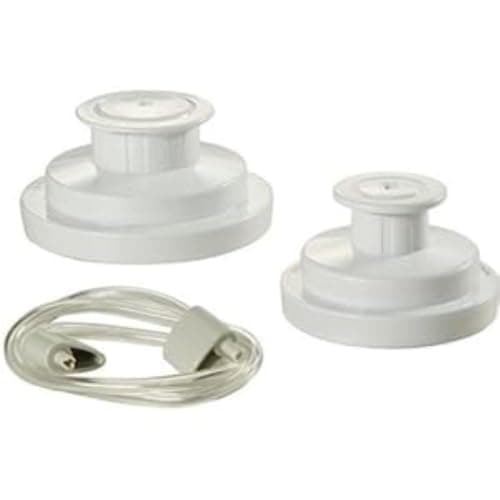
FoodSaver Jar Sealer with Accessory Hose
The cheapest way into vacuum-sealed jars if you already own a FoodSaver machine: a plastic dome that sits over a mason jar lid and pulls the air out through a hose. FoodSaver's own historical product pages named the use case and the limit in the same breath — great for dry goods and fragile foods, and "Not to be used for canning."
Published specs
- Fits
- Regular and wide mouth mason-type jars
- Needs
- A FoodSaver vacuum sealer with an accessory port; the hose is included
- Good for
- Dry goods, ground coffee, nuts, flour, brown sugar, and opened jars in the refrigerator
- FoodSaver (archived product page)
- "FoodSaver Jar Sealers replace standard Mason-type jar lids to create a vacuum seal that locks out air... Not to be used for canning."
What works
- Uses the mason jars and flat lids you already have, so the ongoing cost is close to zero
- Handles the two things bags do badly: fragile dry foods that crush, and anything you open and reseal repeatedly
- Both mouth sizes and the hose in one purchase, which is not true of every jar-sealer listing
What to know first
- Useless on its own. It needs a FoodSaver machine with an accessory port, which is the real expense
- Not canning, and not a substitute for it — a vacuum seal on an unheated jar does not make food shelf stable
- Plastic dome over a flat lid is a slightly fussy assembly compared with a purpose-built electric jar sealer
Specs from FoodSaver, Jar Sealer product page (archived 2017), University of Minnesota Extension, Vacuum-sealing mason jars. We have not handled this product — see how we pick.
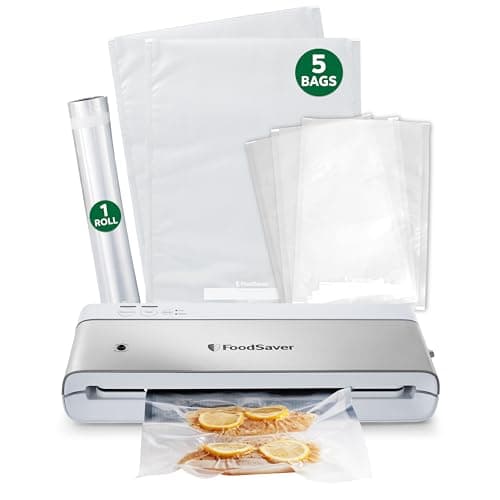
FoodSaver Compact Vacuum Sealer Machine
The engine of the whole arrangement. A jar sealer is an attachment, and it needs a machine with an accessory port to pull against; this is FoodSaver's compact one, which also does the bag sealing that is most of what a vacuum sealer earns its counter space for.
Published specs
- Type
- External vacuum sealer for bags and rolls
- Accessory port
- Required for jar sealers; included on this model
- Included
- Airtight bags and a roll, per the listing
- Jar use
- Works with FoodSaver jar sealers for regular and wide mouth mason jars
What works
- Compact footprint, which matters for an appliance used weekly rather than daily
- Bags and jars from one machine, so dry pantry goods and freezer portions are covered by a single purchase
- FoodSaver's accessory ecosystem is the one most jar sealers are built to fit
What to know first
- It is the expensive part of vacuum-sealing jars, and a jar sealer alone will not work without it
- External sealers cannot pull the deep vacuum a chamber machine can, which matters for liquids
- Bags are a recurring cost, and the machine is only as useful as your willingness to keep buying them
Specs from FoodSaver, Jar Sealer product page (archived 2017), NCHFP, "Dry Canning" Isn't Canning. We have not handled this product — see how we pick.
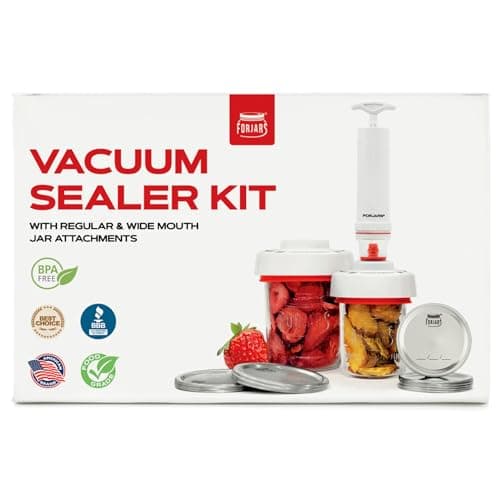
FORJARS Jar Vacuum Sealer Accessory Set
The same idea from the canning-lid brand: domes for both mouth sizes with a hose, compatible with FoodSaver machines. Buy it if you want both sizes and a spare hose for less than the branded set costs, and hold it to exactly the same limits.
Published specs
- Fits
- Regular and wide mouth mason jars
- Compatible with
- FoodSaver vacuum sealer machines, per the listing
- Good for
- Dry pantry goods and refrigerated leftovers in jars
- Not for
- Canning or any shelf-stable storage of low-acid food
What works
- Both mouth sizes in one set, usually for less than the branded equivalent
- From a brand that already sells canning lids, so the jars and sealers come from the same place
- A spare hose is genuinely useful, because the hose is the part that gets lost
What to know first
- Third-party compatibility means the fit is only as good as your specific machine's port
- No manufacturer safety documentation of its own to cite — the limits here come from FoodSaver's and extension guidance
- Still needs a vacuum sealer machine, which this set does not include
Specs from University of Minnesota Extension, Vacuum-sealing mason jars, NCHFP, "Dry Canning" Isn't Canning. We have not handled this product — see how we pick.
Vacuum sealing as a substitute for canning
The reason this page needs a warning section. Vacuum sealing removes air; it applies no heat, kills nothing, and cannot make food shelf stable. The University of Minnesota Extension states it directly: mason jar vacuum sealers "cannot be used to preserve foods that would otherwise be canned and processed using a heat treatment."
Published specs
- UMN Extension
- "When using a vacuum sealer device on a jar, no heat treatment occurs... This process makes the food shelf-stable" - referring to canning, which vacuum sealing is not
- Utah State Extension
- "In fact, vacuum packaging will increase the ability of the botulism bacteria to grow by removing oxygen."
- NCHFP
- "A sealed jar is not a sign of food being processed safely!"
- Also not canning
- Heating dry goods in jars in an oven - "dry canning" - which the NCHFP does not recommend
What works
- Vacuum sealing is genuinely useful for dry goods and for refrigerated or frozen storage, which is the job this page recommends it for
What to know first
- No heat process means nothing in the jar has been destroyed - spores included
- Removing oxygen actively favors *Clostridium botulinum*, which does not need it
- Filling a jar with hot food and vacuum sealing it is specifically called out by extension services as unsafe
Specs from University of Minnesota Extension, Vacuum-sealing mason jars, Utah State University Extension, Packaging Foods. We have not handled this product — see how we pick.
How the setup actually works
Worth spelling out, because the parts are sold separately and the listings assume you know. You need three things: a vacuum sealer machine with an accessory port, an accessory hose, and the jar sealer dome in the right mouth size. You reuse your own mason jars and ordinary flat canning lids; the dome sits over the lid, the hose connects it to the machine, and the machine pulls the air out.
- Use a clean, undamaged flat lid. It is holding a vacuum, and a bent one will not.
- Wipe the rim first, exactly as you would for canning. Oil or crumbs break the seal.
- Do not fill hot. UMN is explicit that filling a jar with steaming hot food and then vacuum sealing it "is not a safe process."
- Label what is inside and when you sealed it, the same habit as canning — see canning labels.
- Store dry goods somewhere cool and dark. A vacuum does nothing about light or heat.
A note on reusing canning lids here
This is one place where a used flat lid is legitimately fine. A lid whose sealing compound has already been indented by one canning cycle cannot be trusted to seal in a canner again — but holding a cold vacuum on a jar of rice asks much less of it. Keeping a jar of "used once" lids for the vacuum sealer is a reasonable habit, provided they never find their way back into the canner.
The rule that governs the other direction is absolute, and it is in can you reuse canning lids: a used lid does not go back in a canner.
What about "dry canning" in the oven?
You will find instructions for heating jars of flour, rice or beans in an oven to make them seal. The NCHFP addresses it directly and does not recommend it: "Just because canning jars are used in 'dry canning' does not mean the suggested procedures fit the classic definition of canning," and "the dry oven process used at home has never been shown to sterilize these various dry foods or produce the claimed extended shelf life with quality."
They note it can even make things worse — moisture condensing on cooling, or heat accelerating rancidity in nuts and grains. If the goal is airless dry storage, do it the way the NCHFP describes: room-temperature vacuum packaging, or oxygen absorbers in the container. The oven adds risk and subtracts quality.
The decision, in one paragraph
If you already own a FoodSaver, buy the jar sealer with the hose and start with coffee, nuts and dried fruit — it is a small amount of money for a real improvement in how long pantry staples stay good. If you do not own a machine, the compact sealer is the piece that makes the rest work, and bags are most of what you will use it for. Buy the FORJARS set if you want both mouth sizes cheaply. And hold the whole arrangement to one rule: this is storage, not preservation. Low-acid food that has not been processed belongs in the refrigerator or the freezer, whatever the lid is doing.
Next stepHow the methods compareCommon questions
Is vacuum sealing mason jars the same as canning?
Is it safe to vacuum seal food in jars at room temperature?
What can you vacuum seal in mason jars?
Does a vacuum-sealed jar mean the food is preserved?
Can you vacuum seal hot food in a jar?
Do I need a special machine for jar sealers?
Can I reuse canning lids with a jar sealer?
Does vacuum sealing kill insect eggs in flour?
Is oven "dry canning" a safe alternative?
Do you earn a commission on these?
Sources
- University of Minnesota Extension — Vacuum-sealing mason jars
- Utah State University Extension — Packaging Foods
- NCHFP — But my jars sealed…
- NCHFP — "Dry Canning" Isn't Canning
- NCHFP — Packaging and Storing Dried Foods
- NCHFP — Equipment and Methods Not Recommended
- MU Extension — Preserve It Fresh, Preserve It Safe (2024, No. 5)
- FoodSaver — Jar Sealer product page (archived 2017)
Product specifications are taken from each manufacturer’s own published page, cited on the product. We have not handled these products — how we pick.