Are Mason jars oven and microwave safe?
One manufacturer says no in six words. Another publishes a microwave claim and a thermal-shock limit. The difference is the whole answer.
Disclosure: we earn a commission on purchases made through links on this page, at no extra cost to you. It does not change what we recommend — see how we pick and our affiliate disclosure.
No for Ball, yes for Weck. Ball's own use and care page is six words long on the subject: "Jars should not be used in the microwave or oven." Weck publishes the opposite for its jars - "WECK Jars and glass lids are both dishwasher and microwave safe" - with a published thermal-shock limit. If you want to reheat food in glass, buy a Weck 743. If you want to can, buy Ball jars and keep them out of both appliances.
This is a rare question in home canning with a flat, documented answer from the manufacturers themselves, which is why it is worth a page. Nobody has to interpret anything. Both companies publish a position, the positions differ, and the difference is about the glass and not about the food.
What follows is what each maker claims, the one real number anybody publishes, and the correct purchase for each of the three things people are actually asking about: the oven, the microwave and the dishwasher.
How we judged this
One criterion, and it ruled out most of what is sold as a storage jar: does the manufacturer publish a position on heat? Not a retail listing, not a star rating, not an icon on the box - the maker's own support page. A jar with no published claim gets treated as having no claim, because an unlabelled jar is a jar whose glass you know nothing about.
That standard is the whole reason this page has four picks and not fourteen. We are not estimating a thermal tolerance from the look of a jar, and we have not handled any of these - see how we pick.
Quick picks
Every pick below is screened against the National Center for Home Food Preservation’s published canner rules first. Tap a row for the full write-up.
| # | Product | Best for | Key spec | Price |
|---|---|---|---|---|
| 1 |  Weck 743 Mold Jar (3/4 L)Beautiful, genuinely well made, and not what the USDA processes were written for. Weck's own product page does not make a canning claim, and NCHFP names threaded Mason-type jars with two-piece self-sealing lids as the best choice. Buy these because you like them, not to replace your Mason jars. | Fridge, gifts and dry storage | No published canning claim | $21.99 · View on Amazon#ad we earn a commission · price as of October 18, 2026 |
| 2 |  Ball Wide Mouth Leakproof Storage LidsThe lid that turns a canning jar into a lunch container. Ball lists these as leakproof, freezer safe and dishwasher safe, and — importantly — classifies them as "Lid Type: Non-Canning". They are for the eleven months of the year your jars are not in a canner. | Wide mouth jars in daily use | Non-canning, leakproof, freezer safe | $22.99 · View on Amazon#ad we earn a commission · price as of October 18, 2026 |
| 3 |  Ball Wide Mouth Quart Jars (32 oz)The jar to buy when you are packing peach halves, pickle spears or anything you have to reach into. The wider 86 mm mouth is easier to fill and far easier to clean, and quarts are the standard size for tomatoes. | Whole fruit and packing by hand | 86 mm mouth, 32 oz | |
| 4 |  Ball Plastic Freezer Jars, 16 oz (2-Count)The simplest answer to the freezer-jar problem: do not use glass. These are Ball's own plastic pint jars with leak-resistant lids, made for freezer jam and anything else that goes straight from the counter to 0°F. Nothing about headspace or jar shape can break them. | Freezer jam, without the glass question | Pint, polypropylene | $17.99 · View on Amazon#ad we earn a commission · price as of October 18, 2026 |
| 5 | Oven canning, and baking in a Mason jarSkipThere is no version of this that works. NCHFP rules out processing filled jars in a conventional oven, the jar makers rule out baking in their jars, and a lid that pops down afterwards is not evidence the food was preserved. Buy the pot the tested process was written for. | Nothing - no tested process exists | Not a canning method | Check price on Amazon#ad we earn a commission · live price pending |
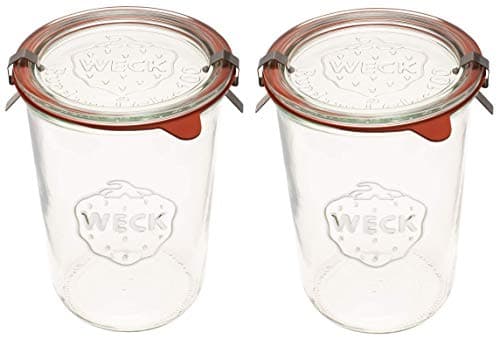
Weck 743 Mold Jar (3/4 L)
Beautiful, genuinely well made, and not what the USDA processes were written for. Weck's own product page does not make a canning claim, and NCHFP names threaded Mason-type jars with two-piece self-sealing lids as the best choice. Buy these because you like them, not to replace your Mason jars.
Published specs
- Capacity
- 28.7 fl. oz. (3/4 L)
- Dimensions
- Height 5 3/4", opening 3 7/8"
- Set contents
- 6 jars, 6 glass lids, 6 rings and 12 clamps
- Lid size
- Large (glass)
- Closure
- Glass lid, rubber ring and two steel clamps
- Made in
- Germany
- Dishwasher / microwave
- Weck states both are safe
- Canning claim
- Not published by Weck
What works
- Genuinely excellent glassware. The straight-sided mold shape empties cleanly and the glass lid does not corrode, dent or need replacing annually the way a flat metal lid does
- The rubber ring and clamps are sold as spare parts, so the system is repairable rather than consumable
- Superb for refrigerator pickles, dry goods, leftovers and gifting — all the jobs where no tested process is involved and no seal has to survive a year on a shelf
What to know first
- Weck publishes no canning claim for this jar, so there is no manufacturer statement to rely on and we are not going to invent one
- NCHFP names regular and wide-mouth threaded Mason-type jars with self-sealing lids as the best choice. The tested processes and the seal-check method both assume that closure
- The 3 7/8" opening is wider than the 3-inch wide-mouth Mason standard, so Mason lids, bands and your existing lid rack do not fit it
Specs from Weck, 743 Mold Jar (3/4 L), NCHFP, Recommended Jars and Lids. We have not handled this product — see how we pick.
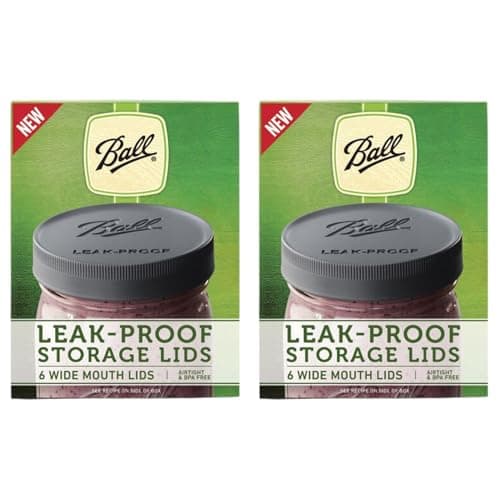
Ball Wide Mouth Leakproof Storage Lids
The lid that turns a canning jar into a lunch container. Ball lists these as leakproof, freezer safe and dishwasher safe, and — importantly — classifies them as "Lid Type: Non-Canning". They are for the eleven months of the year your jars are not in a canner.
Published specs
- Model
- 1440010813 (Ball)
- Fits
- Wide mouth Ball and Kerr jars
- Claims
- Airtight and leakproof, freezer safe, dishwasher safe, BPA-free (Ball)
- Lid type
- Non-canning (Ball)
- Pack
- 6 lids per pack; the listing here is a pack of 2
What works
- A genuine leakproof seal, which a screw band and flat lid never gives you on a jar of soup in a bag
- Ball rates them freezer safe and dishwasher safe, so they handle the whole meal-prep cycle
- One lid replaces a two-piece closure you would rather keep clean and unbent for canning season
What to know first
- Not for canning, and Ball says so outright: "Do not use Ball non-canning lids for preserving."
- Plastic, so it stains with tomato and curry and will eventually warp if you put it through a hot dishwasher cycle enough times
- Pack sizes are small relative to how many jars a canner household owns
Specs from Ball, Wide Mouth Leakproof Storage Lids, 6-Pack, Ball, Lids Use & Care. We have not handled this product — see how we pick.
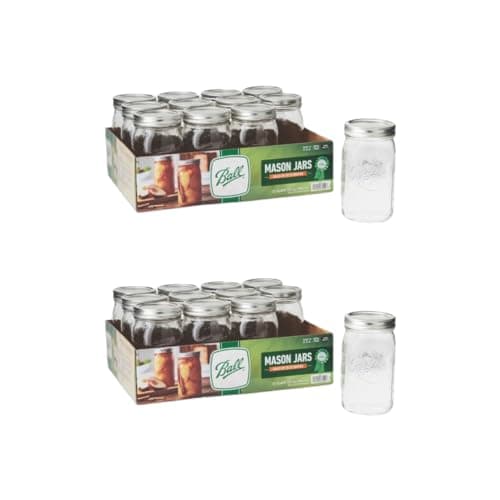
Ball Wide Mouth Quart Jars (32 oz)
The jar to buy when you are packing peach halves, pickle spears or anything you have to reach into. The wider 86 mm mouth is easier to fill and far easier to clean, and quarts are the standard size for tomatoes.
Published specs
- Volume
- 32 oz / 4 cups
- Mouth
- Wide, about 86 mm lid diameter
- Inner mouth diameter
- About 76 mm
- Jar dimensions
- About 6 1/2" tall x 3 1/4" wide
What works
- You can get a hand and a jar funnel into it, which turns packing peaches from a chore into a task
- Quart is the size the tomato and peach processing times in tested recipes are written around
- Much easier to wash by hand than a regular mouth quart
What to know first
- Wide mouth lids cost more than regular mouth and disappear from shelves first in peak season
- Seven quarts is a full canner load, so a quart-jar day is a longer day per jar of finished food
- A quart of anything low-acid still needs a pressure canner, and quarts take the longest processing times
Specs from Ball, Mason Jars & Lids, Wide Mouth. We have not handled this product — see how we pick.
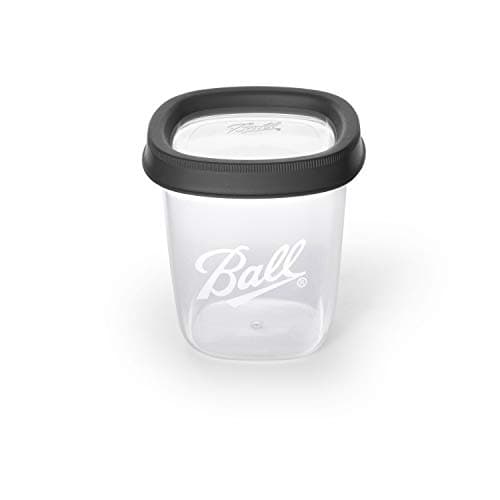
Ball Plastic Freezer Jars, 16 oz (2-Count)
The simplest answer to the freezer-jar problem: do not use glass. These are Ball's own plastic pint jars with leak-resistant lids, made for freezer jam and anything else that goes straight from the counter to 0°F. Nothing about headspace or jar shape can break them.
Published specs
- Size
- 16 oz (pint), 2 per pack
- Material
- Polypropylene (Ball item 1440080103, per distributor listing)
- Lid
- Leak-resistant plastic lid
- Use
- Freezer and refrigerator storage; not for canning
What works
- No thermal shock question at all, which removes the one real risk in freezing glass
- Light and stackable, so a freezer shelf of them is easier to handle than a shelf of jars
- The natural home for freezer jam, which Ball's own freezer-jam method fills with 1/2 inch of headspace
What to know first
- Plastic is not for canning. These jars never see a canner, and using them that way is not a supported option
- Ball does not publish a product page for these — the material and item number come from a distributor listing, not from Ball's own catalog
- Two jars per pack is a thin quantity for a jam day, so the per-jar cost is high
Specs from Ball, Step-by-Step Freezing, NCHFP, Containers for Freezing. We have not handled this product — see how we pick.
Oven canning, and baking in a Mason jar
There is no version of this that works. NCHFP rules out processing filled jars in a conventional oven, the jar makers rule out baking in their jars, and a lid that pops down afterwards is not evidence the food was preserved. Buy the pot the tested process was written for.
Published specs
- NCHFP, on ovens
- "the processing of freshly filled jars in conventional ovens, microwave ovens, and dishwashers are not recommended"
- NCHFP, on why
- These practices "do not prevent all risks of spoilage"
- NCHFP, on jar makers
- "Manufacturers of canning jars do not recommend baking or oven canning in the jars"
- NCHFP, on breakage
- "It is very risky with regard to causing jar breakage"
- NCHFP, on dry heat
- "It is well known that bacteria and bacterial spores are more sensitive to wet heat than dry heat"
- Ball
- "Jars should not be used in the microwave or oven"
- Buy instead
- A boiling-water canner for high-acid food, a pressure canner for low-acid food
What works
- Nothing. The only thing to say for it is that it is cheap, and the saving is the price of a canner against the cost of a batch you cannot trust
What to know first
- Dry air transfers heat far worse than boiling water, so the jar's contents never reach the temperature the process assumed
- NCHFP says there is no evidence dry oven heat sterilizes jar surfaces, and no research-based documentation supporting canning any food in a dry oven
- The jars themselves are not rated for it, so breakage - in a hot oven, with hot contents - is a live risk and not a theoretical one
- A sealed lid proves a vacuum formed as the jar cooled. It proves nothing about whether spores were destroyed
Specs from NCHFP, Equipment and Methods Not Recommended, NCHFP, Canning FAQs, Ball, Use & Care - Canning. We have not handled this product — see how we pick.
What each maker publishes
| Ball (Newell) | Weck | |
|---|---|---|
| Oven | "Jars should not be used in the microwave or oven" | No oven claim published |
| Microwave | Not recommended, same sentence | "Jars and glass lids are both dishwasher and microwave safe" |
| Dishwasher, jars | No published jar claim | Stated safe for jars and glass lids |
| Dishwasher, other parts | Bands: "Handwash bands for future use and dry thoroughly to prevent rusting" | Not recommended for rubber rings, metal clamps, wood or cork lids |
| Thermal shock | "No hot liquids or foods in jars without heating jars prior" | Difference "should not exceed 122°F" |
| Freezer | Straight or tapered jars only; "Jars with shoulders should not be used for freezing" | Mold, Mini Mold and Quadro, with a Keep Fresh Cover |
| Made in | "BPA-free, Made in USA" | Germany |
Weck's 122°F figure is the only published thermal-shock number we have found anywhere in this category, and it is strict: the difference between the jar and its surroundings should not exceed it. That rules out a cold jar straight into a hot oven whatever the jar is made of, and it is the physics behind Ball's rule about not putting hot food into an unheated jar.
The oven: no, and the reason is not the food
Neither company makes an oven claim, and the NCHFP's canning FAQ explains the risk in the one sentence that matters: "Manufacturers of canning jars do not recommend baking or oven canning in the jars," and "It is very risky with regard to causing jar breakage."
Breakage, not contamination, is the headline hazard. A canning jar is annealed soda-lime glass designed to come up to 212°F surrounded by water and to come back down slowly - a gentle, even, wet heat. Dry oven air heats the exposed glass above the food line at a completely different rate from the glass below it, and that gradient is what cracks a jar.
If what you actually want is to preserve food in the oven rather than bake in a jar, that is a different and more consequential question, and it has its own page: can you can in the oven.
The microwave: depends entirely on the jar
Ball says no. Weck says yes, for the jars and the glass lids. We have no basis for a view beyond repeating both, and no reason to doubt either - these are different glass formulations made in different factories to different specifications, and each company knows what it makes.
Two things to add that are not controversial. A metal band or a flat metal lid does not belong in a microwave regardless of the jar, so anything you reheat in a jar needs a non-metal lid off or on. And a narrow-shouldered jar heats unevenly in a microwave for the same geometric reason it is not recommended for freezing.
The practical answer for most people is the one in the picks: keep the canning jars for canning, put a plastic storage lid on the ones in daily refrigerator use, and tip the contents into a bowl to reheat. If you want to skip the bowl, buy a jar whose maker publishes a microwave claim.
The dishwasher: the quiet gap
Here is the odd finding. Ball publishes dishwasher statements for several of its accessories - its dissolvable labels "dissolve by hand washing or in the dishwasher," its fermentation lids are "Dishwasher-safe," its jar lifter is "Not dishwasher safe" - and publishes no dishwasher claim for the jars themselves. It does instruct you to handwash the screw bands and dry them to stop them rusting.
In practice Mason jars go through dishwashers constantly and survive. We are flagging the absence rather than inventing a permission. Where it does matter is sterilizing: a dishwasher is not a sterilizing process for canning, and the NCHFP groups dishwasher processing with oven processing in the same not-recommended sentence. How to actually do it is in how to sterilize canning jars.
What about the freezer?
Opposite direction, same glass, and a genuinely different set of manufacturer rules - Ball permits straight and tapered jars and excludes shouldered ones, which is a shape rule rather than a temperature rule. That has its own page, with the headspace figures: are mason jars freezer safe.
The decision, in one paragraph
Buy a Weck 743 if you want to reheat food in glass, because it is the only jar here whose maker publishes a microwave claim, and respect its 122°F differential. Buy Ball plastic storage lids for the canning jars already in your refrigerator, which is the cheap fix for most of what people are trying to microwave. Keep Ball jars for canning and cold storage, as Ball instructs. Use plastic freezer jars for freezer jam if the glass question bothers you. And put nothing in the oven, because no maker in this category claims it and the failure mode is broken glass at 350°F.
Next stepThe oven question, when the goal is preservingCommon questions
Can you microwave Mason jars?
Are Mason jars oven safe?
Are Mason jars dishwasher safe?
Can I bake a cake in a Mason jar?
What is thermal shock, in a number?
Can I reheat soup in the jar I canned it in?
Does using a jar for crafts ruin it for canning?
Do you earn a commission on these?
Sources
- Ball — Use & Care (canning jars, lids and bands)
- Weck — Frequently Asked Questions
- Weck — 743 Mold Jar
- NCHFP — Canning FAQs
- NCHFP — Equipment and Methods Not Recommended
- Ball — Wide Mouth Leakproof Storage Lids
- Ball — Mason Jars & Lids, Wide Mouth
Product specifications are taken from each manufacturer’s own published page, cited on the product. We have not handled these products — how we pick.