The best pectin for jam and jelly
Four kinds of pectin sit in the same aisle and they are not substitutes for each other. The recipe decides which one you need before price does.
Disclosure: we earn a commission on purchases made through links on this page, at no extra cost to you. It does not change what we recommend — see how we pick and our affiliate disclosure.
Buy the type of pectin your recipe names. Regular powdered pectin goes into the fruit before the sugar; liquid pectin goes in after the sugar, at a full rolling boil; low or no-sugar-needed pectin is a modified product with its own recipes; and Pomona's is activated by calcium rather than sugar. They are not interchangeable, and swapping one for another is the usual reason jam does not set.
Pectin is the only ingredient in a jam recipe that most people buy without knowing what they are choosing between. There are four genuinely different products in that small stretch of shelf, they behave differently, and the recipe you are following was written for exactly one of them.
This is not a safety purchase in the way a pressure canner is. A jam that fails to set is a disappointment rather than a hazard. But it is the purchase most likely to waste a morning and eight pounds of fruit, and the rules that prevent that are short.
What pectin is actually doing
The National Center for Home Food Preservation describes a jellied product as a balance of four things: fruit, which provides the color and flavor; pectin, which is "the substance that causes the fruit to gel"; acid, "needed both for gel formation and flavor"; and sugar, which must be present "in the proper proportion". Change one of the four and you have changed the set.
Fruits do not arrive with equal amounts of pectin. The NCHFP sorts them into groups: sour apples, crabapples, cranberries, Concord grapes and quinces are high enough in pectin and acid to gel with sugar alone. Ripe apples, sour cherries and some grapes sit in the middle. Apricots, blueberries, peaches and strawberries always need added acid, added pectin, or both. That last group is most of what people actually want to make jam from, which is why the boxes exist.
Added pectin buys more than a reliable gel. The NCHFP notes that jam and jelly made with it "requires less cooking and generally gives a larger yield", the flavor is fresher for it, and it "eliminates the need to test hot jellies and jams for proper gelling" — no cold plate, no sheeting off a spoon, no judgment call at the stove.
The four types, and what each one is for
| Type | What it is | Sugar | When it goes in |
|---|---|---|---|
| Regular powdered | Dry pectin, sold by the box or the bottle | Full sugar, as written | Into the fruit or juice, before the sugar |
| Liquid | Pectin in solution, in pouches | Full sugar, as written | After the sugar, at a full rolling boil |
| Low or no-sugar-needed | Modified pectin for reduced-sugar recipes | Less sugar, honey, or none | Into the fruit or juice, per its own recipes |
| Calcium-activated (Pomona's) | Low-methoxyl citrus pectin plus a calcium packet | Optional — sweeten to taste | Dispersed in sweetener, with calcium water added to the fruit |
Why you cannot swap one for another
Compare two NCHFP grape jelly recipes that make the same product. The powdered version: "Measure juice into a kettle. Add pectin and stir well," bring to a full rolling boil, "Add sugar, continue stirring, and heat again to a full rolling boil," boil hard for 1 minute. The liquid version: "Measure juice into a kettle. Stir in sugar," bring to a full rolling boil, "Add pectin and heat again to a full rolling boil," boil hard for 1 minute.
Same fruit, same sugar, same minute of hard boiling, opposite order. Powdered pectin needs to disperse into the unsweetened liquid; liquid pectin needs to arrive into a boiling sugar syrup. Pour one in where the other belongs and the gel never forms properly. This is the single most common cause of a soft set, and it is entirely avoidable by buying the type the recipe names.
How we screened these
We have not made jam with every one of these. What we checked is each manufacturer's published product information against the NCHFP's guidance for added-pectin products, and against how people actually buy pectin: once a year, in whatever quantity the harvest demands. The method is on how we pick.
- Does it come with tested directions? The NCHFP's instruction for added pectin is to "follow the instructions with each package". A pectin with no recipes attached fails that test.
- Batch flexibility. A box that is one fixed batch suits a planned run; a flex-batch bottle suits a picking that came in at four pounds.
- Sugar range. Full-sugar, reduced-sugar and no-sugar sets are three different products, not three settings.
- Quantity per purchase. The NCHFP says to "purchase fresh fruit pectin each year", because "old pectin may result in poor gels". Anything you cannot use in a season is not a bargain.
- Availability in a form worth buying. Single boxes, multipacks and bulk bags are priced very differently per batch, and the cheapest per ounce is often the worst value in practice.
Quick picks
Every pick below is screened against the National Center for Home Food Preservation’s published canner rules first. Tap a row for the full write-up.
| # | Product | Best for | Key spec | Price |
|---|---|---|---|---|
| 1 |  Ball RealFruit Classic PectinThe powdered pectin to buy if you want to decide the batch size on the day. A box of Sure-Jell is one batch, measured for you; this is a flex-batch bottle with instructions for scaling between one and ten batches, which suits the cook who jams whatever the picking produced rather than a planned 7-cup run. | One batch or ten, from one bottle | Flex batch, 1 to 10 batches | |
| 2 |  Sure-Jell Original Premium Fruit PectinThe box in the supermarket canning aisle, and the pectin a great many American jam recipes are written around. One box is one batch, the insert has the fruit-by-fruit recipes, and there is nothing to scale or calculate. If a recipe says "1 package powdered pectin", this is the package it means. | Following the recipe in the box | 1.75 oz box, one batch | |
| 3 |  Ball RealFruit Low or No-Sugar-Needed PectinThe honest way to make jam that is not mostly sugar. You cannot get there by cutting the sugar in a regular recipe — the NCHFP is blunt about that — because sugar is doing the gelling work in those. This is the modified pectin that sets with little or no sugar, with Ball's own recipes written to match. | Jam with much less sugar | 5.4 oz, less sugar or none | $9.59 · View on Amazon#ad we earn a commission · price as of October 18, 2026 |
| 4 |  Certo Premium Liquid Fruit PectinBuy this when your recipe calls for liquid pectin — and only then. Liquid pectin goes in at the opposite end of the process from powder: the sugar is stirred into the juice first, the mixture is brought to a full rolling boil, and the pectin goes in last. Swapping it for powder in the same recipe is a soft, unset jar. | Recipes written for liquid pectin | 6 fl oz box, 2 pouches | $14.99 · View on Amazon#ad we earn a commission · price as of October 18, 2026 |
| 5 |  Pomona's Universal PectinThe one that works on a different principle. Pomona's is a low-methoxyl citrus pectin activated by calcium rather than by sugar, so the sweetener becomes a flavor decision instead of a structural one — sugar, honey or none at all. Every box includes the calcium packet you mix into calcium water. | No sugar, honey or a light set | Calcium-activated citrus pectin | |
| 6 | Bulk pectin with no recipe attachedSkipTwo-pound bags of unbranded pectin look like the thrifty option, and they are the one pectin purchase we would talk you out of. A tested jam recipe is built around a specific pectin product and the directions that come with it. A bag with a scoop and no recipes leaves you guessing at the one ratio that decides whether the batch sets. | Nothing - buy the pectin your recipe names | No tested recipe comes with it | Check price on Amazon#ad we earn a commission · live price pending |
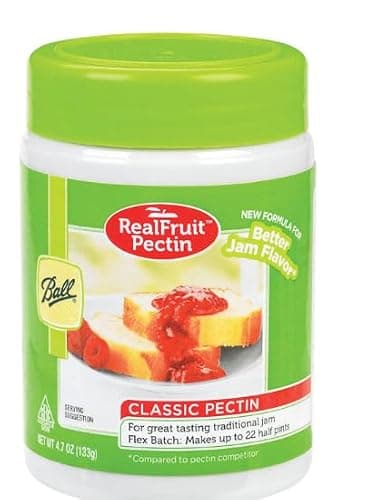
Ball RealFruit Classic Pectin
The powdered pectin to buy if you want to decide the batch size on the day. A box of Sure-Jell is one batch, measured for you; this is a flex-batch bottle with instructions for scaling between one and ten batches, which suits the cook who jams whatever the picking produced rather than a planned 7-cup run.
Published specs
- Type
- Regular powdered pectin, for full-sugar recipes
- Size
- 4.7 oz bottle (Ball 71065); Ball also publishes a 5.4 oz size
- Yield
- Up to 22 half-pint jars per 5.4 oz bottle (Ball)
- Batch range
- 1 to 10 batches, instructions on the bottle (Ball)
- Added when
- Whisked into the fruit or juice before the sugar
- Other
- Kosher certified, made in the USA (Ball)
What works
- The flex-batch format is the real advantage: a half-batch of a fruit you only got two pounds of is a normal thing to make rather than a recipe you have to rewrite
- One bottle covers a whole season for most households — Ball puts the 5.4 oz size at up to 22 half-pint jars
- Ball's instructions and recipes are written for this exact product, which is what a tested recipe requires
What to know first
- It costs meaningfully more online than the same bottle costs in a supermarket canning aisle, and listings move between the 4.7 oz and 5.4 oz sizes, so check which size you are actually buying
- It is a full-sugar pectin. Cutting the sugar in these recipes gives syrup, not jam; that job needs the low or no-sugar version
- Measuring by batch multiples is one more step than tearing open a single-batch box
Specs from Ball, RealFruit Classic Flex Batch Pectin 5.4 oz, NCHFP, Making Jams and Jellies with Added Pectin. We have not handled this product — see how we pick.
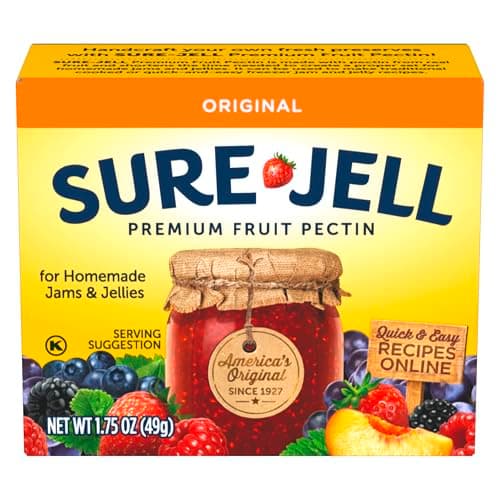
Sure-Jell Original Premium Fruit Pectin
The box in the supermarket canning aisle, and the pectin a great many American jam recipes are written around. One box is one batch, the insert has the fruit-by-fruit recipes, and there is nothing to scale or calculate. If a recipe says "1 package powdered pectin", this is the package it means.
Published specs
- Type
- Regular powdered pectin, for full-sugar recipes
- Size
- 1.75 oz box
- Ingredients
- Dextrose, citric acid (assists gel), fruit pectin (Kraft Heinz)
- Added when
- Stirred into the fruit or juice before the sugar
- Recipes
- Fruit-by-fruit directions on the package insert
What works
- One box, one batch: the format tested jam and jelly recipes are written around, with no batch math to get wrong
- The package insert is the recipe source, which is exactly what the NCHFP tells you to follow for added-pectin products
- Cheap per batch and stocked in ordinary supermarkets, so a replacement is never a special order
What to know first
- Amazon sells it in multipacks rather than single boxes. Eight boxes is a lot of pectin to keep for a year, and old pectin gels poorly
- Full-sugar only. A Sure-Jell recipe with the sugar reduced does not set — the less or no sugar needed version is a different product with its own recipes
- No batch flexibility: a box is a batch, so an odd amount of fruit means eating the rest fresh or freezing it
Specs from Kraft Heinz, SURE-JELL Original Premium Fruit Pectin, NCHFP, Making Jams and Jellies with Added Pectin. We have not handled this product — see how we pick.
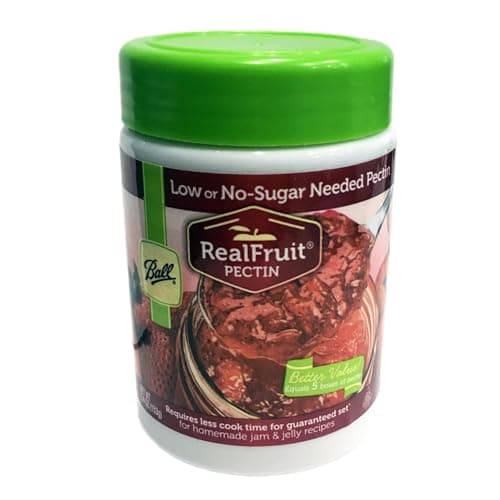
Ball RealFruit Low or No-Sugar-Needed Pectin
The honest way to make jam that is not mostly sugar. You cannot get there by cutting the sugar in a regular recipe — the NCHFP is blunt about that — because sugar is doing the gelling work in those. This is the modified pectin that sets with little or no sugar, with Ball's own recipes written to match.
Published specs
- Type
- Modified pectin for less-sugar or no-sugar recipes
- Size
- 5.4 oz bottle
- Yield
- Up to 22 half-pint jars per bottle (Ball)
- Batch range
- 1 to 10 batches, instructions on the bottle (Ball)
- Sweeteners
- Less sugar, honey or other sweeteners, per Ball's instructions
- Added when
- Whisked into the fruit or juice until dissolved, then boiled hard 1 minute (Ball)
What works
- It is the correct tool for reduced-sugar jam, rather than the improvisation of cutting sugar from a regular recipe and hoping
- Same flex-batch scaling as the classic version — 1 to 10 batches from one bottle, up to 22 half-pints
- Sold as a single bottle, so you can buy one season's worth and keep the pectin fresh
What to know first
- Low-sugar jam keeps differently once opened and tastes more of fruit and less of preserve — a real difference, not a flaw, but it surprises people
- Its recipes are not interchangeable with classic-pectin recipes in either direction
- Sugar does more than sweeten in a jam jar. Reducing it changes texture and keeping quality, so follow Ball's recipes rather than adapting your own
Specs from Ball, RealFruit Low or No Sugar Needed Flex Batch Pectin, NCHFP, Jellied Product Ingredients. We have not handled this product — see how we pick.
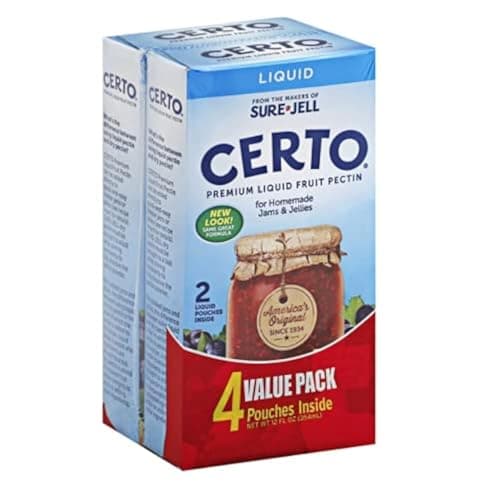
Certo Premium Liquid Fruit Pectin
Buy this when your recipe calls for liquid pectin — and only then. Liquid pectin goes in at the opposite end of the process from powder: the sugar is stirred into the juice first, the mixture is brought to a full rolling boil, and the pectin goes in last. Swapping it for powder in the same recipe is a soft, unset jar.
Published specs
- Type
- Liquid pectin, for full-sugar recipes written for liquid
- Size
- 6 fl oz box containing two pouches
- Ingredients
- Water, fruit pectin, lactic acid and citric acid (assist gel), potassium citrate, sodium benzoate (Kraft Heinz)
- Added when
- After the sugar, once the mixture is at a full rolling boil
- NCHFP note
- Powdered and liquid pectin are not interchangeable in a recipe
What works
- Some long-standing family and community recipes are written for liquid pectin only, and this is the product they mean
- Two pouches per box, so a box is two batches and there is less left over than a big powdered bottle
- There is no powder to clump, which is the thing that catches people out when pectin meets hot juice
What to know first
- Not interchangeable with powdered pectin. The order of operations is reversed, and using the wrong one is the classic cause of jam that never sets
- Liquid pectin is the harder of the two to find in stock in a single box; listings are often two-box sets
- It carries a preservative the powders do not — sodium benzoate, per Kraft Heinz's ingredient list — if that matters to you
Specs from Kraft Heinz, SURE-JELL Premium Liquid Fruit Pectin (Certo), NCHFP, Making Jams and Jellies with Added Pectin. We have not handled this product — see how we pick.
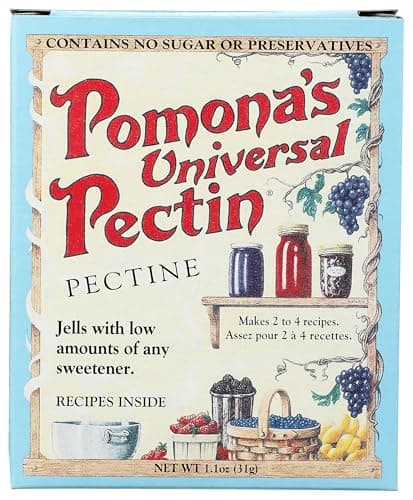
Pomona's Universal Pectin
The one that works on a different principle. Pomona's is a low-methoxyl citrus pectin activated by calcium rather than by sugar, so the sweetener becomes a flavor decision instead of a structural one — sugar, honey or none at all. Every box includes the calcium packet you mix into calcium water.
Published specs
- Type
- Low-methoxyl citrus pectin, activated by calcium
- What it is
- 100% citrus pectin extracted from dried lemon, lime and orange peel (Pomona's)
- In the box
- Pectin powder plus a monocalcium phosphate packet for calcium water
- Jelly ratio
- 1 tsp pectin and 1 tsp calcium water per cup of juice (Pomona's)
- Jam ratio
- 1/2 to 3/4 tsp pectin per cup of mashed fruit, by fruit type (Pomona's)
- Sweetener
- A scant 1/4 to 1/2 cup sugar or honey per cup, or none (Pomona's)
- Calcium water
- Keeps for months in the refrigerator; can be frozen (Pomona's)
What works
- Sugar is optional rather than structural, which is the only way to get a genuinely low-sugar or honey-sweetened set without a modified pectin recipe
- Sold in small 1.1 oz boxes that make a lot of jam, so buying fresh each year costs very little
- The ratios are per cup of fruit or juice, so any amount of fruit is a valid batch
What to know first
- It is a system, not a drop-in: you make calcium water first, and the pectin has to be dispersed in sweetener or it clumps in the fruit
- Pomona's recipes are its own. Do not use it in a Sure-Jell or Ball recipe, or those in it
- Pomona's puts jam made with it at a year on the shelf and about three weeks in the refrigerator once opened
Specs from Pomona's Universal Pectin, Pectin & Calcium, Pomona's Universal Pectin, Create Your Own Recipe. We have not handled this product — see how we pick.
Bulk pectin with no recipe attached
Two-pound bags of unbranded pectin look like the thrifty option, and they are the one pectin purchase we would talk you out of. A tested jam recipe is built around a specific pectin product and the directions that come with it. A bag with a scoop and no recipes leaves you guessing at the one ratio that decides whether the batch sets.
Published specs
- What you get
- Powdered pectin in bulk, usually with no fruit-by-fruit recipes
- What the NCHFP says
- Follow the instructions with each package and the recommended process times
- The problem
- Pectin strength and quantities differ between products; ratios are not transferable
- Better
- A single-batch box or a flex-batch bottle with its own tested directions
What works
- It is cheaper per ounce, and if you are making pectin-set confections outside canning that may be all you need
What to know first
- No tested recipes come with it, and borrowing a Sure-Jell or Ball ratio is not a tested substitution
- Bulk quantities work against the NCHFP's advice to buy fresh pectin each year, since old pectin gels poorly
- Setting problems with an unbranded bag are unfixable in any systematic way — there is nothing to check your ratio against
Specs from NCHFP, Making Jams and Jellies with Added Pectin, NCHFP, Jellied Product Ingredients. We have not handled this product — see how we pick.
Buy it fresh, every single year
This is the one storage rule worth writing on the shelf. The NCHFP's advice on added pectin is to purchase fresh fruit pectin each year, because old pectin may result in poor gels. Pectin does not spoil in a way that makes anyone ill — it simply loses gelling strength, and it does so invisibly, which is worse. You find out at the end of a batch.
That single line should shape how much you buy. A nine-box multipack looks thrifty against a supermarket single box, but if seven of those boxes are still in the cupboard next August, you have bought seven boxes of uncertainty. Buy a season's worth, keep it somewhere cool and dry, and start the next season with new pectin.
The jars still have to be processed
Pectin decides whether a jam sets. It has nothing to do with whether the jar keeps. The NCHFP's procedure for jams and jellies is to fill hot product into sterile jars with 1/4-inch headspace and process 5 minutes in a boiling water canner, adding 1 additional minute per 1,000 feet above sea level.
- Sterile jars, and why it matters here. Processing under 10 minutes requires sterilized jars. The NCHFP notes that unsterile jars need a 10-minute process, which can give weaker gels in fruits low in pectin — see how to sterilize canning jars.
- Paraffin is finished. Wax seals "are no longer recommended for any sweet spread, including jellies". Two-piece lids and a water bath, every time.
- Do not double the batch. "Increasing the quantities often results in soft gels. Make one batch at a time, according to the recipe."
- Use the jar size the recipe names. Jellies filled into larger jars can come out excessively soft. Half-pints are the standard, and 4 oz jars are the other sensible size.
- Adjust for your elevation — the arithmetic is in altitude adjustment.
If the jam does not set
A soft set is recoverable, and the NCHFP publishes the remedy. For each quart of jelly you are remaking with powdered pectin, you mix 1/4 cup sugar, 1/2 cup water, 2 tablespoons bottled lemon juice and 4 teaspoons powdered pectin. With liquid pectin it is 3/4 cup sugar, 2 tablespoons bottled lemon juice and 2 tablespoons liquid pectin per quart. Follow the full procedure on the NCHFP page rather than improvising — and note that even the fix comes in two versions, one per pectin type.
Before you remake anything, give it a week. Some batches set slowly, particularly low-sugar ones, and a jar that looks like syrup on Sunday is sometimes jam by the following weekend.
Where pectin is not the answer
Three things get bought as if they were pectin problems and are not. The first is a thicker pie filling, which is a Clear Jel job — a starch that thickens the fruit rather than a gel that sets it. The second is a firmer pickle, which is a calcium chloride job rather than a pectin one — that and the rest of the canning aisle's small jars are covered in canning additives and firming agents.
The third is fruit that simply has not been cooked down. No-added-pectin jam recipes are their own family: they use more fruit, longer cooking, and the fruit's own pectin to set. They are perfectly good recipes. What you cannot do is stir a packet into one of them partway through and expect the ratios to still work, or leave the pectin out of a recipe written around it. Pick a recipe from one family and follow it — what counts as a tested recipe is in how to find safe canning recipes.
Which one to buy
If you follow recipes from a box insert and make a batch or two a year, buy Sure-Jell and follow the insert. If your jam happens whenever fruit turns up and the amount is never the same twice, buy Ball RealFruit Classic for its one-to-ten batch scaling. If you want jam that tastes of fruit rather than sugar, buy Ball RealFruit Low or No-Sugar-Needed and use Ball's recipes, or Pomona's if you want honey, a lighter set, or no added sugar at all. Buy Certo only when the recipe in front of you calls for liquid pectin, and never as a substitute for powder.
Whatever is in the pot, the last step does not change: sterile jars, 1/4-inch headspace, five minutes in a boiling water canner plus your altitude adjustment. The pectin decides the texture. The canner decides the shelf life.
Next stepHow to water bath can, step by stepCommon questions
What is the difference between liquid and powdered pectin?
Can I use less sugar with regular pectin?
Does pectin expire?
Can I use a Sure-Jell recipe with Ball pectin?
What is calcium water, and why does Pomona's need it?
How much pectin do I need per batch?
Do jars of jam still need a water bath if I used pectin?
Can I double a jam recipe to save time?
My jam did not set. Can I fix it?
Do you earn a commission on these?
Sources
- NCHFP — Making Jams and Jellies with Added Pectin
- NCHFP — Jellied Product Ingredients
- NCHFP — General Information on Canning Jams, Jellies, and Marmalades
- NCHFP — Grape Jelly, Powdered Pectin
- NCHFP — Grape Jelly, Liquid Pectin
- NCHFP — Remaking Soft Jellies
- Ball — RealFruit Classic Flex Batch Pectin
- Ball — RealFruit Low or No Sugar Needed Flex Batch Pectin
- Kraft Heinz — SURE-JELL Original Premium Fruit Pectin
- Kraft Heinz — SURE-JELL Premium Liquid Fruit Pectin (Certo)
- Pomona's Universal Pectin — Pectin & Calcium
- Pomona's Universal Pectin — Create Your Own Recipe
Product specifications are taken from each manufacturer’s own published page, cited on the product. We have not handled these products — how we pick.