The best steam juicer for canning
A steam juicer turns a lug of grapes into juice without a jelly bag. It does not can that juice for you, and the recipes that say it does are the part to ignore.
Disclosure: we earn a commission on purchases made through links on this page, at no extra cost to you. It does not change what we recommend — see how we pick and our affiliate disclosure.
The best steam juicer for canning is stainless steel with a glass lid, sized to your harvest. It only extracts the juice. To keep that juice on a shelf, Iowa State University Extension says it must still be processed in a hot water bath; bottling it hot from the hose without processing is not a safe practice.
A steam juicer is a stack of pans that uses steam to pull juice out of fruit. It is the tool people buy when grapes, berries or apples arrive in quantities that make a jelly bag hanging from a cupboard door look like a very long weekend. It is genuinely good at that job, and the choice between models is simpler than the price range suggests.
The part worth slowing down for is what happens after the juice comes out of the hose. A lot of recipes skip a step there, and it is the step that decides whether the jars are safe. This page covers both: which juicer to buy, and how to turn its juice into jars that keep.
How a steam juicer works
Iowa State University Extension describes it as a four-part stacked unit: a water reservoir at the bottom, a collection pan with a funnel opening in the center, a steam basket, and a lid. Water boils in the bottom pan, steam rises through the funnel into the fruit, and as the fruit heats it releases juice that drips through the holes in the basket and collects in the middle pan. A hose with a clamp drains the collection pan.
Oregon State University Extension lists grapes, berries, apples, pears and tomatoes among the fruits that work well, along with elderberries, mulberries and pomegranates, and points out the main convenience: you do not have to peel anything. OSU puts the time at between half an hour and an hour, depending on how much fruit is in the basket.
How we screened these
We have not used these juicers. What we checked is each manufacturer's published specifications against what extension services say to look for, and against the amount of fruit a real juice day involves. Where a well-known model had no manufacturer page we could check its figures against, or its retail listings disagreed with each other, we left it out rather than guess. The full method is on how we pick.
- Stainless steel over aluminum. Iowa State University Extension's advice, stated directly: consider stainless steel over aluminum.
- A glass lid. The same ISU guidance suggests choosing one with a glass lid, so you can see the fruit without lifting it.
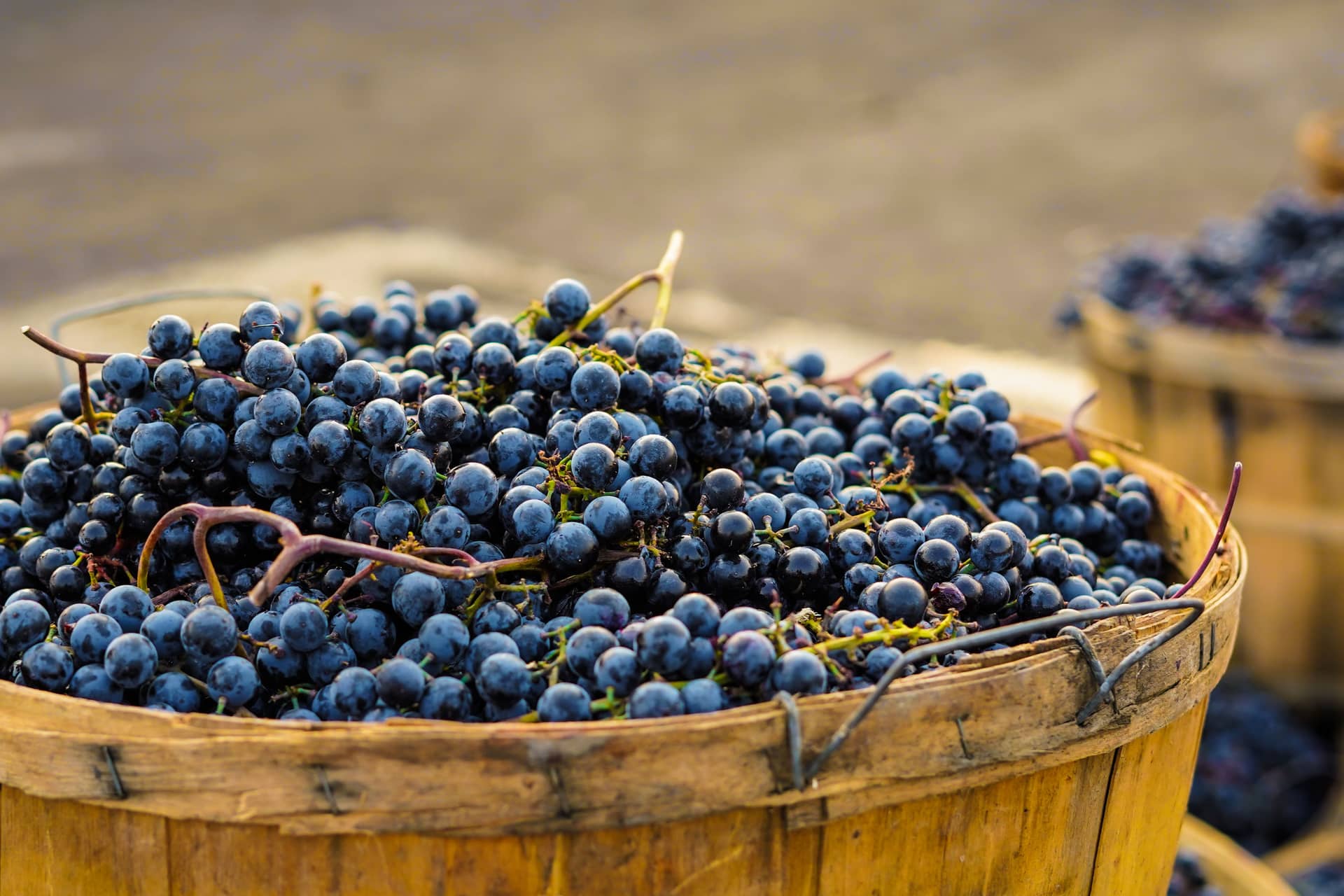
- Basket size against your harvest. The NCHFP puts a lug of grapes at 26 pounds, yielding 7 to 9 quarts of juice. A small basket turns that into many rounds.
- Your cooktop and your clearance. A stacked juicer is tall. Check induction compatibility if you need it, and measure the space under your hood.
- Specifications we could verify. Capacities, materials and included parts from the maker's own page, not from reseller copy.
The three picks, side by side
| Norpro 619 | Kitchen Crop VKP1150 | Cook N Home 11-qt | |
|---|---|---|---|
| Fruit basket | 11.75 qt | 8 qt | 11 qt per product name; not broken out |
| Juice container | 4 qt | 4 qt | Not published |
| Water pot | 7.25 qt | 8 qt | Not published |
| Material | Professional gauge stainless | 18/8 stainless, clad bottom | Stainless, aluminum-layered base |
| Lid | Not stated | Tempered glass | Not stated |
| Induction | Yes | Yes | Yes |
| Dishwasher | Not stated | Yes | Yes, hand washing recommended |
| Warranty | Not stated | 5 years | Not stated |
Two things stand out. The Norpro has the largest basket with a clearly published figure, and the Kitchen Crop is the only one whose maker confirms both of the features ISU suggests: stainless and a glass lid. The Cook N Home is the budget route, with the caveat that its own product page gives two different capacities.
Quick picks
Every pick below is screened against the National Center for Home Food Preservation’s published canner rules first. Tap a row for the full write-up.
| # | Product | Best for | Key spec | Price |
|---|---|---|---|---|
| 1 |  Norpro 619 Stainless Steel Steamer/JuicerThe largest fruit basket of our picks and the most complete published spec sheet: an 11.75-quart steamer insert over a 4-quart juice container and a 7.25-quart water pot, all stainless, on an encapsulated base Norpro lists for induction. It is the most expensive of the three, and what the money buys is more fruit per load when the grapes arrive by the lug. | The biggest fruit basket | 11.75 qt steamer insert | $182.29 · View on Amazon#ad we earn a commission · price as of October 18, 2026 |
| 2 |  Kitchen Crop Vineyard Deluxe Steam Juicer (VKP1150)The pick that matches Iowa State University Extension's advice most directly: 18/8 stainless steel rather than aluminum, and a tempered glass lid so you can see how the fruit is doing without lifting it. The fruit basket is smaller at 8 quarts, but the parts are dishwasher safe and Kitchen Crop backs it with a five-year warranty. | A glass lid and dishwasher-safe parts | 8 qt colander, glass lid | $139.99 · View on Amazon#ad we earn a commission · price as of October 18, 2026 |
| 3 |  Cook N Home 11-Quart Stainless Steel Steam Juice ExtractorThe least expensive of our three picks. It has the same stacked design, a hose with a clamp, and a base rated for induction. What you give up is detail: the maker's own page says 11 quarts in the product name and 6 quarts in its spec table, and lists no per-pan capacities, so we cannot size the basket for you with confidence. | Trying steam juicing on a budget | 11 qt, induction-ready | $112.49 · View on Amazon#ad we earn a commission · price as of October 18, 2026 |
| 4 | Bottling juice straight from the hose, unprocessedSkipMany recipes say to run hot juice from the hose into sterilized jars, cap them and let them seal on the counter. Iowa State University Extension says plainly that this is not a safe practice: to be shelf safe, fruit juice needs to be processed in a hot water bath. The steam juicer makes the juice. It does not can it. | Nothing - process the jars | Not a safe practice (ISU Extension) | Check price on Amazon#ad we earn a commission · live price pending |
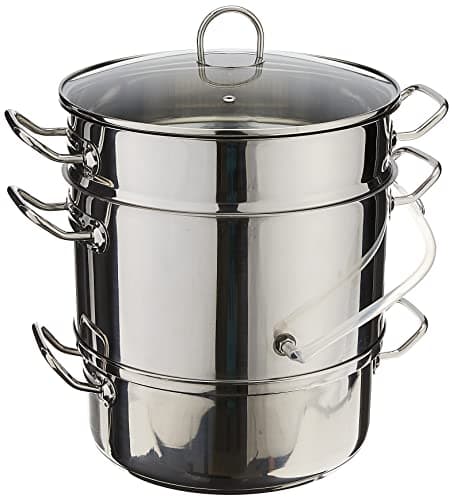
Norpro 619 Stainless Steel Steamer/Juicer
The largest fruit basket of our picks and the most complete published spec sheet: an 11.75-quart steamer insert over a 4-quart juice container and a 7.25-quart water pot, all stainless, on an encapsulated base Norpro lists for induction. It is the most expensive of the three, and what the money buys is more fruit per load when the grapes arrive by the lug.
Published specs
- Model
- 619
- Steamer insert
- 11.75 qt / 11 L
- Juice container
- 4 qt / 3.8 L
- Water pot
- 7.25 qt / 6.75 L
- Material
- Professional gauge stainless steel
- Base
- Encapsulated base, induction compatible (Norpro)
- Included
- Rubber tube and clamp, recipes and instructions
- Size and weight
- 18.5" x 15.25" x 11.5", 12.85 lb
What works
- At 11.75 quarts, the steamer insert is the largest basket among our picks, so each load takes more fruit and a big harvest takes fewer rounds
- Stainless steel throughout, which is the material Iowa State University Extension suggests choosing over aluminum
- Norpro also sells it as a roaster and stovetop cooker, oven safe to 400°F, so it has a job outside juice season
What to know first
- The most expensive of the three by a clear margin
- Norpro's specification page does not say whether the lid is glass. ISU Extension suggests a glass lid, so check the listing photos if that matters to you
- At 12.85 lb empty, a full, hot stack is a heavy thing to lift off the stove, and the size wants a clear burner with room around it
Specs from Norpro, 619 Stainless Steel Steamer/Juicer, Iowa State University Extension, Steam Juicing Fruits. We have not handled this product — see how we pick.
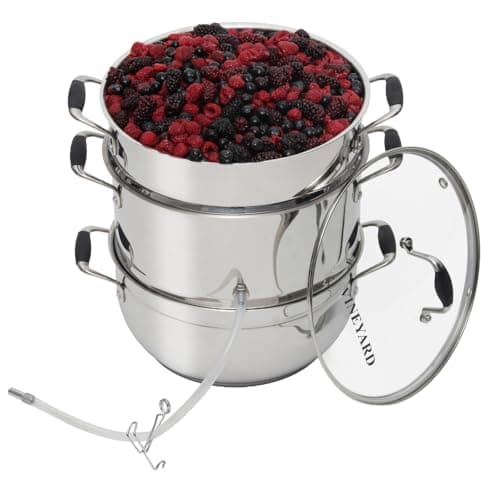
Kitchen Crop Vineyard Deluxe Steam Juicer (VKP1150)
The pick that matches Iowa State University Extension's advice most directly: 18/8 stainless steel rather than aluminum, and a tempered glass lid so you can see how the fruit is doing without lifting it. The fruit basket is smaller at 8 quarts, but the parts are dishwasher safe and Kitchen Crop backs it with a five-year warranty.
Published specs
- Model
- VKP1150
- Colander (fruit basket)
- 8 qt
- Juice kettle
- 4 qt
- Water pot
- 8 qt
- Material
- 18/8 stainless steel, clad bottom
- Lid
- Tempered glass
- Cooktops
- Induction and smooth-top ranges
- Hose and clamp
- Silicone hose, chrome-plated steel clamp
- Assembled height
- 16"
- Care and warranty
- Dishwasher safe; 5-year warranty
What works
- A tempered glass lid on an 18/8 stainless body: both of the features ISU Extension suggests looking for in a steam juicer
- Kitchen Crop lists the parts as dishwasher safe, which is welcome after a long day of sticky grape juice
- Five-year warranty, and the bottom pot doubles as an oven roaster to 400°F
What to know first
- The 8-quart colander is the smallest fruit basket here, about two-thirds the size of the Norpro's, so a big harvest means more loads
- It stands 16 inches tall assembled. Check the clearance under your range hood or microwave before you buy
- Usually priced above the Cook N Home, despite holding less fruit per load
Specs from Kitchen Crop, Vineyard Deluxe Stainless Steel Steam Juicer VKP1150, Iowa State University Extension, Steam Juicing Fruits. We have not handled this product — see how we pick.
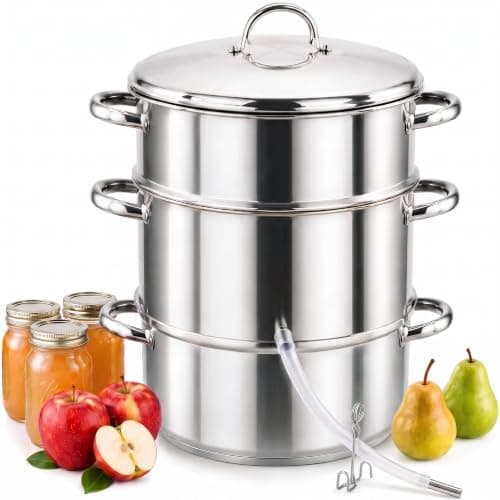
Cook N Home 11-Quart Stainless Steel Steam Juice Extractor
The least expensive of our three picks. It has the same stacked design, a hose with a clamp, and a base rated for induction. What you give up is detail: the maker's own page says 11 quarts in the product name and 6 quarts in its spec table, and lists no per-pan capacities, so we cannot size the basket for you with confidence.
Published specs
- Capacity
- 11 qt, per the product name (the spec table on the same page says 6 qt)
- Material
- Stainless steel levels with an aluminum-layered base
- Cooktops
- Any stovetop, including induction
- Included
- Water pan, juice pan, strainer/steamer pan, lid, hose with clamp
- Handles
- Side loop handles on each level; loop handle on the lid
- Care
- Dishwasher safe; hand washing recommended
What works
- Usually the least expensive of our picks, which makes sense if you are not yet sure a steam juicer will earn its cupboard space
- Stainless steel levels, which ISU Extension prefers over aluminum, with a layered base Cook N Home rates for any stovetop including induction
- Loop handles on every level make it easier to lift the fruit basket off a hot stack
What to know first
- The manufacturer's page contradicts itself on capacity and gives no per-pan figures, so you are buying with less information than the other two picks give you
- The page does not say whether the lid is glass, one of the two features ISU Extension suggests looking for
- Dishwasher safe on paper, but Cook N Home recommends hand washing, so plan on scrubbing it
Specs from Cook N Home, 11-Quart Stainless Steel Steam Juice Extractor, Iowa State University Extension, Steam Juicing Fruits. We have not handled this product — see how we pick.
Bottling juice straight from the hose, unprocessed
Many recipes say to run hot juice from the hose into sterilized jars, cap them and let them seal on the counter. Iowa State University Extension says plainly that this is not a safe practice: to be shelf safe, fruit juice needs to be processed in a hot water bath. The steam juicer makes the juice. It does not can it.
Published specs
- The shortcut
- Hot juice from the hose into jars, capped and left to seal as it cools
- ISU Extension
- Not a safe practice; fruit juice must be processed in a hot water bath to be shelf safe
- The tested route
- NCHFP grape juice: reheat to boiling, 1/4-inch headspace, 5 minutes for pints or quarts at 0-1,000 ft
What works
- It saves a few minutes, and that is the entire case for it. A lid that seals is not the same thing as a jar that was processed
What to know first
- ISU Extension calls it not a safe practice and says fruit juice must be processed in a hot water bath to be shelf safe
- The water bath it skips is short: 5 minutes for pints or quarts of grape juice at 0-1,000 ft, per the NCHFP
- If you do not want to process the jars, freeze the juice instead, which ISU Extension lists as an option
Specs from Iowa State University Extension, Steam Juicing Fruits, NCHFP, Grape Juice. We have not handled this product — see how we pick.
What the juicer replaces in the tested procedure
The National Center for Home Food Preservation's grape juice procedure extracts juice the traditional way: crush the stemmed grapes, add just enough boiling water to cover, simmer slowly for about 10 minutes until the skins are soft, then strain through a damp jelly bag or a double layer of cheesecloth. That is the step a steam juicer replaces. No crushing, no pot of simmering grapes to manage, and no bag hanging for hours while it drips.
It is worth being precise about the scope of that swap. The NCHFP procedure is written around its own extraction method, not around a steam juicer. The juicer takes the place of the extraction step only. Everything after extraction, from settling the juice to processing the jars, is still the tested procedure and should be followed as written.
From the hose to the shelf
For grape juice, the NCHFP procedure picks up once you have juice, and the apple juice procedure follows the same pattern with the same processing times:
- 1Settle it. Refrigerate the juice for 24 to 48 hours. Without mixing, carefully pour off the clear liquid and discard the sediment. For clearer juice, strain it through a paper coffee filter.
- 2Sweeten if you like. Sweeten to taste in a saucepan and stir until the sugar dissolves. This is optional; ISU Extension notes sugar may be added before canning or freezing if desired.
- 3Bring it to a boil. Keep heating, stirring occasionally, until the juice begins to boil.
- 4Fill immediately. Leave 1/4-inch headspace. The NCHFP apple juice procedure calls for sterile pint or quart jars and clean half-gallon jars. See how to sterilize canning jars.
- 5Process in a boiling water canner for the time that matches your jar size and altitude, below.
| Jar size | 0-1,000 ft | 1,001-6,000 ft | Above 6,000 ft |
|---|---|---|---|
| Pints or quarts | 5 min | 10 min | 15 min |
| Half-gallons | 10 min | 15 min | 20 min |
Half-gallon jars finally make sense
Juice is the one place in home canning where half-gallon jars are the right tool. The NCHFP permits them only for very acid juices, and grape and apple juice both have tested half-gallon processing times: 10 minutes at 0-1,000 feet. A steam juicer produces juice in the volume that makes those jars worthwhile, and it halves the number of jars a juice day fills. What the limit means in practice is in half-gallon canning jars.
Two practical notes. A half-gallon jar is tall, so check that your water bath canner can cover them with water before you fill a batch. And the permission is narrow: it covers very acid juices like grape and apple, not juice blends you have invented, and not tomato juice.
Tomatoes: juice them the other way
OSU Extension lists tomatoes among the produce that works in a steam juicer, and it does make tomato juice you can drink or cook with. Canning it is a different matter. The NCHFP's tested tomato juice is made by crushing and boiling quartered tomatoes, then pressing the hot juice through a sieve or food mill to remove skins and seeds, so the pulp goes into the jar with the juice. It is then acidified, filled with 1/2-inch headspace, and processed 35 minutes for pints or 40 minutes for quarts at 0-1,000 feet.
A steam juicer leaves the pulp behind in the basket, so what it produces is not the product that procedure was written for, and we did not find a tested canning process for steam-extracted tomato juice. Use it fresh or freeze it. If canned tomato juice is the goal, a food mill or tomato strainer is the tool the tested recipe uses, and the acid is required either way.
Jelly, syrup and the freezer
Not every jar of steam-juiced fruit needs to be juice. OSU Extension points out the other obvious route: add sugar and pectin and you have jelly. Steam juice is a natural starting point for it, because you have skipped the jelly bag already. Use a tested jelly recipe that starts from prepared juice, and follow its sugar, pectin and processing instructions as written — which pectin it calls for matters, because the types are not interchangeable. Jelly is one of the most forgiving foods in a water bath, but the recipe still decides the set and the safety.
The freezer is the simplest option of all. ISU Extension lists freezing as an alternative to canning, and sugar can go in beforehand if you like. Leave room in the container for the juice to expand as it freezes. If you juice a small batch, or you are not ready to run a canner that day, freezing is the honest answer rather than the hot-fill shortcut.
Using one safely on the stove
- Watch the water. The bottom pan boiling dry is the main way a juice day goes wrong. OSU Extension's tip: put a few inches of water and a handful of marbles in the bottom pan. The marbles rattle when the water gets low, telling you to add more.
- Respect the juice. OSU's instruction is to be very careful, because the juice will be hot. Have the jar or container in place before you release the clamp.
- Keep the stack level. A juicer full of fruit and water is heavy and tall. Use a burner that suits the base, and do not slide a loaded stack across the cooktop.
- Check the height first. A stacked juicer is tall; the Kitchen Crop is 16 inches assembled. Measure the space under your range hood or microwave, and see will it fit your stove if you are not sure.
- Plan for the pulp. When the fruit has given up its juice, the basket holds hot, collapsed skins and seeds. Let it cool before you empty it.
Which one to buy
If you have grapevines, an old apple tree or a berry patch that produces more than you can eat, buy the Norpro 619 for its large basket and stainless construction, and check its listing photos for the lid. If you want the model that lines up best with extension advice, with a glass lid, dishwasher-safe parts and a five-year warranty, buy the Kitchen Crop VKP1150 and accept more loads for a big harvest. If you want to find out whether steam juicing suits you before spending more, the Cook N Home is the budget route, bought knowing its maker's specs are thin.
Whichever you choose, the juicer ends at the hose. Settle the juice, boil it, fill the jars, and process them. Five minutes in a boiling water canner is not what stands between you and a shelf of grape juice. It is what makes the shelf safe.
Next stepHalf-gallon jars, the juice jarCommon questions
Can you can juice straight from a steam juicer without a water bath?
How long do you water bath grape juice?
Is a stainless steel or aluminum steam juicer better?
What fruits can you use in a steam juicer?
How long does it take to steam juice fruit?
Can I can tomato juice made in a steam juicer?
Can I use half-gallon jars for juice?
Why does grape juice sit in the fridge before canning?
Can I freeze steam-juiced fruit juice instead of canning it?
Do you earn a commission on these?
Sources
- Iowa State University Extension — Steam Juicing Fruits
- Oregon State University Extension — Steam juicer
- NCHFP — Grape Juice
- NCHFP — Apple Juice
- NCHFP — Tomato Juice
- NCHFP — Recommended Jars and Lids
- Norpro — 619 Stainless Steel Steamer/Juicer
- Kitchen Crop — Vineyard Deluxe Steam Juicer VKP1150
- Cook N Home — 11-Quart Steam Juice Extractor
Product specifications are taken from each manufacturer’s own published page, cited on the product. We have not handled these products — how we pick.