The best vinegar for pickling
One number on the label decides whether a jar of pickles is safe. Everything else about vinegar is flavor.
Disclosure: we earn a commission on purchases made through links on this page, at no extra cost to you. It does not change what we recommend — see how we pick and our affiliate disclosure.
Buy distilled white or cider vinegar labeled 5% acidity (50 grain). The NCHFP recommends exactly those two at that strength, and tested pickle recipes are balanced around it. Do not dilute it, do not use homemade vinegar of unknown strength, and do not use cleaning vinegar. White keeps pale vegetables pale; cider adds flavor and darkens them.
Vinegar is the only ingredient in a jar of pickles doing safety work. The cucumbers contribute nothing, the salt is mostly flavor and texture, and the spices are decoration. What keeps the jar below the pH where *Clostridium botulinum* can grow is the acid, and the recipe was written assuming a specific strength of it.
That makes this the rare buying decision where the cheapest bottle that meets the spec is genuinely the right answer — and where a nicer, pricier bottle can be the wrong one.
The number that matters: 5% acidity
The NCHFP's pickling guidance is short and specific: "White distilled and cider vinegars of 5 percent acidity (50 grain) are recommended." It follows that with the instruction people skip: "Do not alter vinegar, food, or water proportions in a recipe or use a vinegar with unknown acidity."
The reason is the pH boundary. Pickling works by bringing the finished product to pH 4.6 or below, which the University of Minnesota Extension states plainly — pickling "preserve[s] produce by lowering the pH of the food to 4.60 or below." The NCHFP puts the consequence in one sentence: "There must be a minimum, uniform level of acid throughout the mixed product to prevent the growth of botulinum bacteria." The jar is the other half of a tested pickle recipe, and it is narrower than people expect: the best jars for pickling.
How we screened these
We have not run acid titrations on supermarket vinegar. What we checked is the label claim against what extension services say a tested recipe needs, plus the practical questions — format, flavor, and what a gallon costs when you need three of them. The method is on how we pick.
- 5% acidity, stated on the label. Penn State Extension: "Vinegar used for pickling must at least 5% acidity." If a bottle does not say, it does not qualify.
- Food vinegar, not cleaning vinegar. The same guidance rules out vinegars sold for cleaning or horticulture.
- White or cider. Those are the two the NCHFP names. Specialty vinegars only when a research-tested recipe calls for them.
- Format that suits a canning day. A gallon is cheaper per ounce; bottles are easier to measure from. Both are valid answers.
- Availability in season. The gallon jugs vanish in September, which is worth planning around.
White or cider: the only real flavor decision
Both are permitted at 5%, so this is genuinely a taste and appearance question rather than a safety one. Penn State is explicit: "If your research-tested recipe does not specify a particular type of vinegar, you may safely use either white or cider vinegar as long as it is labeled as 5% acidity."
| Distilled white | Cider | |
|---|---|---|
| Flavor | Sharp and neutral | Fruity, rounder |
| Color effect | Leaves pale produce pale | Darkens light-colored fruit and vegetables |
| Classic uses | Dill pickles, cauliflower, onions, pears | Bread-and-butter pickles, relishes, chutneys |
| Clarity | Clear brine | Cloudier, especially unfiltered cider |
| Cost | The cheapest acid you can buy | Several times the price per ounce |
New Mexico State Extension states the color point directly: "Cider vinegar tends to darken light-colored fruits and vegetables, so white distilled vinegar is often selected for a clear appearance." If you are canning cauliflower or pears and want them to look like cauliflower and pears, use white.
Quick picks
Every pick below is screened against the National Center for Home Food Preservation’s published canner rules first. Tap a row for the full write-up.
| # | Product | Best for | Key spec | Price |
|---|---|---|---|---|
| 1 |  Iberia Distilled White Vinegar, 1 GallonA gallon of plain 5% distilled white vinegar is what most tested pickle recipes are written around, and buying it by the gallon is the difference between a calm pickling day and a mid-brine trip to the store. Nothing about this bottle is special, which is the point: the label says 5% acidity and the contents are neutral enough to leave cauliflower and onions the color they started. | The default pickling vinegar | 5% acidity, 1 gallon | $12.99 · View on Amazon#ad we earn a commission · price as of October 18, 2026 |
| 2 | Bragg Organic Apple Cider Vinegar with the Mother, 128 ozCider vinegar is the other vinegar tested recipes name, and Bragg publishes the number that matters: "we bottle our Organic Apple Cider Vinegar at 5% acidity." Use it where its fruitiness earns its place — bread-and-butter pickles, chutneys, relishes — and accept that it will darken pale vegetables. | Flavor, where color does not matter | 5% acidity, raw and unfiltered | Check price on Amazon#ad we earn a commission · live price pending |
| 3 |  Lucy's Family Owned Distilled White Vinegar, 1 GallonThe same job as any other 5% white vinegar, from a brand that tends to stay in stock through pickling season when the supermarket gallon jugs disappear. It is priced above the cheapest gallon on the shelf; what you are buying is availability in September. | When the shelf is bare | 5% acidity, 1 gallon | |
| 4 | Cleaning and horticultural vinegarSkipThe gallon jug beside the food vinegar is often 6%, 30% or even 45% acid, sold for cleaning and weeds. Penn State Extension is direct about it: "Do not use vinegars intended for cleaning or for horticultural purposes." Higher acid is not a safety bonus here — these are not food-grade products, and a tested recipe is balanced around 5%. | Nothing - it is not food | Not intended for food preservation | Check price on Amazon#ad we earn a commission · live price pending |
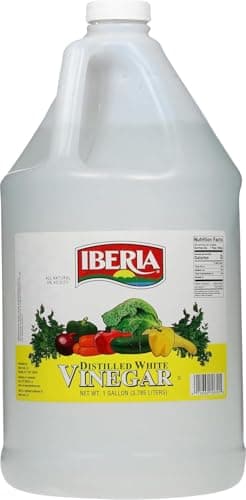
Iberia Distilled White Vinegar, 1 Gallon
A gallon of plain 5% distilled white vinegar is what most tested pickle recipes are written around, and buying it by the gallon is the difference between a calm pickling day and a mid-brine trip to the store. Nothing about this bottle is special, which is the point: the label says 5% acidity and the contents are neutral enough to leave cauliflower and onions the color they started.
Published specs
- Acidity
- 5% (50 grain), as labeled
- Size
- 1 gallon
- Type
- Distilled white
- Where it fits
- Any tested recipe calling for 5% white vinegar
What works
- 5% acidity on the label, which is the number every tested pickle recipe assumes
- Distilled white keeps light-colored produce light — extension services suggest it for cauliflower, onions and pears
- A gallon covers a full canner load of quarts with room to spare, and the per-ounce cost is the lowest of any format
What to know first
- Flavor is flat and sharp by design. If you want the fruitiness cider vinegar brings, this is not it
- A gallon jug is awkward to pour from into a measuring cup, and pickling day involves a lot of measuring
- Check the label on arrival. Some white vinegars now sold in supermarkets are 4%, which extension services say is not adequate for canning
Specs from NCHFP, General Information on Pickling, Clemson Cooperative Extension, Pickle Basics. We have not handled this product — see how we pick.
Bragg Organic Apple Cider Vinegar with the Mother, 128 oz
Cider vinegar is the other vinegar tested recipes name, and Bragg publishes the number that matters: "we bottle our Organic Apple Cider Vinegar at 5% acidity." Use it where its fruitiness earns its place — bread-and-butter pickles, chutneys, relishes — and accept that it will darken pale vegetables.
Published specs
- Acidity
- 5%, published by Bragg
- Size
- 128 oz (1 gallon) jug
- Type
- Organic cider vinegar, raw and unfiltered, with the mother
- Per tablespoon
- About 750 mg acetic acid (Bragg)
What works
- Bragg states 5% acidity outright, which is more than most cider vinegar labels make easy to confirm
- Real cider flavor, which matters in bread-and-butter pickles, relishes and chutneys where the brine is part of the taste
- The gallon is the format that suits a canning day, and one jug covers even a bread-and-butter batch, which takes nearly seven cups of vinegar
What to know first
- Cider vinegar darkens white and light-colored produce — extension services point to white distilled for cauliflower, onions and pears
- The unfiltered mother makes for a cloudy brine, which is harmless but looks like a spoilage cue to anyone who does not know
- Costs more per ounce than a gallon of distilled white, and a gallon is more cider vinegar than a household making the occasional bread-and-butter batch will get through
Specs from Bragg, Acetic Acid, Clemson Cooperative Extension, Pickle Basics. We have not handled this product — see how we pick.
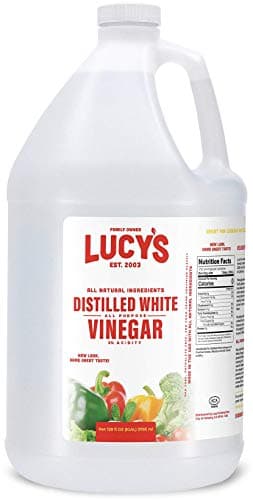
Lucy's Family Owned Distilled White Vinegar, 1 Gallon
The same job as any other 5% white vinegar, from a brand that tends to stay in stock through pickling season when the supermarket gallon jugs disappear. It is priced above the cheapest gallon on the shelf; what you are buying is availability in September.
Published specs
- Acidity
- 5% (50 grain), as labeled
- Size
- 1 gallon
- Type
- Distilled white
- Also sold as
- 32 oz bottles, in pairs
What works
- Labeled 5% acidity, so it drops straight into a tested recipe
- Reliably available online in the weeks when supermarket vinegar shelves are stripped
- The 32 oz bottles are easier to pour and measure from than a gallon jug if you pickle in small batches
What to know first
- Costs meaningfully more per ounce than the cheapest supermarket gallon of the identical product
- No flavor advantage over any other distilled white vinegar — it is a commodity, and paying more does not make a better pickle
- Same awkward gallon jug pour as every other gallon
Specs from NCHFP, General Information on Pickling, Penn State Extension, Advice about Vinegar. We have not handled this product — see how we pick.
Cleaning and horticultural vinegar
The gallon jug beside the food vinegar is often 6%, 30% or even 45% acid, sold for cleaning and weeds. Penn State Extension is direct about it: "Do not use vinegars intended for cleaning or for horticultural purposes." Higher acid is not a safety bonus here — these are not food-grade products, and a tested recipe is balanced around 5%.
Published specs
- What it is
- Vinegar sold for cleaning or weed control, often 6% to 45% acid
- Penn State Extension
- "Do not use vinegars intended for cleaning or for horticultural purposes. Some can be extremely high in acid (11-30%), one is 75% acidity. These are not intended for food preservation."
- Buy instead
- Distilled white or cider vinegar labeled 5% acidity
What works
- It is cheaper per ounce, and genuinely useful for descaling a kettle. That is the entire case, and it has nothing to do with jars
What to know first
- Not sold as a food product, so it is not held to food-grade standards
- The acidity is wrong for the recipe: tested pickle recipes are balanced around 5%, and stronger acid changes the product rather than improving safety
- Specialty and flavored vinegars fall in the same bucket — extension guidance is to use them only when a research-tested recipe names them
Specs from Penn State Extension, Advice about Vinegar, UC Master Food Preservers, About That Vinegar - Read The Label!. We have not handled this product — see how we pick.
Four things never to do with pickling vinegar
- Do not dilute it. Clemson: "Do not dilute vinegar unless the recipe specifies." If the result is too sour, their fix is to "add sugar rather than dilute the vinegar."
- Do not use homemade vinegar. Its strength is unknown and inconsistent, which is the one property a pickling ingredient cannot have.
- Do not swap in specialty vinegars. Wine, malt, balsamic and flavored vinegars go in only when a research-tested recipe names them.
- Do not reduce the amount. NMSU: "do not reduce the amount of vinegar called for in a recipe." Less vinegar is less acid, and the ratio is the recipe.
If you already used 4% vinegar
This happens, and South Dakota State University Extension publishes the answer rather than leaving you to guess. Their guidance: if the food has been preserved for less than 24 hours using 4% vinegar, refrigerate the jars and treat them as refrigerator pickles. If it has been more than 24 hours, discard the product.
It is a hard line, and it is the right one. A jar that is fractionally short on acid gives you no visible signal, and the failure mode is botulism rather than a bad taste. The cost of being wrong is a batch of cucumbers; the cost of being right is nothing.
What about the salt, the spices and the water?
Of the four things in a pickle brine, only one is fixed by safety. Penn State's guide to what can be changed in a canning recipe puts spices and herbs in the "may change" column, and Iowa State is blunter still: "Spices are the only safe ingredient you may change in a tested recipe to adjust for flavor." The vinegar, the water and the produce quantities all stay as written.
Salt is its own case. In a quick-process pickle it is largely flavor and crispness; in a fermented pickle it is doing preservation work and the amount matters. That distinction, and which salt to buy, is in canning salt. What goes in the cheesecloth bag is in the best pickling spice.
How much to buy
More than you think. A canner load of quart dill pickles from a standard mix takes over three cups of vinegar before you have opened a jar of anything else, and a bread-and-butter batch takes nearly seven. Two gallons covers a serious pickling weekend with a margin; one gallon covers a single batch and leaves you nervous.
Buy it in July. Vinegar keeps indefinitely, it costs almost nothing, and the gallon jugs are the second thing to disappear from supermarket shelves in canning season after the lids.
The decision, in one paragraph
For almost everything, buy the cheapest gallon of distilled white vinegar labeled 5% acidity you can find and stop thinking about it. Buy cider vinegar at 5% as a second bottle if you make bread-and-butter pickles, relishes or chutneys, and accept the darkening. Keep cleaning vinegar for the kettle. And whichever bottle you pick up, turn it around and read the acidity before it goes in the cart — that one habit is the whole of this page.
Next stepWhat goes in the brine with itCommon questions
What percentage vinegar do you need for pickling?
Can you use 4% vinegar for canning pickles?
Is white or apple cider vinegar better for pickles?
Can I dilute vinegar to make pickles less sour?
Can I use cleaning vinegar for pickling?
Can I use homemade vinegar for canning?
Can I substitute wine or balsamic vinegar in a pickle recipe?
How much vinegar does a batch of pickles take?
Does vinegar go bad?
Do you earn a commission on these?
Sources
- NCHFP — General Information on Pickling
- Penn State Extension — Advice about Vinegar
- Clemson Cooperative Extension — Pickle Basics
- UC Master Food Preservers — About That Vinegar, Read The Label
- SDSU Extension — Safety Concern with Vinegar Acidity Level in Home Canning
- NMSU Extension — Preparing and Canning Pickled and Fermented Foods
- University of Minnesota Extension — Pickling basics
- Iowa State University Extension — Here's to Crisp Pickles
- Penn State Extension — What Can You Change in a Canning Recipe?
- Bragg — Acetic Acid
Product specifications are taken from each manufacturer’s own published page, cited on the product. We have not handled these products — how we pick.