The best jars for pickling
Pickles are the one category where the jar is part of the recipe. Choose outside the two sizes your recipe publishes and there is no process time to follow.
Disclosure: we earn a commission on purchases made through links on this page, at no extra cost to you. It does not change what we recommend — see how we pick and our affiliate disclosure.
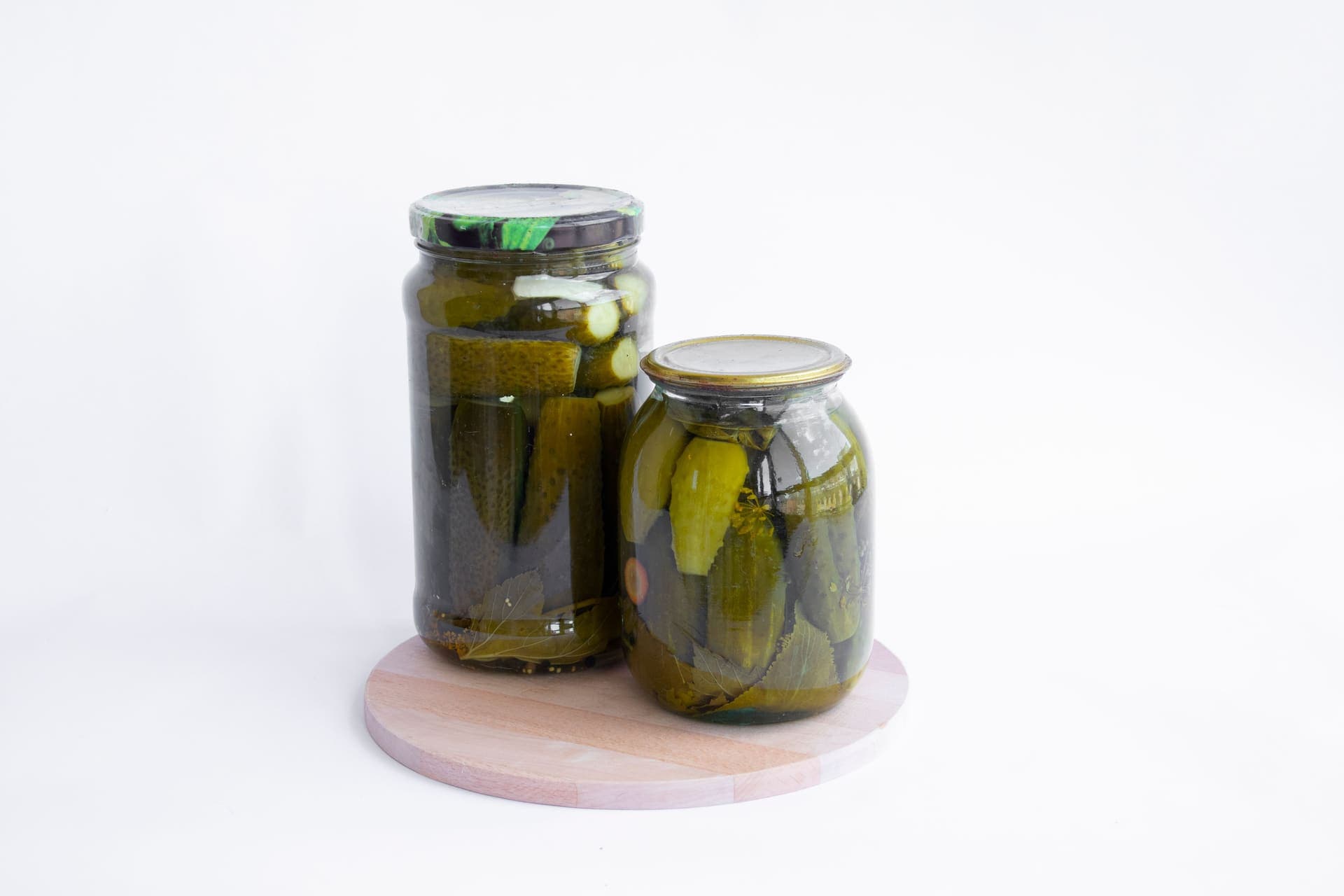
Buy wide-mouth quarts for spears and regular-mouth pints for everything else. Those are the two sizes tested pickle recipes publish times for - NCHFP's dill pickles give 10 minutes for pints and 15 for quarts - and a jar size your recipe does not list has no tested process. Wide mouth matters for spears because you are standing cucumbers upright; for rounds and relish, regular mouth is cheaper every season because the lids are.
Pickling is the one corner of canning where the jar is not a container choice. It is part of the process. The time in the recipe was developed by measuring how long heat took to reach the middle of a specific jar, packed a specific way, and the jar is in that measurement.
Which is why this page exists as something other than a repeat of the best canning jars. The general jar question is about mouth size and how many to buy. The pickling question is about which jars have a number attached, and the answer turns out to be narrower than the shelf at the shop suggests.
How we picked
One rule above all the others: a jar only makes this page if tested pickle recipes publish a process time for it. Everything else - price, looks, the per-jar cost of lids, how easy it is to pack - is a tiebreak between jars that already pass.
That is not an arbitrary standard. NCHFP states the general principle for pickle products plainly: "Use only recipes with tested proportions of ingredients," and "Do not alter vinegar, food, or water proportions in a recipe or use a vinegar with unknown acidity." The jar is the last variable in that list, and it is the one people change without noticing they have changed anything.
Quick picks
Every pick below is screened against the National Center for Home Food Preservation’s published canner rules first. Tap a row for the full write-up.
| # | Product | Best for | Key spec | Price |
|---|---|---|---|---|
| 1 |  Ball Wide Mouth Quart Jars (32 oz)The jar to buy when you are packing peach halves, pickle spears or anything you have to reach into. The wider 86 mm mouth is easier to fill and far easier to clean, and quarts are the standard size for tomatoes. | Whole fruit and packing by hand | 86 mm mouth, 32 oz | |
| 2 |  Ball Regular Mouth Pint Jars (16 oz)If you buy one case of jars this season, buy this one. Pints are the size most tested recipes are written for, regular-mouth lids are the cheapest and most available lid on any shelf, and the jars are reusable indefinitely. | The default first case | 70 mm mouth, 16 oz | $36.99 · View on Amazon#ad we earn a commission · price as of October 18, 2026 |
| 3 |  Ball Half-Pint Jelly Jars (8 oz)Small jars for the things you eat slowly. A half-pint of jam opens, gets used and gets finished before it goes dull in the fridge, and a full canner load of them processes in a fraction of the time a quart load does. | Jam, jelly and gifts | 8 oz / 1 cup | $45.99 · View on Amazon#ad we earn a commission · price as of October 18, 2026 |
| 4 |  Ball Pickle Crisp Granules (calcium chloride)The one additive on this page that is purely about texture, and the one most likely to fix the complaint people actually have about home pickles. It is calcium chloride, it firms the vegetable's natural pectin, and Iowa State Extension is clear that it does not change the pH or pose a safety risk. | Pickles that go soft | 1/8 tsp per pint | |
| 5 | Pint-and-a-half (24 oz) jars for picklesSkipIt looks like the perfect spear jar and the arithmetic does not support it. NCHFP's rule is that a 24-ounce jar takes the quart process time if the recipe publishes one - and if the recipe only lists pints, there is no tested process for that jar at all. Most pickle recipes list pints and quarts, so buy those. | Dry storage, not a tested pickle | No pint-and-a-half pickle process | Check price on Amazon#ad we earn a commission · live price pending |
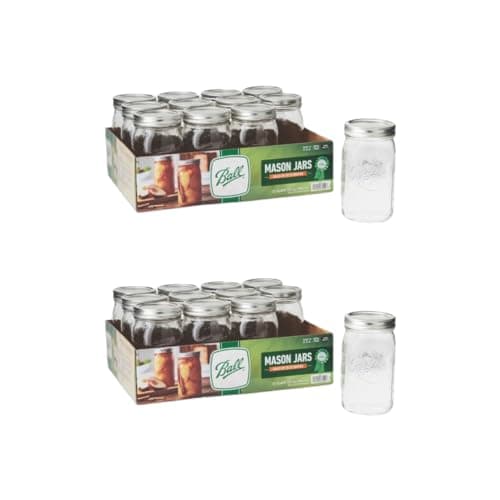
Ball Wide Mouth Quart Jars (32 oz)
The jar to buy when you are packing peach halves, pickle spears or anything you have to reach into. The wider 86 mm mouth is easier to fill and far easier to clean, and quarts are the standard size for tomatoes.
Published specs
- Volume
- 32 oz / 4 cups
- Mouth
- Wide, about 86 mm lid diameter
- Inner mouth diameter
- About 76 mm
- Jar dimensions
- About 6 1/2" tall x 3 1/4" wide
What works
- You can get a hand and a jar funnel into it, which turns packing peaches from a chore into a task
- Quart is the size the tomato and peach processing times in tested recipes are written around
- Much easier to wash by hand than a regular mouth quart
What to know first
- Wide mouth lids cost more than regular mouth and disappear from shelves first in peak season
- Seven quarts is a full canner load, so a quart-jar day is a longer day per jar of finished food
- A quart of anything low-acid still needs a pressure canner, and quarts take the longest processing times
Specs from Ball, Mason Jars & Lids, Wide Mouth. We have not handled this product — see how we pick.
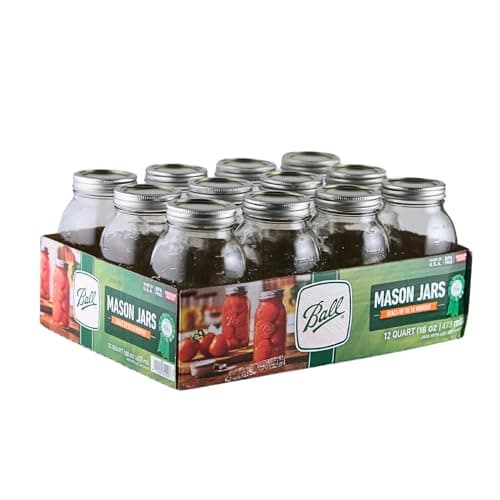
Ball Regular Mouth Pint Jars (16 oz)
If you buy one case of jars this season, buy this one. Pints are the size most tested recipes are written for, regular-mouth lids are the cheapest and most available lid on any shelf, and the jars are reusable indefinitely.
Published specs
- Volume
- 16 oz / 2 cups
- Mouth
- Regular, about 70 mm lid diameter
- Inner mouth diameter
- About 60 mm
- Jar dimensions
- About 5" tall x 2 3/4" wide
- Reuse
- Jars and rings reusable; flat lids are single-use
What works
- Pints fit both a water bath canner and a pressure canner comfortably, so the case is not stranded when you move up to beans
- Regular-mouth lids are the most stocked size in the country, which matters in September when shelves empty out
- The jars outlive everything else in this list. The consumable is the flat lid, not the glass
What to know first
- The narrower 60 mm opening is fiddly for whole peaches or large pickle spears — that is what wide mouth is for
- Regular and wide mouth lids are not interchangeable, so mixing both means stocking two lid sizes
- Glass. Handle the case like glass
Specs from Ball, Mason Jars & Lids, Regular Mouth. We have not handled this product — see how we pick.
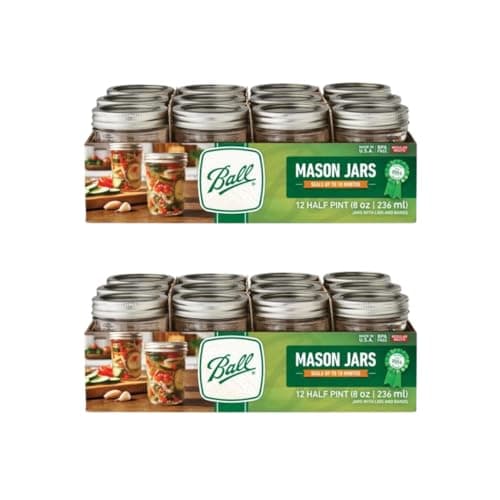
Ball Half-Pint Jelly Jars (8 oz)
Small jars for the things you eat slowly. A half-pint of jam opens, gets used and gets finished before it goes dull in the fridge, and a full canner load of them processes in a fraction of the time a quart load does.
Published specs
- Volume
- 8 oz / 1 cup
- Mouth
- Regular, about 70 mm lid diameter
- Jar dimensions
- About 3 3/4" tall x 2 3/8" wide
- Typical load
- 12 half-pints in a 21.5-quart canner rack
What works
- Short processing times, so a jam day is genuinely a morning rather than a day
- The right size for anything you open and use a spoonful of at a time
- Uses the same regular-mouth lids as pint jars, so no second lid size to stock
What to know first
- Too small to be useful for anything you cook with in volume
- More jars per batch means more lids, and lids are the recurring cost
- Easy to over-buy in a jam-making mood and then not use for a year
Specs from Ball, Mason Jars & Lids, Regular Mouth. We have not handled this product — see how we pick.
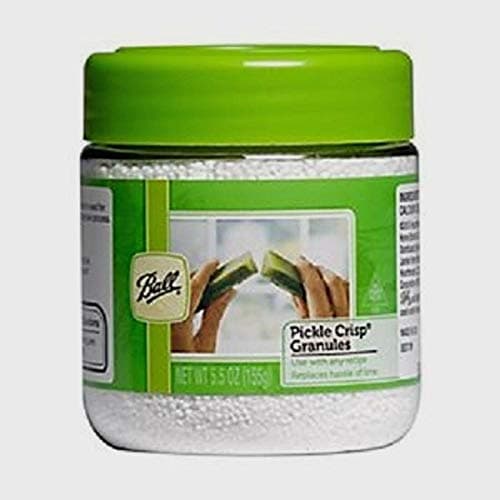
Ball Pickle Crisp Granules (calcium chloride)
The one additive on this page that is purely about texture, and the one most likely to fix the complaint people actually have about home pickles. It is calcium chloride, it firms the vegetable's natural pectin, and Iowa State Extension is clear that it does not change the pH or pose a safety risk.
Published specs
- What it is
- Calcium chloride
- What it does
- Iowa State Extension: it works by firming the natural pectin of the vegetable
- Dose
- Generally 1/8 teaspoon per pint and 1/4 teaspoon per quart
- Safety
- Does not have the hydroxide component of lime, so it does not change the pH of pickled food or pose a food safety risk
- Replaces
- Food-grade lime soaking, with less fuss
- Added
- To each jar before processing
What works
- It solves a real and common disappointment. Soft pickles are the single most-reported home canning letdown, and this addresses the cause rather than the recipe
- Because it does not shift pH, adding it does not invalidate the acidity a tested pickle recipe depends on — which is the reason most additives are a bad idea
- Far less work than the traditional pickling-lime soak, which needs repeated rinsing to get the lime back out
What to know first
- It is a texture aid and nothing more. It does not preserve, does not acidify, and does not extend a processing time
- Iowa State notes most recipes do not specifically state its use, and there are no established guidelines beyond pickles. Outside pickles you are on your own, and we would not
- It cannot rescue produce that was already limp. Firming works on a fresh, crisp cucumber, not on one that sat in a warm car
Specs from Iowa State University Extension, Calcium Chloride for Pickling Crispness. We have not handled this product — see how we pick.
Pint-and-a-half (24 oz) jars for pickles
It looks like the perfect spear jar and the arithmetic does not support it. NCHFP's rule is that a 24-ounce jar takes the quart process time if the recipe publishes one - and if the recipe only lists pints, there is no tested process for that jar at all. Most pickle recipes list pints and quarts, so buy those.
Published specs
- NCHFP, on in-between sizes
- "These are between pint and quart size jars, so you would use the quart process time if one is available"
- NCHFP, when there is no quart time
- "there is no tested process available for a 24-, 28- or quart size jar"
- NCHFP, on extrapolating
- "there is not a formula to be able to say how to increase the process time for a larger jar"
- Recognized as a Mason size
- NCHFP lists 1 1/2 pint among Mason-type jar sizes
- Buy instead
- Wide-mouth quarts for spears, pints for rounds and relish
What works
- It is a real Mason size and a genuinely useful storage jar, and where a recipe does publish a quart time you may use that time in a 24-ounce jar
What to know first
- Nearly every tested pickle recipe publishes pints and quarts, so the 24-ounce jar is either redundant or unprocessable depending on which one you were reaching for
- The branded options are thin - most 24-ounce wide-mouth listings are unbranded, with no manufacturer page behind the glass
- Using the pint time because the jar is closer to a pint is exactly the error NCHFP's rule exists to prevent
Specs from NCHFP, Jar Size Choices Have You Frustrated?, NCHFP, Recommended Jars and Lids. We have not handled this product — see how we pick.
The two sizes, and the numbers behind them
NCHFP's fermented dill pickle recipe is the clearest example because it publishes both sizes and both times. Fill the jar "leaving 1/2-inch headspace," then process in a boiling-water canner:
| Jar | 0-1,000 ft | 1,001-6,000 ft | Above 6,000 ft |
|---|---|---|---|
| Pints | 10 min | 15 min | 20 min |
| Quarts | 15 min | 20 min | 25 min |
Fifty per cent more time, for identical cucumbers in identical brine. That gap is heat penetration, and it is why there is no arithmetic you can do to invent a time for a jar nobody tested. Altitude goes on top of it, and if you do not know yours, altitude adjustment for canning has the table.
Why the pint-and-a-half jar is a trap
A 24-ounce wide-mouth jar looks like the perfect spear jar - taller than a pint, cheaper and lighter than a quart. NCHFP's own blog answers the question directly, and the answer has two halves.
First: "These are between pint and quart size jars, so you would use the quart process time if one is available." Second, and this is the half that matters: "there is no tested process available for a 24-, 28- or quart size jar" when the recipe lists only pints or half-pints. And there is no way around it, because "there is not a formula to be able to say how to increase the process time for a larger jar."
So the 24-ounce jar is only usable where your recipe happens to publish a quart time, and then it is doing nothing a quart would not do. Reach for it because it is the right height and use the pint time because it is nearer a pint, and you have under-processed the batch. NCHFP's half-pint rule runs the other way and is safe: "use the process time for the next size larger jar than you have."
Mouth size, for this job specifically
Wide mouth earns its premium on spears and loses it on everything else. A quart of cucumber spears is packed standing up, by hand, against the glass - a three-inch opening is the difference between arranging them and wrestling them. A quart of relish or sliced rounds pours through a funnel either way.
- Spears and whole small cucumbers: wide-mouth quarts. You are packing vertically and the shoulder is the obstacle.
- Sliced rounds, bread-and-butter, pickled beans: regular-mouth pints. Cheaper jars, cheaper lids, and nothing about the pack needs the extra inch.
- Relish, chutney, pickled jalapeño rings: half-pint jelly jars. A pint of relish opened in January is a pint of relish you will not finish.
- Pickled whole beets or large cauliflower florets: wide-mouth quarts again, for the same packing reason as spears.
The season-over-season cost argument is the real one, and it is not about the glass: wide-mouth flat lids cost more than regular-mouth lids every single year, forever, because the lid is the consumable. The full comparison is wide mouth vs regular mouth.
Headspace, and the thing that is not headspace
Half an inch for pickles, per the NCHFP recipe above - less than the inch a low-acid vegetable gets in a pressure canner, and more than the quarter-inch a jam gets. Measure it rather than eyeballing it; the bubble remover in most tool sets has the scale printed on it.
Separately, and this is where pickle questions usually end up: softness is not a jar problem. NCHFP notes that "The level of acidity in a pickled product is as important to its safety as it is to taste and texture," and that firmness comes from calcium rather than from a different jar - "The calcium in lime definitely improves pickle firmness." The modern, safe version of that is calcium chloride, and it is covered in canning additives and firming agents.
The rest of the pickle shopping list
The jar is the part nobody tells you is load-bearing. The two parts everybody asks about are the vinegar and the spice, and both have a hard requirement behind them rather than a preference.
- Vinegar at 5% acidity, stated on the label, because the recipe's safety is a dilution calculation. Best vinegar for pickling.
- Whole pickling spice, not ground, which is about the brine staying clear as much as the flavor. Best pickling spice.
- Canning or pickling salt, where in a fermented pickle the type genuinely matters. Canning salt.
- New flat lids every time, which is not negotiable and not a brand question. Best canning lids.
The decision, in one paragraph
Buy a case of wide-mouth quarts if you are making dill spears, because packing them is the only part of pickling the jar can make hard. Buy regular-mouth pints for rounds, beans and bread-and-butter, and save the lid money every year after. Add half-pint jelly jars for relish, because the portion is the point. Add Pickle Crisp if your last batch went soft. And buy the jar size your recipe publishes a time for, which in practice means pints and quarts and nothing in between.
Next stepThe 5% rule on the vinegarCommon questions
What size jars are best for pickling?
Can I use 24 oz jars for pickles?
Do I need wide mouth jars for pickles?
How much headspace do pickles need?
Can I use half-gallon jars for pickles?
Can I use a smaller jar than the recipe says?
Why did my pickles go soft?
Do pickling jars need to be sterilized?
Do you earn a commission on these?
Sources
- NCHFP — Dill Pickles (jar sizes, headspace and process times)
- NCHFP — General Information on Pickling
- NCHFP — Jar Size Choices Have You Frustrated?
- NCHFP — Recommended Jars and Lids
- Ball — Mason Jars & Lids, Wide Mouth
- Ball — Mason Jars & Lids, Regular Mouth
Product specifications are taken from each manufacturer’s own published page, cited on the product. We have not handled these products — how we pick.