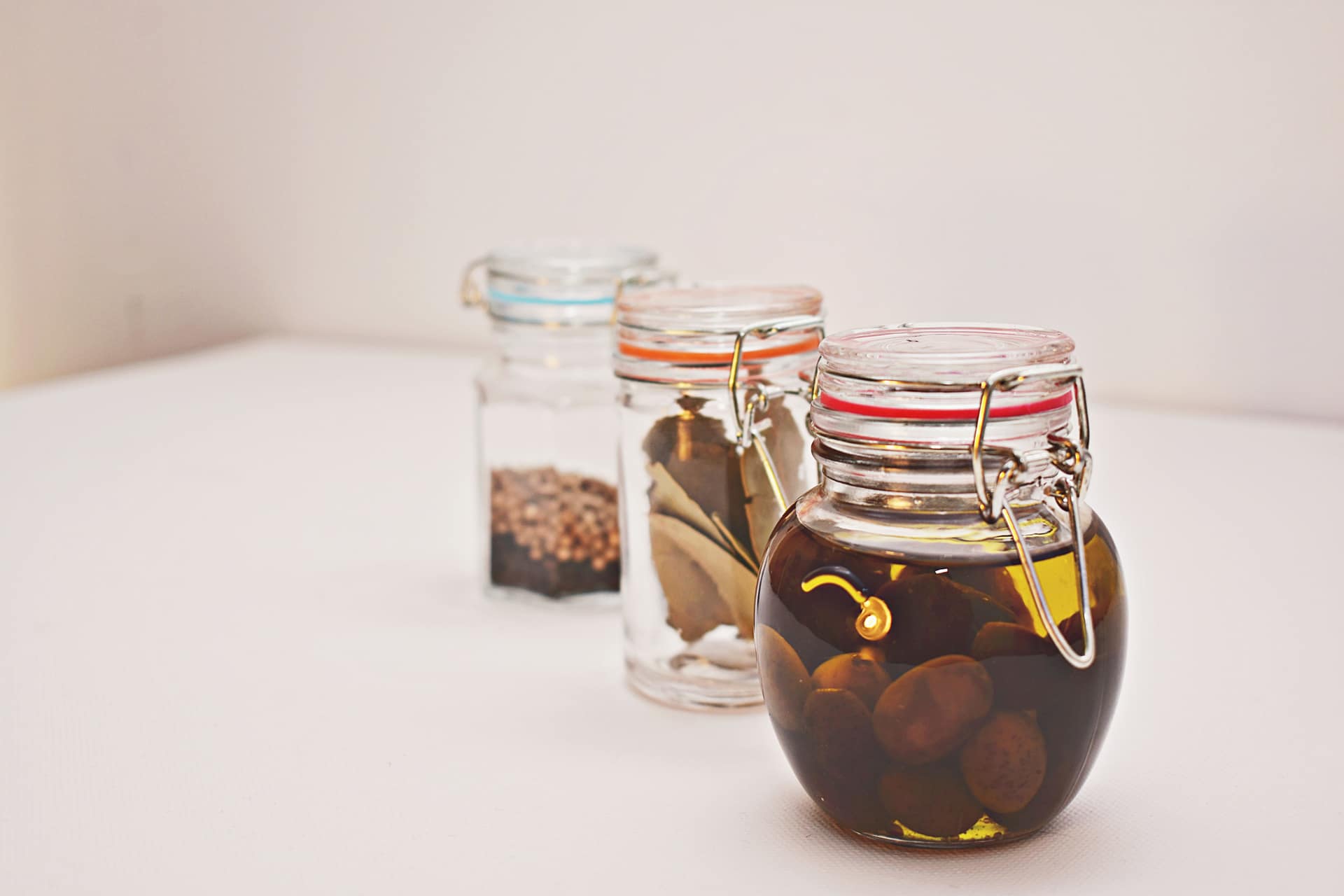
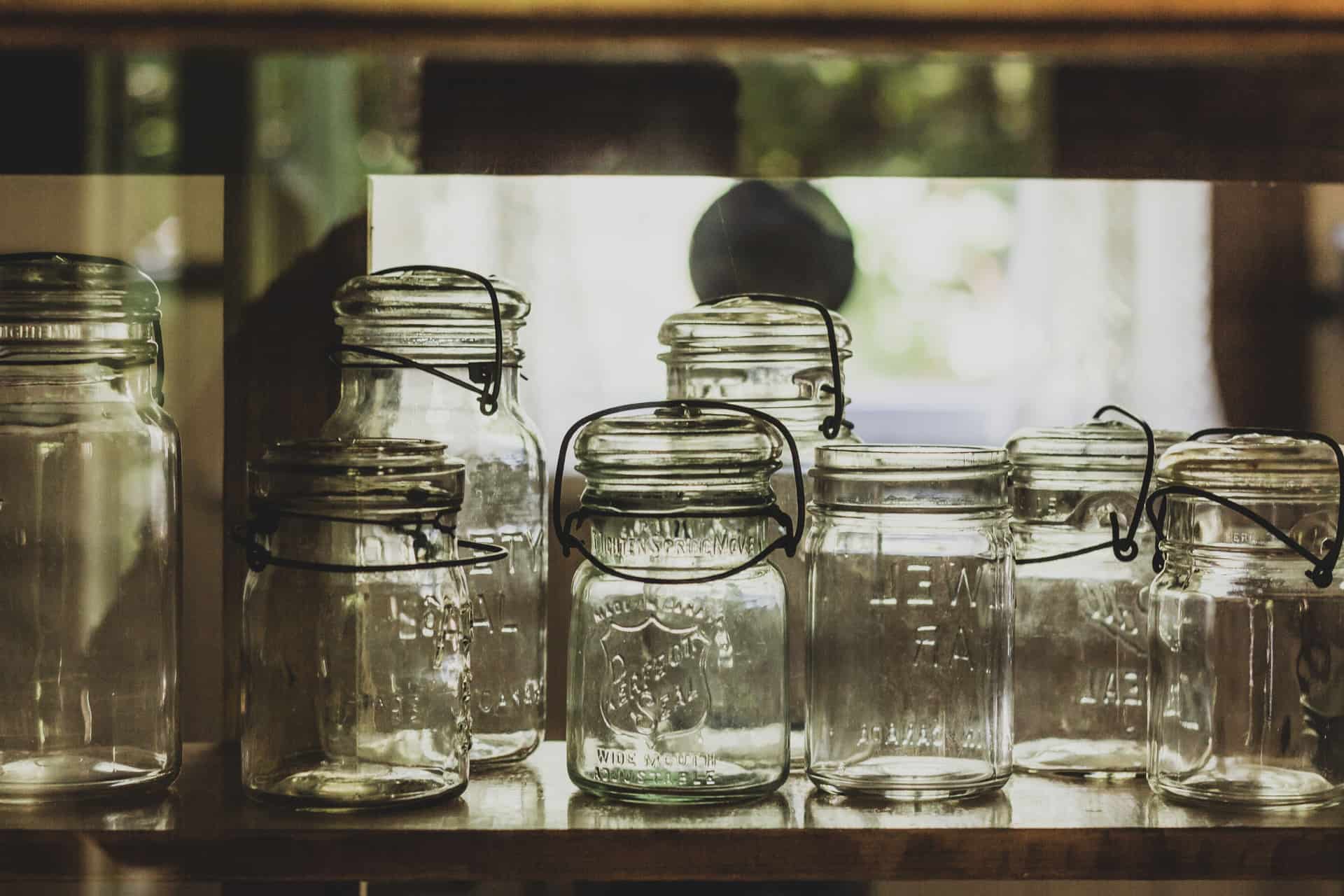
European canning jars vs Mason jars
Kilner, Le Parfait and Fido make excellent glass. The closure is the problem — and the makers and the US guidance flatly disagree about it.
Disclosure: we earn a commission on purchases made through links on this page, at no extra cost to you. It does not change what we recommend — see how we pick and our affiliate disclosure.
Not for US canning processes. The NCHFP says jars with wire bails and glass caps "make attractive antiques or storage containers for dry food ingredients but are not recommended for use in canning." Kilner, Le Parfait and Bormioli all market theirs for preserving, and two of the three publish processing advice that does not match US tested recipes. Buy them for fermenting, dry storage and serving — and can in Mason jars.
This is the page where a site that likes these jars has to be unhelpful about them. The glass is better than most Mason jars. The closures are satisfying. The whole rack of them looks like the pantry you meant to have. And the US canning literature says do not process food in them.
What makes this worth a page rather than a footnote is that the manufacturers do not agree with that, in writing, on their own websites. So the honest version is not "they are unsafe" — it is a specific account of what each maker claims, what the US guidance says, and where the two do not meet.
What the US guidance actually says
The NCHFP's list of equipment it does not recommend is short, and bail jars are on it: "Jars with wire bails and glass caps make attractive antiques or storage containers for dry food ingredients but are not recommended for use in canning." The same page retires zinc caps and rubber-ring closures.
Extension services repeat it in their own words. Penn State: "Bail lids with a rubber gasket are designed for decorative use or dry food storage." South Dakota State: "jars with wire bales and rubber rings should be used for storage only, not for food preservation." New Hampshire adds the practical history — "Bail wire jars have not been made in the United States since the early 1960's" — which is the reason no US process time was ever developed around them.
What the makers say — quoted, because it is the crux
All three brands sell these as preserving jars, and their claims differ enough to be worth reading side by side.
| Kilner (UK) | Le Parfait (France) | Bormioli Rocco Fido (Italy) | |
|---|---|---|---|
| Closure | Stainless clip, rubber seal | Wire bail, rubber gasket | Wire bail, rubber gasket |
| Marketed for | "preserving healthy, home grown foods and pantry storage" | "preserving/canning, pantry storage, fermenting, soups" | "preserving, home decoration and original table setting" |
| Processing advice published | "Bring to the boil for 30 minutes" — one time for everything | Defers to its own recipe blog; claims water bath and pressure canning both work | "pasteurization in water bath", and only in sizes 4.25-50.75 oz |
| Altitude adjustment | None published | None published | None published |
| Acid vs low-acid distinction | None published | None published | Pasteurized jams and preserves only |
| Seal check | Lift the jar by the lid | Not published | Not published |
Le Parfait's US arm makes the strongest claim of the three: "Yes! Le Parfait jars are approved for use with foodstuffs and can be used for long-term food preservation with either water bath canning or pressure canning process." Read that sentence carefully — "approved for use with foodstuffs" is a food-contact materials approval, which is about the glass and the gasket touching food. It is not a tested canning process, and no USDA or NCHFP process research is cited anywhere on the page.
Bormioli is the most careful. Its US page says Fido jars are "Suitable for home canning and cooking in a jar 'au bain-marie'" and then caps it: "Only sizes from 4.25oz to 50.75oz can be used for canning (pasteurization in water bath)." Pasteurization is a lower-temperature process than the boiling water bath a US tested recipe specifies, and the corporate page narrows it further, to "pasteurized jams and preserves."
Kilner does publish an instruction, and it is the one that would worry us most: "Place the jar in a large pan and cover the whole jar with water. Bring to the boil for 30 minutes." Thirty minutes for every food, at every elevation, acid or not. A US tested recipe gives a time per food, per jar size, per altitude band, and the differences between those times are not decorative.
The part that cannot be argued: verifying the seal
Even setting process times aside, there is a mechanical problem. The NCHFP's three seal tests — press the center, tap it with a spoon, look across it at eye level — all describe a flat metal lid that flexes. Its own instruction for anything else is a shrug in the direction of the manufacturer: "These three options are for two-piece metal lid system with a flat lid and a ring band. If you use another type, follow the manufacturer's directions for determining if jars are vacuum sealed."
Kilner's directions, for its part, are to undo the clip and lift the jar by the lid. That tests whether the gasket is gripping. It does not tell you a vacuum formed, and it is the check you would use on a jar of flour. How the standard tests work is in how to tell if a jar sealed.
Quick picks
Every pick below is screened against the National Center for Home Food Preservation’s published canner rules first. Tap a row for the full write-up.
| # | Product | Best for | Key spec | Price |
|---|---|---|---|---|
| 1 |  Le Parfait Super Jar, 1 L (32 oz)The French bail jar people buy for canning and should buy for everything else. The glass is excellent, the gasket-and-wire closure is genuinely airtight for storage, and it ferments beautifully because carbon dioxide can push past the gasket. What it is not is a jar US canning processes were written for. | Fermenting and dry storage | Wire bail, rubber gasket | $15.97 · View on Amazon#ad we earn a commission · price as of October 18, 2026 |
| 2 |  Kilner Clip Top Jars, 1 L (set of 3)The English clip-top jar, in production since 1842 and sold on both sides of the Atlantic as a preserving jar. It is a lovely dry-storage container with a stainless clip and a replaceable orange seal. Kilner does publish preserving instructions — but they are a blanket "boil for 30 minutes" with no recipe times, no altitude adjustment and no acid distinction, which is not how US canning works. | Dry storage with a good seal | Stainless clip, rubber seal | $50.65 · View on Amazon#ad we earn a commission · price as of October 18, 2026 |
| 3 |  Bormioli Rocco Fido Jar, 33.75 ozThe Italian version of the same idea, and the one whose maker is most careful about what it claims. Bormioli says Fido jars suit "domestic vacuum storage through pasteurization" and caps even that at the smaller sizes — a narrower claim than either Kilner or Le Parfait makes, and closer to what the closure can actually do. | Serving, storing, fermenting | Italian bail jar, 1 L | $15.24 · View on Amazon#ad we earn a commission · price as of October 18, 2026 |
| 4 |  Ball Regular Mouth Pint Jars (16 oz)If you buy one case of jars this season, buy this one. Pints are the size most tested recipes are written for, regular-mouth lids are the cheapest and most available lid on any shelf, and the jars are reusable indefinitely. | The default first case | 70 mm mouth, 16 oz | $36.99 · View on Amazon#ad we earn a commission · price as of October 18, 2026 |
| 5 | Bail-and-gasket jars for canningSkipThe jars are good. The closure is the problem. The NCHFP puts bail jars in the same sentence as antiques: they "make attractive antiques or storage containers for dry food ingredients but are not recommended for use in canning." Oregon State Extension explains why in one line — the two-piece lid was developed to fix the poor sealing rate of exactly this design. | Nothing - use a Mason jar | Not a recommended closure | Check price on Amazon#ad we earn a commission · live price pending |
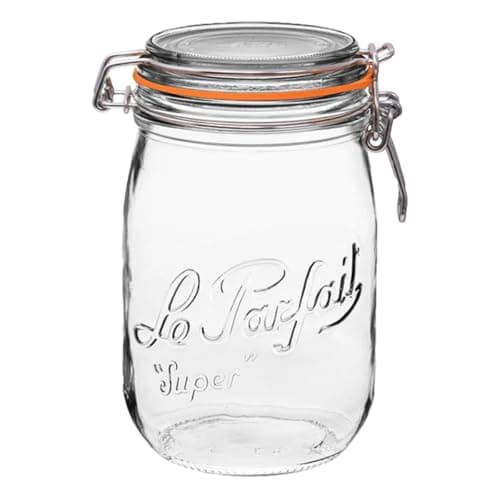
Le Parfait Super Jar, 1 L (32 oz)
The French bail jar people buy for canning and should buy for everything else. The glass is excellent, the gasket-and-wire closure is genuinely airtight for storage, and it ferments beautifully because carbon dioxide can push past the gasket. What it is not is a jar US canning processes were written for.
Published specs
- Size
- 1 liter (32 oz)
- Closure
- Wire bail with a replaceable rubber gasket
- Maker's use list
- "preserving/canning, pantry storage, fermenting, soups" (Le Parfait America)
- Fermenting
- Le Parfait: the closure "allows CO2 from active fermentation to escape while keeping oxygen and contaminants out, no airlock required"
- Gasket life
- Le Parfait: replace "after every canning or pickling project, or every six months for everyday use"
- Made in
- France (Le Parfait America)
What works
- A genuinely excellent fermenting vessel — the gasket vents CO2 without an airlock, which is exactly what a sauerkraut crock does for ten times the price
- Wide opening and thick glass handles; Le Parfait rates the jars for refrigerator and freezer use with headspace left for expansion
- The closure needs no consumable lid: you replace a rubber gasket occasionally rather than buying flats every season
What to know first
- Not a recommended closure for US home canning. The NCHFP: jars with wire bails "are not recommended for use in canning"
- You cannot verify a seal the way you can on a two-piece lid — there is no flat metal disc to press, and NCHFP's three seal tests are written for that system
- Le Parfait's own US FAQ says the jars "can be used for long-term food preservation with either water bath canning or pressure canning process", which conflicts with NCHFP guidance and cites no tested process times
Specs from Le Parfait America, Super Jar, NCHFP, Equipment and Methods Not Recommended. We have not handled this product — see how we pick.
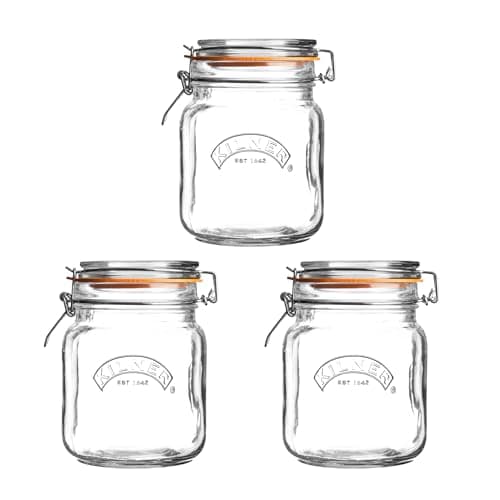
Kilner Clip Top Jars, 1 L (set of 3)
The English clip-top jar, in production since 1842 and sold on both sides of the Atlantic as a preserving jar. It is a lovely dry-storage container with a stainless clip and a replaceable orange seal. Kilner does publish preserving instructions — but they are a blanket "boil for 30 minutes" with no recipe times, no altitude adjustment and no acid distinction, which is not how US canning works.
Published specs
- Size
- 1 liter, square clip top, sold in threes
- Closure
- "high grade stainless steel clip system" with an orange rubber seal (Kilner)
- Maker's framing
- "perfect for preserving healthy, home grown foods and pantry storage" (Kilner)
- Kilner's processing instruction
- "Bring to the boil for 30 minutes" — one time for everything, with no altitude or acidity adjustment
- Seals
- Replacement rubber seals sold in packs; hand wash and sterilize before use (Kilner)
- Care
- Jar is dishwasher safe; "Do not pour boiling water directly into your jars" (Kilner)
What works
- The clip really is airtight for storage — flour, rice, tea and lentils keep well and you can see what is in there
- Replaceable seals mean the jar is not disposable in the way a jar that needs new flats every year is
- Kilner publishes its own seal check and a sterilizing method, which is more documentation than most storage jars come with
What to know first
- Kilner's "boil for 30 minutes" covers every food at every elevation, where US tested recipes give a specific time per food, jar size and altitude
- The same closure type is what Penn State describes as "designed for decorative use or dry food storage"
- Kilner's seal check — lift the jar by the lid — tests whether the clip holds, not whether a vacuum formed
Specs from Kilner, Clip Top Round Jar 1 Litre, Kilner, Making Your First Jam or Preserve. We have not handled this product — see how we pick.
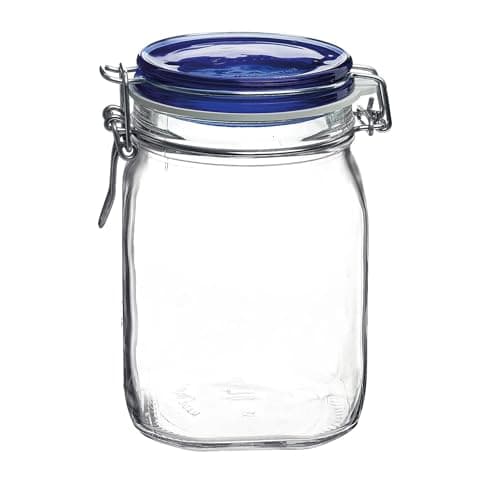
Bormioli Rocco Fido Jar, 33.75 oz
The Italian version of the same idea, and the one whose maker is most careful about what it claims. Bormioli says Fido jars suit "domestic vacuum storage through pasteurization" and caps even that at the smaller sizes — a narrower claim than either Kilner or Le Parfait makes, and closer to what the closure can actually do.
Published specs
- Size
- 33.75 oz (1 liter)
- Closure
- Bail and gasket; "airtight bail & seal closures" (Bormioli)
- Maker's canning limit
- "Only sizes from 4.25oz to 50.75oz can be used for canning (pasteurization in water bath)" (Bormioli Rocco USA)
- Also rated for
- Fermentation; freezer to -20°C/-4°F; not oven safe (Bormioli)
- Care
- Remove the metal ring and gasket before the dishwasher; hand wash the gasket without detergent (Bormioli)
- Gaskets
- Replacement gaskets sold separately in packs of six (Bormioli)
What works
- Attractive enough to serve from, which is most of what these jars actually get used for in American kitchens
- Bormioli publishes a freezer rating and a fermentation use, so the jar has documented jobs outside canning
- The most conservative canning claim of the three brands — pasteurization only, and only in the smaller sizes
What to know first
- "Pasteurization" is not the boiling water or pressure process a US tested recipe specifies, and Bormioli publishes no process times, altitude table or acidity guidance
- Same closure limitation as every bail jar: no flat disc to press, so the standard seal checks do not apply
- The metal ring and gasket need hand washing, which makes it a fussier storage jar than a screw-band Mason
Specs from Bormioli Rocco USA, Fido Food & Canning Jar, NCHFP, Equipment and Methods Not Recommended. We have not handled this product — see how we pick.
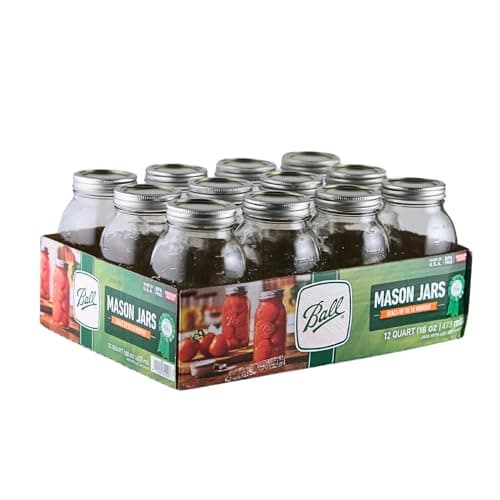
Ball Regular Mouth Pint Jars (16 oz)
If you buy one case of jars this season, buy this one. Pints are the size most tested recipes are written for, regular-mouth lids are the cheapest and most available lid on any shelf, and the jars are reusable indefinitely.
Published specs
- Volume
- 16 oz / 2 cups
- Mouth
- Regular, about 70 mm lid diameter
- Inner mouth diameter
- About 60 mm
- Jar dimensions
- About 5" tall x 2 3/4" wide
- Reuse
- Jars and rings reusable; flat lids are single-use
What works
- Pints fit both a water bath canner and a pressure canner comfortably, so the case is not stranded when you move up to beans
- Regular-mouth lids are the most stocked size in the country, which matters in September when shelves empty out
- The jars outlive everything else in this list. The consumable is the flat lid, not the glass
What to know first
- The narrower 60 mm opening is fiddly for whole peaches or large pickle spears — that is what wide mouth is for
- Regular and wide mouth lids are not interchangeable, so mixing both means stocking two lid sizes
- Glass. Handle the case like glass
Specs from Ball, Mason Jars & Lids, Regular Mouth. We have not handled this product — see how we pick.
Bail-and-gasket jars for canning
The jars are good. The closure is the problem. The NCHFP puts bail jars in the same sentence as antiques: they "make attractive antiques or storage containers for dry food ingredients but are not recommended for use in canning." Oregon State Extension explains why in one line — the two-piece lid was developed to fix the poor sealing rate of exactly this design.
Published specs
- NCHFP
- "Jars with wire bails and glass caps make attractive antiques or storage containers for dry food ingredients but are not recommended for use in canning."
- Oregon State Extension
- "The two-piece metal lid and screw band system was developed to improve upon the poor sealing rate of the old canning jar with separate gasket and bail over the lid. In recent tests by the National Center for Home Food Preservation, the two-piece metal lid system showed a 100% sealing rate with strong vacuum when processed according to directions."
- Penn State
- "Bail lids with a rubber gasket are designed for decorative use or dry food storage."
- Buy instead
- Regular or wide mouth Mason-type jars with two-piece lids
What works
- As storage, fermenting and serving vessels these jars are genuinely excellent, which is why this entry is about the process and not the glass
What to know first
- US processing times were developed with two-piece lids; UNH Extension notes bail-wire jars "have not been made in the United States since the early 1960's"
- The seal cannot be verified by the standard press, tap and look tests, and NCHFP's own instruction for other closures is to follow the manufacturer's directions — which, for these brands, do not include tested process times
- A failed seal on a shelf-stable low-acid food is the failure mode you cannot see, taste or smell
Specs from NCHFP, Equipment and Methods Not Recommended, Penn State Extension, Canning Jars and Lids - An Update. We have not handled this product — see how we pick.
What these jars are genuinely excellent at
This is not a page about bad products. It is a page about the wrong job. Every source we checked — including the ones saying do not can in them — lists real uses, and the makers document them too.
- Fermenting. Le Parfait's own description is the best argument: the closure "allows CO2 from active fermentation to escape while keeping oxygen and contaminants out, no airlock required." Bormioli lists Fido as "suitable for fermentation" too. Mason jars can do this job as well, with a different lid — can you ferment in canning jars.
- Dry storage. The NCHFP itself calls bail jars "storage containers for dry food ingredients", and Kilner's own copy points at couscous, tea and lentils.
- Refrigerator and freezer. Le Parfait rates its jars for freezer use with headspace for expansion; Bormioli publishes a freezer rating to -20°C.
- Serving and gifting. Bormioli is explicit that Fido jars are made to be served from and given as gifts, and that is a genuine use a Mason jar does less prettily.
- Not canning. The one job on the label that the US literature does not support.
The tulip-jar footnote
One more thing Penn State flags about European jars, and it applies to shape rather than closure: "Tulip-shaped jars are not recommended because the wider part of the jar will not heat at the same rate as the more narrow part." Processing times assume a jar shape heat moves through predictably. A jar that bulges in the middle does not qualify, whatever is holding its lid on.
The same reasoning is why the site's Weck comparison reaches the same conclusion by a different route — glass lid, rubber ring, clips, and no tested US process behind any of it.
If you already own a shelf of them
Nothing here says throw them out. Fill them with rice, ferment in them, take one to a friend full of granola, put leftovers in one in the refrigerator. What we would not do is process low-acid food in them and put it on a shelf for a year, because the failure mode of that decision is invisible and the closure was never tested for it. The same reasoning applies to inherited jars with zinc caps and glass lids — old canning jars.
If you want the look with a tested closure, the nearest thing is a straight-sided wide-mouth Mason jar, which photographs better than it gets credit for and costs a fraction of a Le Parfait. Which jars to buy is in the best canning jars.
The decision, in one paragraph
Buy Le Parfait if you ferment — the gasket venting genuinely is the feature, and no Mason jar does it without an airlock. Buy Kilner or Fido if you want handsome airtight storage and do not mind hand-washing a gasket. Buy Mason jars for anything that goes in a canner, because that is the closure every US tested process was written around and the only one whose seal you can check three ways in five seconds.
Next stepThe jars to can in insteadCommon questions
Can you can in Kilner jars?
Are Le Parfait jars safe for canning?
What about Bormioli Rocco Fido jars?
Why are bail jars not recommended?
What are European jars good for?
Can I use Mason lids on a Le Parfait or Kilner jar?
Are tulip-shaped European jars any different?
Do the rubber gaskets need replacing?
Do you earn a commission on these?
Sources
- NCHFP — Equipment and Methods Not Recommended
- NCHFP — Recommended Jars and Lids
- NCHFP — Storing Home Canned Foods
- Penn State Extension — Canning Jars and Lids, An Update
- SDSU Extension — Canning Jar Update
- UNH Extension — Successful Home Canning Starts with Jars and Lids
- Oregon State Extension (Ask Extension) — bail jars and vacuum seals
- Kilner — Clip Top Round Jar, 1 L
- Kilner — Making Your First Jam or Preserve
- Le Parfait America — Super Jar and FAQ
- Bormioli Rocco USA — Fido Food & Canning Jar
Product specifications are taken from each manufacturer’s own published page, cited on the product. We have not handled these products — how we pick.