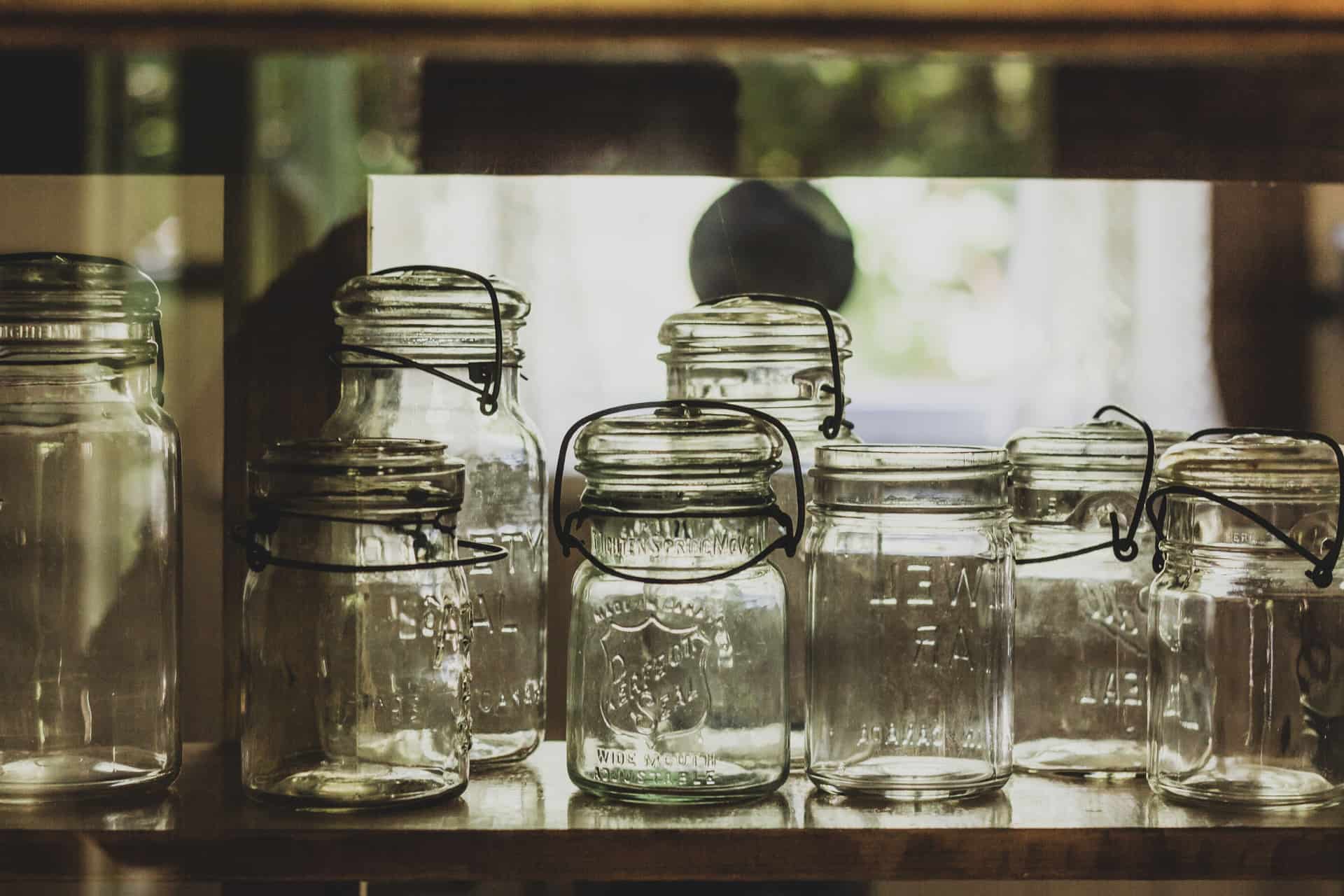
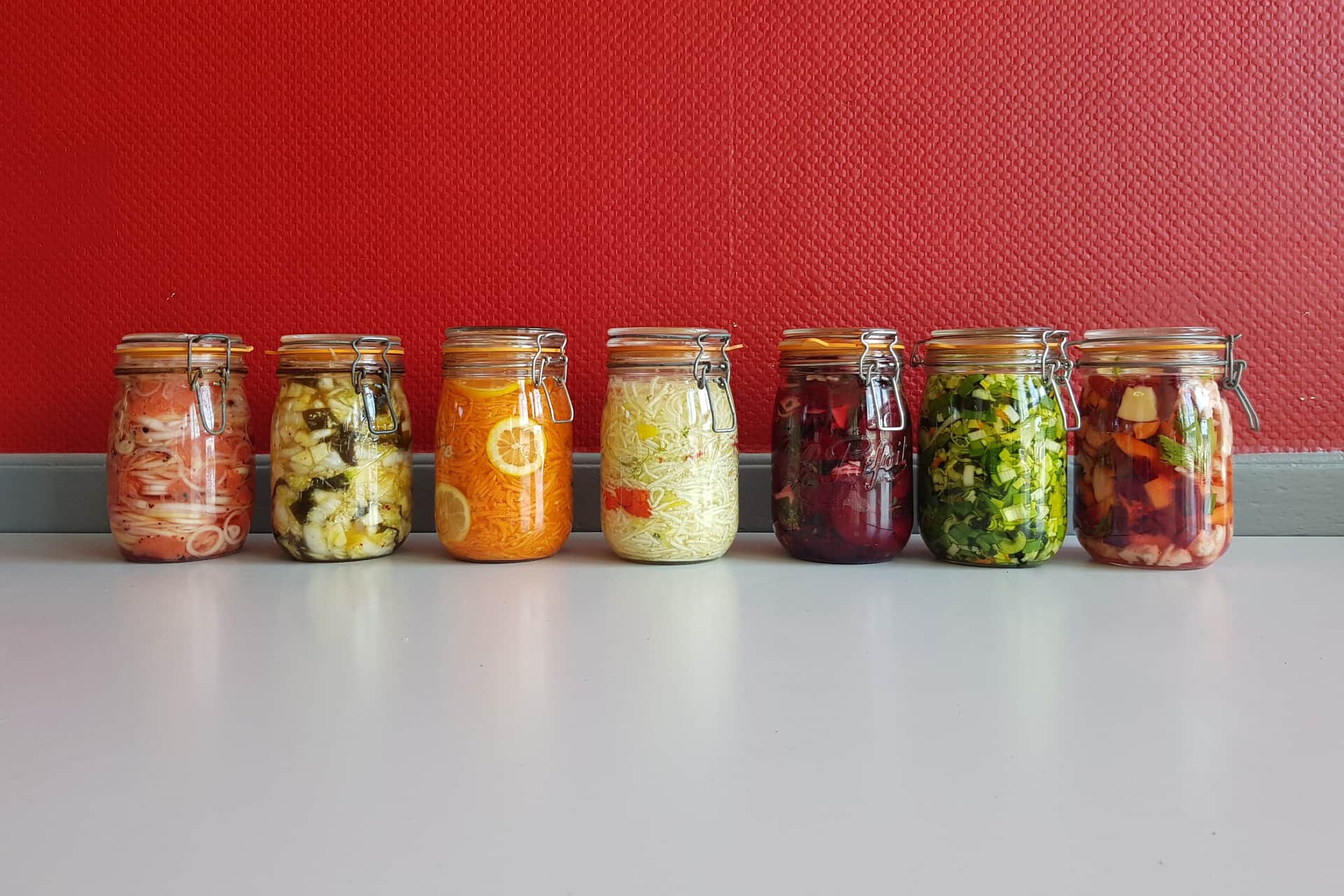
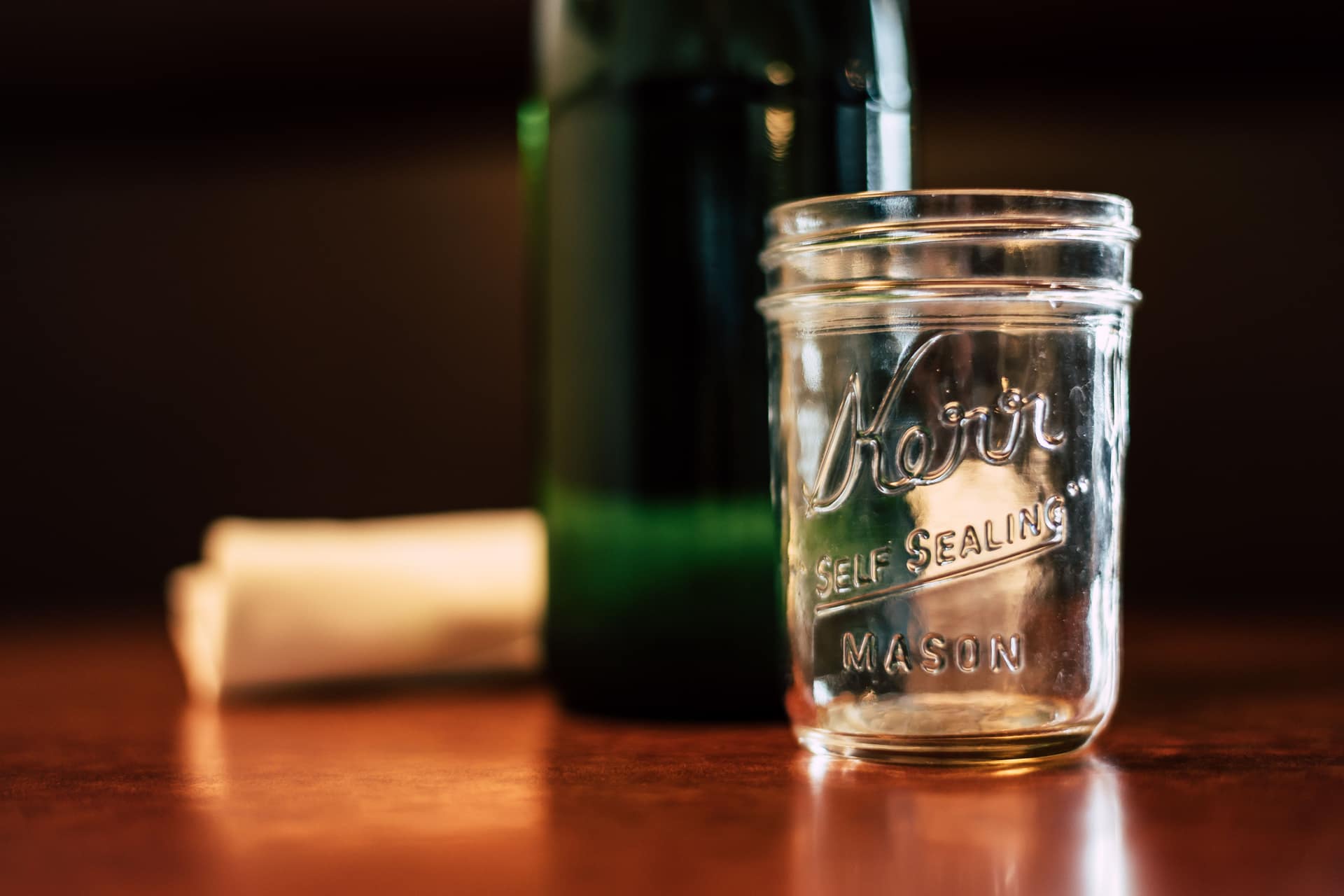
Can you ferment in canning jars?
The jars are fine. The NCHFP says so in writing. It is the flat lid that cannot do this job, and replacing it costs about the price of a case of jars.
Disclosure: we earn a commission on purchases made through links on this page, at no extra cost to you. It does not change what we recommend — see how we pick and our affiliate disclosure.
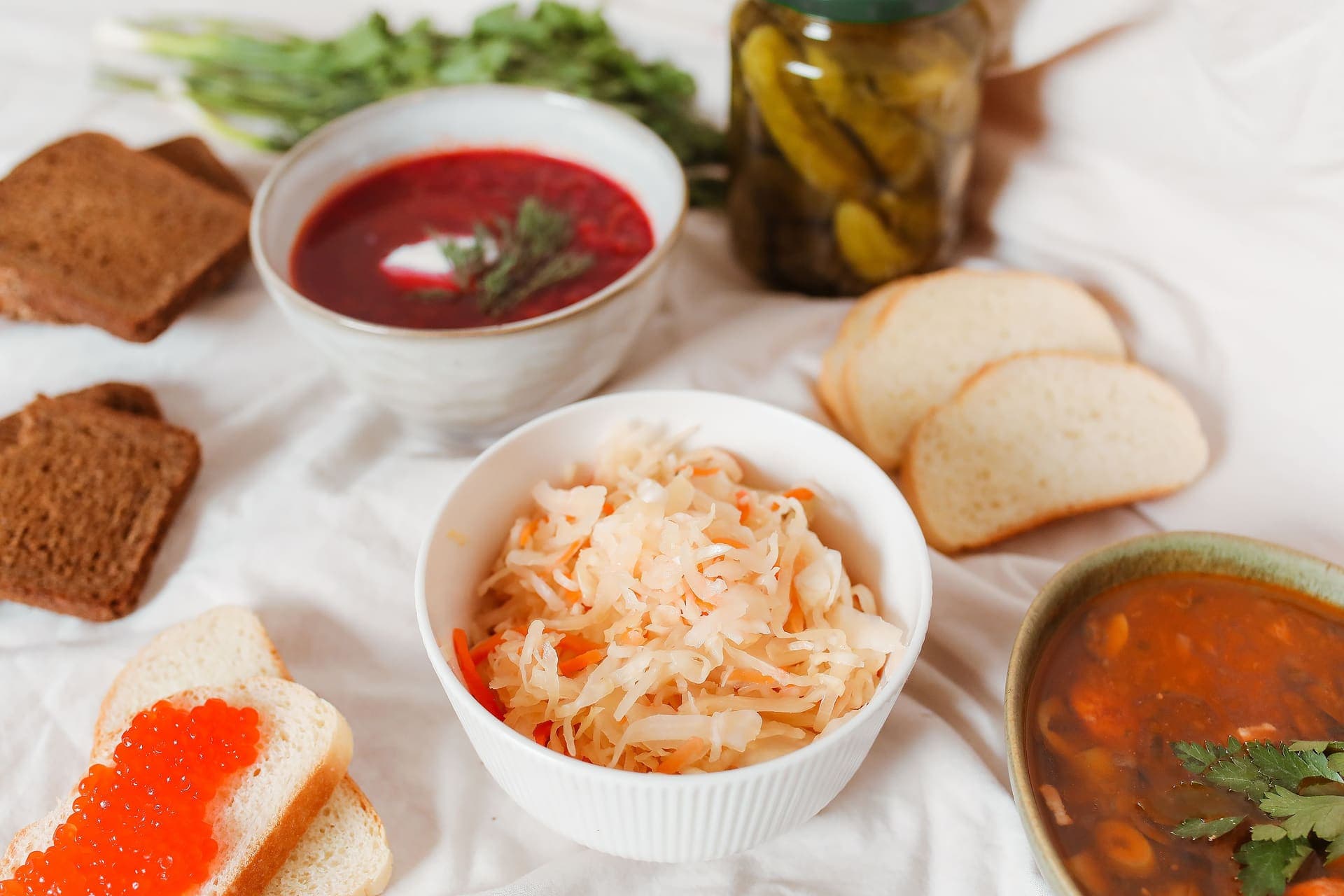
Yes. For a ferment of about five pounds or less, buy a silicone airlock lid - the Masontops Pickle Pipe is the one to get - put it on a wide-mouth quart jar you already own, and weight the vegetables under the brine. NCHFP states that "food-grade plastic and glass containers are excellent substitutes for stone crocks" and that fermenting sauerkraut in quart and half-gallon Mason jars "is an acceptable practice." The only part of your canning setup that cannot do this job is the flat two-piece lid.
This question gets asked because it looks like it should have a complicated answer. You have a cupboard of jars bought for canning, a cabbage, and a vague sense that fermenting is a different discipline with different equipment. It mostly is not. The glass is the same glass.
What is genuinely different is the direction the gas travels. A canning lid exists to hold a vacuum - to pull down and stay down. A ferment spends about three weeks producing carbon dioxide and needs somewhere to put it. That is the whole adjustment, and it is a lid.
What the US guidance actually says about jars
The NCHFP's fermenting instructions are written around a crock, and then explicitly open the door to glass: "Food-grade plastic and glass containers are excellent substitutes for stone crocks." It goes further and names the jars by size - "Fermenting sauerkraut in quart and half-gallon Mason jars is an acceptable practice, but may result in more spoilage losses."
Read that caveat carefully, because it is the honest version of the answer. Acceptable, with more spoilage losses. A jar is a narrow vessel with a lot of surface area relative to its volume and no room for a plate and a stack of weights, so more of your batches will grow something on top than would in a crock. That is a real trade and not a reason to avoid jars.
How we judged the gear
Three criteria, in this order, and all three come out of the NCHFP page rather than our preferences:
- 1Does it let carbon dioxide out without letting air in? Fermentation is anaerobic. A closure that vents but also admits oxygen invites surface yeast and mold; a closure that admits nothing builds pressure for three weeks.
- 2Does it hold the food under the brine? NCHFP is unambiguous: "Cabbage and cucumbers must be kept 1 to 2 inches under brine while fermenting." Anything floating above the line is exposed, and exposed is where mold starts.
- 3Does the manufacturer publish what it is made of and how to clean it? This site does not test products, so a brand that states its material and its care instructions is worth more than one that states neither. That requirement eliminated most of the cheap unbranded airlock kits on the market.
What we did not weigh: airlock style. A waterless silicone valve and a water-filled S-bend both vent one way. The silicone kind needs nothing topped up, which is why every pick below uses one, but a glass airlock is not wrong.
Quick picks
Every pick below is screened against the National Center for Home Food Preservation’s published canner rules first. Tap a row for the full write-up.
| # | Product | Best for | Key spec | Price |
|---|---|---|---|---|
| 1 |  Masontops Pickle Pipes, Wide Mouth (4-pack)A silicone dome with a one-way slit that replaces the flat canning lid and lets three weeks of carbon dioxide out without letting air in. It is the cheapest honest route from a shelf of Mason jars to a working ferment, and it does the one thing a two-piece canning lid physically cannot. | Fermenting in the jars already in your cupboard | 4 silicone airlock lids | |
| 2 |  Masontops Pickle Pebbles and Pickle Pipes Set, Wide Mouth (8-piece)The airlocks plus the glass weights that hold the vegetables under the brine, which is the half of the job a lid alone leaves to you. Four jars' worth, which is about as much sauerkraut as a first attempt should commit to. | Converting four jars completely | 4 glass weights, 4 airlocks | |
| 3 |  Masontops Complete Mason Jar Fermentation Kit, Wide MouthThe weights and airlocks plus the acacia tamper that packs shredded cabbage down hard enough to make its own brine. The tamper is the piece people improvise worst, and this is the only way to get all three without three orders. | A first ferment with nothing on hand | 9 pieces for 4 jars | $54.95 · View on Amazon#ad we earn a commission · price as of October 18, 2026 |
| 4 |  Ohio Stoneware 1 Gallon Preserving CrockThe vessel NCHFP's fermenting instructions are actually written around, in the smallest size that beats a half-gallon jar. One gallon per five pounds of vegetables is the published ratio, and a jar runs out well before a cabbage does. | Five pounds of cabbage, which a jar cannot hold | 1 gallon per 5 lb of vegetables | $35.05 · View on Amazon#ad we earn a commission · price as of October 18, 2026 |
| 5 |  Ball Wide Mouth Quart Jars (32 oz)The jar to buy when you are packing peach halves, pickle spears or anything you have to reach into. The wider 86 mm mouth is easier to fill and far easier to clean, and quarts are the standard size for tomatoes. | Whole fruit and packing by hand | 86 mm mouth, 32 oz | |
| 6 | A two-piece canning lid, screwed down tightSkipThe flat lid's entire design purpose is to hold a vacuum. A ferment does the opposite for about three weeks. Ball describes what a fermentation lid is for in its own words - it keeps oxygen out while still allowing carbon dioxide to escape - and a sealed flat lid does the first half and not the second. | Nothing - the gas has nowhere to go | Not a fermentation closure | Check price on Amazon#ad we earn a commission · live price pending |
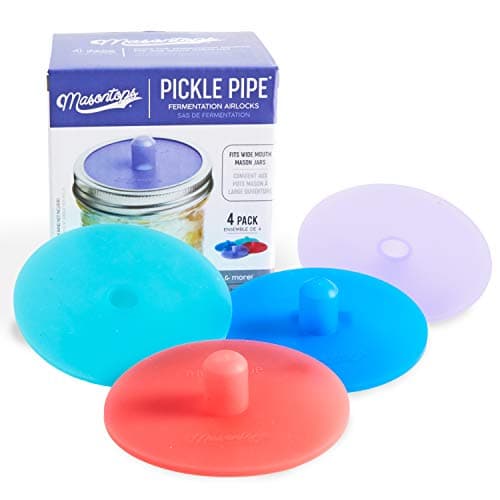
Masontops Pickle Pipes, Wide Mouth (4-pack)
A silicone dome with a one-way slit that replaces the flat canning lid and lets three weeks of carbon dioxide out without letting air in. It is the cheapest honest route from a shelf of Mason jars to a working ferment, and it does the one thing a two-piece canning lid physically cannot.
Published specs
- Material
- "BPA and phthalate-free silicone" (Masontops)
- How it works
- "The one-way valve automatically releases gas, without letting in any oxygen that can cause spoilage" (Masontops)
- Fits
- Wide mouth Mason jars - Masontops gives the outer mouth diameter as 3.38 inches, or 8.6 cm
- Lid diameter
- 3.31 inches (Masontops)
- Pack
- Four airlocks per pack (Masontops)
- Band
- Masontops states the pipe fits on the mouth of a Mason jar and is secured with a screw band, not included
- First use
- Masontops says the pipes must be pinched to activate the one-way valve
- Care
- "dishwasher safe and should be laid flat during storage to prevent warping" (Masontops)
What works
- No water to top up and nothing to burp daily, which is the practical difference between a ferment you finish and one you forget
- Uses the wide-mouth jars and screw bands you already own, so the whole conversion is a lid
- Dishwasher safe, and cheap enough per jar that running four at once is not a decision
What to know first
- No weight in the pack. NCHFP is explicit that "cabbage and cucumbers must be kept 1 to 2 inches under brine while fermenting", so you still need a glass weight or a folded cabbage leaf
- Screw bands are not included either - obvious if you have a shelf of canning jars, annoying if you do not
- This is not a canning lid and cannot be used to process a jar. It is a fermentation closure and nothing else
- Masontops' own store listed both mouth sizes as sold out when we checked, so supply runs through retailers
Specs from Masontops, Pickle Pipe, NCHFP, Suitable Containers, Covers, and Weights for Fermenting Food. We have not handled this product — see how we pick.
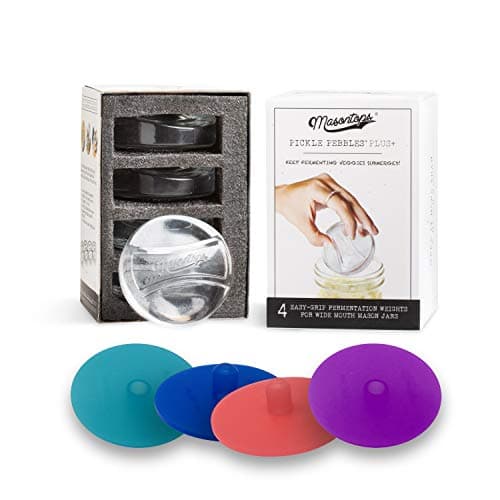
Masontops Pickle Pebbles and Pickle Pipes Set, Wide Mouth (8-piece)
The airlocks plus the glass weights that hold the vegetables under the brine, which is the half of the job a lid alone leaves to you. Four jars' worth, which is about as much sauerkraut as a first attempt should commit to.
Published specs
- Included
- Four Pickle Pebble fermentation weights and four Pickle Pipe airlocks (Masontops)
- Materials
- "Materials Include Food-Safe Glass and Silicone" (Masontops)
- Weight size
- Wide mouth: 2.75 x 1.2 inches, 6 oz each (Masontops)
- Lid diameter
- 3.31 inches, wide mouth (Masontops)
- Fits
- Masontops lists wide mouth or regular mouth Mason and canning jars - Ball, Kerr, Bernardin
- Care
- Pebbles: "wash Pickle Pebbles by hand with dish soap or in the top rack of a dishwasher" (Masontops)
- Heat limit
- Masontops states the Pebbles cannot be boiled for sterilization
- List price
- $39.99 on Masontops' own store
What works
- Solves both halves of the problem at once - gas out, vegetables under the brine - so nothing about the first batch is improvised
- Glass weights with a finger grip come out of a full jar without fishing, which matters more than it sounds when the jar is a quart of brine
- Same silicone airlock as the lids-only pack, so what you are paying extra for is the weights and not a different system
What to know first
- The glass weights cannot be boiled, so the one part of the kit you would most like to sterilize that way is the part you cannot
- Costs appreciably more than the lids plus a generic glass weight set bought separately, and the premium buys brand documentation rather than a different object
- No jars and no screw bands, so this is an accessory set and not a starting point
Specs from Masontops, Pickle Pebbles + Pickle Pipes Set (Wide Mouth), NCHFP, Suitable Containers, Covers, and Weights for Fermenting Food. We have not handled this product — see how we pick.
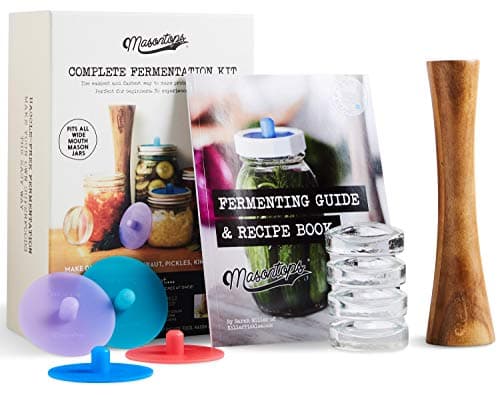
Masontops Complete Mason Jar Fermentation Kit, Wide Mouth
The weights and airlocks plus the acacia tamper that packs shredded cabbage down hard enough to make its own brine. The tamper is the piece people improvise worst, and this is the only way to get all three without three orders.
Published specs
- Included
- One Pickle Packer tamper, four Pickle Pebbles, four Pickle Pipes and a recipe book (Masontops)
- Coverage
- Masontops describes it as enough supplies for up to four fully equipped jars, nine pieces total
- Tamper
- "Vegetable tamper made of acacia wood that fits both wide and regular mouth Mason jars" (Masontops)
- Materials
- "Food-Safe Glass, Silicone, and Acacia Wood" (Masontops)
- Mouth sizes
- Sold in a wide mouth and a regular mouth version (Masontops)
- Bands
- Masontops states the pipes must be secured with a screw band, which is not included
- Care
- Packer: hand wash and do not let it stand in water. Pebbles: not intended for boiling or extreme heat (Masontops)
- List price
- $54.99 on Masontops' own store
What works
- The tamper is the genuine addition. Packing cabbage until it releases its own brine is the step that decides whether a sauerkraut works, and a wooden spoon handle does it badly
- Four fully equipped jars is a real batch without being a commitment to a crock
- One order, one brand, one set of care instructions, and a recipe book rather than a pamphlet
What to know first
- Still no jars and no screw bands, which is easy to miss on a product called Complete
- Acacia wood has to be hand washed and not left to soak, so the kit's most useful piece is also its most fragile
- If you already own glass weights you are paying full kit price for a tamper
Specs from Masontops, Complete Mason Jar Fermentation Kit, NCHFP, Suitable Containers, Covers, and Weights for Fermenting Food. We have not handled this product — see how we pick.
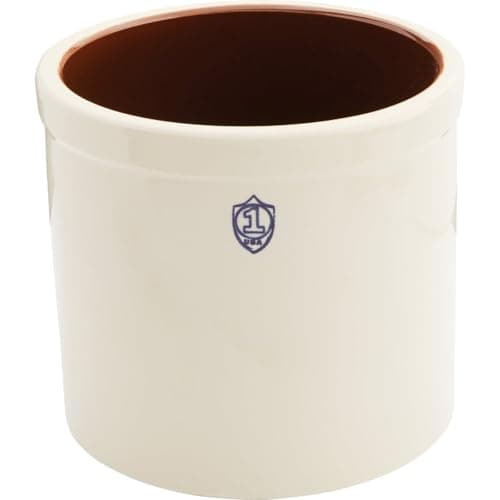
Ohio Stoneware 1 Gallon Preserving Crock
The vessel NCHFP's fermenting instructions are actually written around, in the smallest size that beats a half-gallon jar. One gallon per five pounds of vegetables is the published ratio, and a jar runs out well before a cabbage does.
Published specs
- Capacity
- 1 gallon (Ohio Stoneware item 02429)
- Dimensions
- Diameter 7.75 inches, height 8 inches (Ohio Stoneware)
- Weight
- 8 lbs empty (Ohio Stoneware)
- Made in
- Zanesville, Ohio (Ohio Stoneware)
- Cover and weights
- Sold separately - Ohio Stoneware lists a 1 Gallon Weight Set, item 11655, as its own product
- NCHFP sizing
- "A 1-gallon container is needed for each 5 pounds of fresh vegetables"
- NCHFP cover
- A plate weighted with "2 to 3 sealed quart jars filled with water", under a clean, heavy bath towel
What works
- Matches the published ratio exactly: a gallon per five pounds of vegetables, which is one cabbage and one batch
- NCHFP's own weighting method - a plate held down by sealed quart jars of water, under a heavy towel - works in this crock as written, so the weight set is genuinely optional
- American-made stoneware with published dimensions, which is more than most crock sellers offer
What to know first
- Arrives as a crock. The cover and the stone weight set are separate items, and nothing on the listing makes that obvious
- Opaque, so you cannot see the brine line without lifting the cover - the one real advantage a glass jar has over a crock
- 8 lbs empty, and considerably more with five pounds of cabbage and brine in it
- Ohio Stoneware publishes dimensions but not a glaze composition, so there is no manufacturer statement about the glaze to quote
Specs from Ohio Stoneware, Products (published crock dimensions), NCHFP, Suitable Containers, Covers, and Weights for Fermenting Food. We have not handled this product — see how we pick.
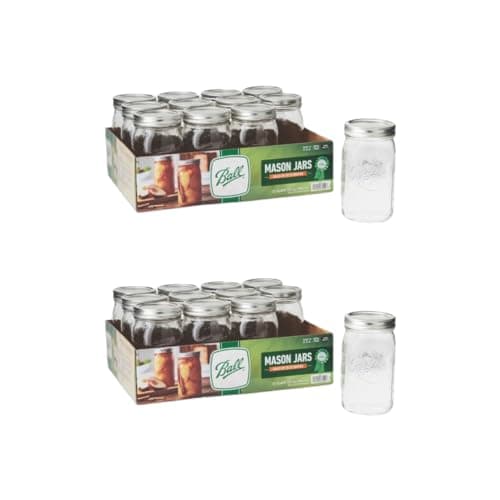
Ball Wide Mouth Quart Jars (32 oz)
The jar to buy when you are packing peach halves, pickle spears or anything you have to reach into. The wider 86 mm mouth is easier to fill and far easier to clean, and quarts are the standard size for tomatoes.
Published specs
- Volume
- 32 oz / 4 cups
- Mouth
- Wide, about 86 mm lid diameter
- Inner mouth diameter
- About 76 mm
- Jar dimensions
- About 6 1/2" tall x 3 1/4" wide
What works
- You can get a hand and a jar funnel into it, which turns packing peaches from a chore into a task
- Quart is the size the tomato and peach processing times in tested recipes are written around
- Much easier to wash by hand than a regular mouth quart
What to know first
- Wide mouth lids cost more than regular mouth and disappear from shelves first in peak season
- Seven quarts is a full canner load, so a quart-jar day is a longer day per jar of finished food
- A quart of anything low-acid still needs a pressure canner, and quarts take the longest processing times
Specs from Ball, Mason Jars & Lids, Wide Mouth. We have not handled this product — see how we pick.
A two-piece canning lid, screwed down tight
The flat lid's entire design purpose is to hold a vacuum. A ferment does the opposite for about three weeks. Ball describes what a fermentation lid is for in its own words - it keeps oxygen out while still allowing carbon dioxide to escape - and a sealed flat lid does the first half and not the second.
Published specs
- Ball, on fermentation lids
- The lid "helps keep oxygen out of the jar, preventing harmful bacteria growth while still allowing carbon dioxide to escape"
- NCHFP, on timing
- "Regular dill pickles and sauerkraut are fermented and cured for about 3 weeks"
- NCHFP, on brine
- "Cabbage and cucumbers must be kept 1 to 2 inches under brine while fermenting"
- Buy instead
- A silicone airlock lid, or leave the band finger-loose and burp the jar daily
What works
- A flat lid and band left deliberately loose will vent, and generations of ferments were made exactly that way - this entry is about screwing it down, not about the lid existing
What to know first
- Tightened down, the only way out for three weeks of carbon dioxide is past the sealing compound, which either leaks brine onto the shelf or does not let go at all
- A flat lid used this way cannot then be trusted for canning - the compound has already been molded to a jar once
- It holds nothing under the brine, which is the other half of the job and the half that decides whether you get mold
Specs from Ball, Use & Care - Canning, NCHFP, Suitable Containers, Covers, and Weights for Fermenting Food. We have not handled this product — see how we pick.
The lid is the whole purchase
Ball describes the job better than we can, in the product copy for its own fermentation lid: it "helps keep oxygen out of the jar, preventing harmful bacteria growth while still allowing carbon dioxide to escape." Those are two requirements in one sentence, and a flat canning lid screwed down tight satisfies the first and fails the second.
We looked for a current Amazon listing for Ball's own Fermentation Lids and Springs and could not find one, so it is not among the picks above. Ball documents the product on its support pages; we are not going to point you at a listing we cannot confirm is live. The Masontops equivalent is documented to the same standard and is in stock.
| Closure | Vents CO2 | Keeps air out | Holds food down | Verdict |
|---|---|---|---|---|
| Two-piece canning lid, tight | No | Yes | No | The one thing not to do |
| Two-piece lid, band finger-loose | Yes, roughly | Mostly | No | Free, works, needs daily attention |
| Silicone airlock lid | Yes, one way | Yes | No | The buy - add a weight |
| Airlock lid + glass weight | Yes, one way | Yes | Yes | A complete jar setup |
| Crock with stone weights | Vents at the rim | Mostly | Yes | For batches past five pounds |
Weighting the food down without a kit
NCHFP's own method does not involve a purchase: "insert a suitably sized dinner plate or glass pie plate inside the fermentation container," then "to keep the plate under the brine, weight it down with 2 to 3 sealed quart jars filled with water," and cover the whole thing with "a clean, heavy bath towel."
None of that fits in a quart jar, which is exactly why the glass pebbles exist. In a jar, the free options are a folded outer cabbage leaf tucked over the shreds, or a small jelly jar filled with water and set inside a wide mouth. Both work. Neither is as tidy as a weight made for the job.
Which jar, specifically
Wide mouth, and a quart or a half-gallon. The mouth matters more for fermenting than it does for canning: you are packing shredded cabbage down with a tamper and then fishing a weight out of brine, and a regular-mouth shoulder makes both awkward. Half-gallon jars are a legitimate fermenting vessel even though they are barely a canning one - which is covered in half-gallon canning jars.
Jar size against mouth size is the same decision as everywhere else on this site, and it is laid out in wide mouth vs regular mouth. The short version for a ferment: wide, always.
When the ferment is finished
NCHFP gives the timing - "Regular dill pickles and sauerkraut are fermented and cured for about 3 weeks" - and then you have a decision this site has a strong view on. A finished ferment lives in the refrigerator, or it gets water bath canned with a tested recipe and becomes shelf stable.
Canning it kills the live cultures that were the point of fermenting it. If shelf stability is what you want, the method is in how to water bath can and the recipe has to come from a tested source - see how to find safe canning recipes. If the cultures are what you want, refrigerate and eat it.
The one thing not to do is swap the airlock for a flat lid, screw it down, and call the ferment canned. The lid will often pull down as the jar cools in the fridge, and that vacuum is not a process.
Where European bail jars come in
They come in here and nowhere else on this site. Le Parfait's own description of its closure is the best argument for a bail jar anywhere: it "allows CO2 from active fermentation to escape while keeping oxygen and contaminants out, no airlock required." That is a fermentation lid built into the jar.
Which is why European canning jars reaches a split verdict: not for canning, genuinely excellent for this. If you already own a shelf of Fido or Le Parfait jars, you already own fermenting vessels and do not need any of the lids above.
The decision, in one paragraph
If you have canning jars and want to ferment: buy Masontops Pickle Pipes and a set of glass weights, or the 8-piece set that is both, and use wide-mouth quarts. If you are starting with nothing, the Complete Fermentation Kit adds the acacia tamper, which is the piece people improvise worst. If your batch is more than five pounds of vegetables, stop buying jar accessories and buy a 1-gallon crock - NCHFP's instructions were written for it. And whatever you do, do not screw a flat canning lid down over a ferment.
Next stepThe jars tested pickle recipes are written forCommon questions
Can you ferment in canning jars?
Can I use a regular canning lid to ferment?
Do I need a fermentation weight?
What size jar should I ferment in?
Do I need an airlock, or will a loose lid do?
Should I buy a crock instead?
Can I can my ferment to make it shelf stable?
Can I use Weck or Le Parfait jars for fermenting?
Can the glass fermentation weights be boiled?
Do you earn a commission on these?
Sources
- NCHFP — Suitable Containers, Covers, and Weights for Fermenting Food
- NCHFP — General Information on Fermenting
- NCHFP — Recommended Jars and Lids
- Ball — Use & Care (canning jars, lids and fermentation lids)
- Masontops — Pickle Pipe
- Masontops — Pickle Pebbles + Pickle Pipes Set
- Masontops — Complete Mason Jar Fermentation Kit
- Ohio Stoneware — Preserving crocks and weight sets
- Le Parfait America — Super Jar and FAQ
Product specifications are taken from each manufacturer’s own published page, cited on the product. We have not handled these products — how we pick.