Canning in an Instant Pot
The appliance has a button for it. The research does not support it. Here is what the evidence actually says, and the equipment that replaces it.
Disclosure: we earn a commission on purchases made through links on this page, at no extra cost to you. It does not change what we recommend — see how we pick and our affiliate disclosure.
No — not for low-acid food. The NCHFP does not support USDA canning processes in electric multi-cookers, including models with a "canning" button, because no USDA thermal process work has been done with jars inside one. Utah State University Extension tested them and found jars were often under-processed. Use a stovetop pressure canner, or an electric canner designed and tested for canning.
This question has a clear answer, and the clear answer is unpopular. Millions of households own a capable electric pressure cooker, several models have shipped with canning presets, and the appliance genuinely does reach canning pressures. None of that adds up to a tested process, and for low-acid food the tested process is the whole of the safety.
What follows is what the research says, in the words of the people who did it, and then the practical question: what to buy instead, and what your multi-cooker can still legitimately do.
What the NCHFP actually says
The National Center for Home Food Preservation addressed this directly: "Even if there are instructions for pressure canning in the manufacturer's directions, we do not support the use of the USDA canning processes in the electric, multi-cooker appliances now containing 'canning' or 'steam canning' buttons on their front panels."
The reasoning is not squeamishness about new appliances. It is that the processes themselves were developed in a specific kind of equipment: "Our recommendations were determined for stovetop pressure canners which hold four or more quart-size jars standing upright." And crucially — "No USDA thermal process work has been done with jars inside an electric pressure cooker, tracking the actual temperatures inside the jars throughout the process."
Why the pressure reading is not the point
This is the part worth understanding, because it is where the intuition fails. The NCHFP: "What matters is temperature, not pressure. One manufacturer says its cooker reaches the pressure required for canning, but that alone does not prove the food in the jars is heated throughout at the same rate as in the canner used for process development."
- Air changes everything. "If air is mixed in the steam, the temperature is lower than the same pressure of pure steam. That's why a proper venting process is so important in pressure canning." Most multi-cookers have no venting step at all.
- The cool-down counts. "Bacteria are not killed in the food only during the process time; the time it takes the canner to come up to pressure, the process time, and the cool-down time all matter."
- Small means fast, and fast means less. "If anything is done to shorten the cooling period, including using a very small cooker, then the food could cool down more quickly, and be under-processed."
- The four-jar rule follows from this. A canner that holds four quart jars upright has enough thermal mass to cool slowly — which is precisely why the size rule exists.
The USDA's own definition in the *Complete Guide to Home Canning* sets the same boundary: a pressure canner has "jar racks, one or more safety devices, systems for exhausting air, and a way to measure or control pressure", and "the minimum volume of canner that can be used is one that will hold 4 quart jars sitting upright on the rack. Use of pressure saucepans with smaller capacities is not recommended."
Somebody did test them
Utah State University Extension ran canning experiments in electric programmable pressure cookers and published what happened. Their conclusion: "electric programmable pressure cookers of any brand are inconsistent at higher altitudes and should NOT be used for low-acid canning."
Two findings from that work matter more than the headline. First, "In many cases the bottled food was under-processed: It DID NOT reach a high enough temperature for a long enough time to destroy botulism spores." Second, and worse for anyone hoping to test their own setup: "The results were often inconsistent. One time the food might be processed adequately, but the next time it was not (using the same food, the same EPPC, and at the same altitude)."
What about the Instant Pot Max?
For a period, Instant Pot's own Max FAQ advertised canning outright: "'Max Pressure' operates at 15 psi and provides the temperature needed for pressure canning low-acid vegetables and meat," and described a "Canning Smart" program for high and low-acid foods. That page is no longer live, and the word canning does not appear on Instant Pot's current multi-cooker pages or FAQ.
Extension services did not accept the claim at the time. Oregon State's answer was direct: "Testing done by the National Center for Home Food Preservation has found that the Instant Pot Max is unsafe to use for canning, despite having a canning function." Penn State's page, updated in 2025, states the general position: "There has been no research by the USDA or a university to show that electric multi-cookers can safely process low-acid food."
Quick picks
Every pick below is screened against the National Center for Home Food Preservation’s published canner rules first. Tap a row for the full write-up.
| # | Product | Best for | Key spec | Price |
|---|---|---|---|---|
| 1 |  Instant Pot Duo (and other electric multi-cookers), for canningSkipAn excellent appliance that should never be used to can low-acid food. The NCHFP's position is explicit: "we do not support the use of the USDA canning processes in the electric, multi-cooker appliances now containing 'canning' or 'steam canning' buttons on their front panels." Buy one to cook beans on a Tuesday. Buy a pressure canner to can them. | Cooking, not canning | Not recommended for canning | |
| 2 |  Presto Precise 12-Quart Digital Pressure Canner (02144)The one electric appliance in this category that Presto states meets USDA home-canning guidelines for low-acid foods, and it holds the temperature itself — including at altitude, with no adjustment. It is also a countertop appliance, so it sidesteps the stove-fit question entirely. | Glass tops, and altitude | 5 quarts, no altitude math | |
| 3 |  Presto 23-Quart Pressure Canner and Cooker (01781)The default first pressure canner, and the one most beginners should buy: it takes a full seven-quart load, it doubles as a boiling-water canner for pints and half-pints, and it costs a fraction of a cast-aluminum canner. The dial gauge is the catch, and it is a real one. | A first pressure canner | 7 quarts / 20 pints | |
| 4 | Small pressure cookers and multi-cookers sold as cannersSkipSkip anything under the seven-quart-jar mark, and skip every electric multi-cooker with a canning button that is not specifically specified for pressure canning. The NCHFP is explicit: pressure saucepans with smaller volume capacities are not recommended for canning. | Nothing — skip these | Excluded by NCHFP | Check price on Amazon#ad we earn a commission · live price pending |
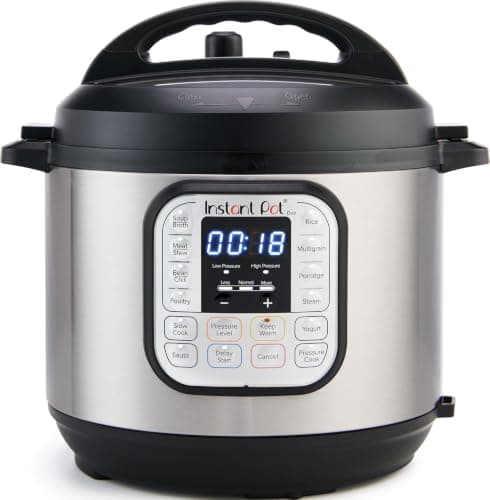
Instant Pot Duo (and other electric multi-cookers), for canning
An excellent appliance that should never be used to can low-acid food. The NCHFP's position is explicit: "we do not support the use of the USDA canning processes in the electric, multi-cooker appliances now containing 'canning' or 'steam canning' buttons on their front panels." Buy one to cook beans on a Tuesday. Buy a pressure canner to can them.
Published specs
- What it is
- A 6-quart electric multi-cooker: pressure cooker, slow cooker, rice cooker, steamer, saute pan
- NCHFP
- "Our canning processes are not recommended for use in electric pressure multi-cookers at this time."
- Why
- No USDA thermal process work has been done with jars inside an electric pressure cooker; heat-up and cool-down are part of the process, and these units heat and cool fast
- Utah State research
- Electric programmable pressure cookers were inconsistent at altitude and often under-processed the food
- Buy instead
- A stovetop pressure canner, or a dedicated electric canner designed and tested for the job
What works
- As a cooker it is genuinely good, and nothing here is a criticism of the appliance for the job it was built for
- Utah State does allow electric programmable pressure cookers for small-batch boiling water canning of high-acid foods, with the jars on a rack under 1-2 inches of water and the pressure lid unlocked
What to know first
- No USDA or university research supports pressure canning low-acid food in a multi-cooker, so there is no tested process to follow
- Utah State's testing found the same appliance could process adequately one time and not the next, with the same food at the same altitude
- A sealed lid proves nothing: the NCHFP notes a vacuum seal forms at far lower heat than the food needs to be safe
Specs from NCHFP, Canning in Electric Multi-Cookers, Utah State University Extension, Why Electric Pressure Cookers Are Not Pressure Canners. We have not handled this product — see how we pick.
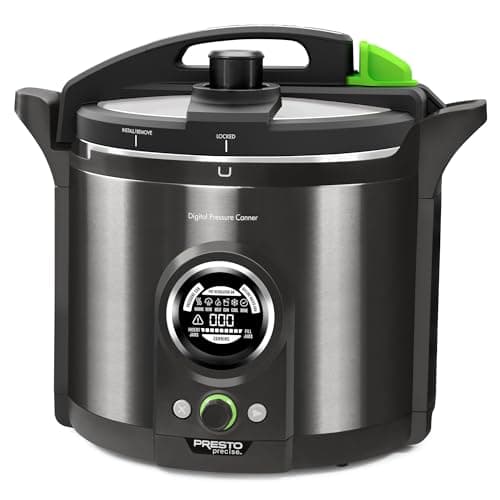
Presto Precise 12-Quart Digital Pressure Canner (02144)
The one electric appliance in this category that Presto states meets USDA home-canning guidelines for low-acid foods, and it holds the temperature itself — including at altitude, with no adjustment. It is also a countertop appliance, so it sidesteps the stove-fit question entirely.
Published specs
- Liquid capacity
- 12 quarts
- Jar capacity
- 10 half-pints, 8 pints, 5 quarts
- Boiling-water use
- Pints and half-pints only
- Power
- 120 volts AC, 1,485 watts (Presto)
- USDA
- Presto states it meets USDA guidelines for meat, poultry, fish and vegetables
- Altitude
- No adjustment needed — the sensor handles it
What works
- Removes the two things beginners get wrong most often: holding pressure steady, and adjusting for altitude
- Countertop, so your stove element size stops mattering — the single most common reason a canner does not work out
- The built-in timer will not start counting until the canner is genuinely at temperature, which is exactly the mistake a nervous first-timer makes
What to know first
- Five quart jars per load against seven in a 23-quart stovetop, so a heavy day is more batches
- It is an appliance with electronics. A stovetop canner has a gauge and a gasket and will outlive it
- Most electric multi-cookers are NOT safe for pressure canning — this one is specified for it and generic pressure cookers are not. Do not generalize from it
Specs from Presto, Precise 12-Quart Digital Pressure Canner (02144). We have not handled this product — see how we pick.
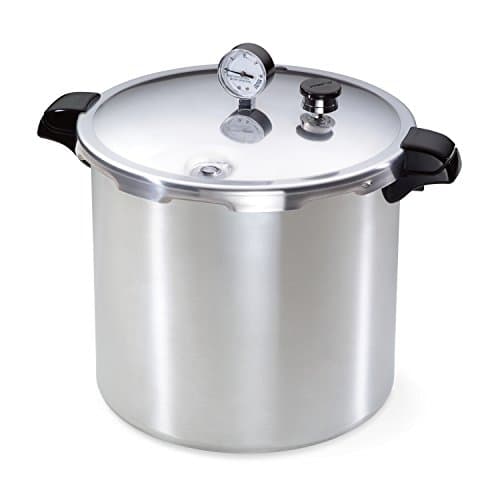
Presto 23-Quart Pressure Canner and Cooker (01781)
The default first pressure canner, and the one most beginners should buy: it takes a full seven-quart load, it doubles as a boiling-water canner for pints and half-pints, and it costs a fraction of a cast-aluminum canner. The dial gauge is the catch, and it is a real one.
Published specs
- Liquid capacity
- 23 quarts (21.8 liters)
- Jar capacity
- 26 half-pints, 20 pints, 7 quarts
- Material
- Warp-resistant aluminum
- Gauge
- Dial gauge
- Ranges
- Regular and smooth-top
- Burner limit
- 12,000 BTUs or less
- Also
- Doubles as a boiling-water canner
- Warranty
- 12-year limited
- Base diameter
- Not published by Presto
What works
- Seven quart jars is the standard batch size every tested NCHFP recipe is written around, so you are never processing a half load
- Doubles as a boiling-water canner for pints and half-pints, which means one pot covers the jam-and-pickles year as well as the beans
- Presto sells a replacement dial gauge and sealing ring separately, so a decade-old canner is a repair rather than a replacement
What to know first
- A dial gauge should be checked for accuracy every year — most extension offices do it free, and most owners never go. A weighted gauge needs no calibration at all
- Presto does not publish a base diameter, so you cannot check it against the NCHFP element rule without measuring the box yourself. See will it fit your stove
- Rated for burners of 12,000 BTUs or less, which rules out most outdoor propane burners and some high-output gas ranges
Specs from Presto, 23-Quart Pressure Canner and Cooker (01781). We have not handled this product — see how we pick.
Small pressure cookers and multi-cookers sold as canners
Skip anything under the seven-quart-jar mark, and skip every electric multi-cooker with a canning button that is not specifically specified for pressure canning. The NCHFP is explicit: pressure saucepans with smaller volume capacities are not recommended for canning.
Published specs
- NCHFP position
- "Pressure saucepans with smaller volume capacities are not recommended for use in canning"
- Required capacity
- Enough for seven quart jars or eight to nine pints
- Required approval
- UL approval
What works
- There is no upside worth listing. This entry exists so you can recognize the category and walk past it
What to know first
- Too small to hold heat the way tested processing times assume, so the times on a tested recipe do not transfer
- A "canning" preset on a multi-cooker is a marketing label, not a validation. Only appliances specified for pressure canning, like the Presto Precise, have been through that work
- This is the failure mode with the worst consequences in the whole category — under-processed low-acid food is where botulism comes from
Specs from NCHFP, Recommended Canners. We have not handled this product — see how we pick.
What your multi-cooker can legitimately do
Not nothing. Utah State, having ruled multi-cookers out for low-acid canning, gives them one preserving job: "EPPCs can be used for small batch waterbath canning of high acid products as long as the jars are sitting on a rack with at least 1-2 inches of water above the top of the jars, and if the EPPC can come up to a full rolling boil for the altitude-specific time required by the USDA recipe. A lid is needed, but the pressure lid should not be locked into place."
- Boiling water canning of high-acid foods, within those limits — jam, jelly, pickles, acidified tomatoes. Which foods qualify is in what can you water bath can.
- Cooking the food you are about to can. Softening apples for sauce or simmering a sauce down is exactly what the appliance is for.
- Everything else it was sold for — beans, stock, rice, yogurt. None of that is in question here.
- Not low-acid canning. Vegetables, meat, poultry, fish and soup all require a tested pressure process; the list is in what foods need pressure canning.
Electric does not mean disqualified
The objection is to multi-cookers, not to electricity. The NCHFP draws the line itself, carving out a dedicated appliance: its statement "does NOT include the Ball Automatic Home Canner for acid foods only, which is electric, but (1) is not a 'multi-cooker', but a dedicated canner, (2) comes with its own instructions and pre-set canning options for specific food preparations, and (3) has had proper thermal process development done to support the recommendations with it."
The same logic covers the digital pressure canner in our picks. Presto states it is "the first electric pressure canner to meet USDA home canning guidelines for safely processing meats, poultry, fish, vegetables, and other low acid foods," and describes the work behind it: units tested "utilizing multiple thermocouples to assess temperatures at many different locations inside the unit... including one inside each jar of food being canned." Oregon State names it as developed specifically for canning rather than cooking.
Worth noting alongside that: Presto's own footnote says neither the USDA nor the NCHFP certifies or approves home canning equipment. "Meets USDA guidelines" is a manufacturer's claim about their own testing, not a government approval. It is still a fundamentally different claim from a multi-cooker with a button on it. The full comparison is in electric pressure canners.
The decision, in one paragraph
Keep the multi-cooker for cooking, and use it for small-batch water bath canning of high-acid foods if you want, within Utah State's limits. For anything low-acid, buy a real canner: the Presto digital canner if you want the electric convenience and the altitude handling done for you, or a stovetop 23-quart if you want the cheapest reliable route and have the burner for it. What you cannot do is split the difference, because the failure mode here is not a soft pickle. It is botulism in food that looked, sealed and smelled fine.
Next stepThe electric canners that are testedCommon questions
Can you pressure can in an Instant Pot?
What about the Instant Pot Max canning function?
Why isn't reaching 15 psi enough?
Can I use an Instant Pot for water bath canning?
But all my jars sealed — doesn't that mean it worked?
Are any electric appliances safe for canning?
What size does a pressure canner have to be?
Is it safe if I add extra processing time in the Instant Pot?
Can I can high-acid food like jam in a multi-cooker?
Sources
- NCHFP — Canning in Electric Multi-Cookers
- NCHFP — Can I Can in a Multi-Cooker?
- NCHFP — Canning in Pressure Cookers
- USDA — Complete Guide to Home Canning, Guide 1
- Utah State University Extension — Why Electric Pressure Cookers Are Not Pressure Canners
- Penn State Extension — Canning in Electric Multi-Cookers
- Oregon State University Extension — Canning with an Instant Pot?
- Iowa State University Extension — Electric Programmable Pressure Cookers
- NCHFP — But my jars sealed…
- Presto — Precise Digital Pressure Canner
Product specifications are taken from each manufacturer’s own published page, cited on the product. We have not handled these products — how we pick.