The best jelly bag and strainer
The tool whose entire job is patience. Hang it, walk away, and do not squeeze it.
Disclosure: we earn a commission on purchases made through links on this page, at no extra cost to you. It does not change what we recommend — see how we pick and our affiliate disclosure.
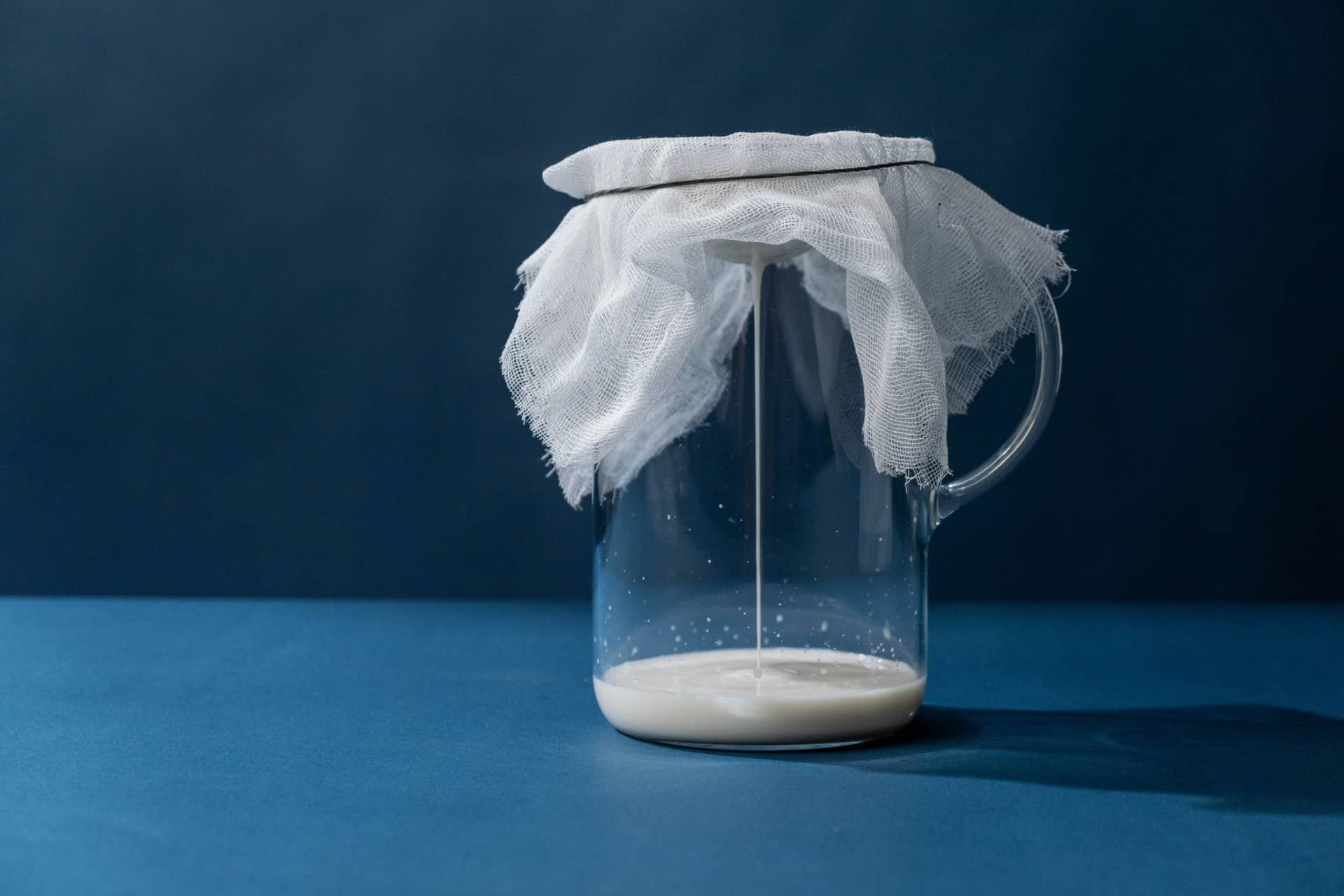
The NCHFP's jelly procedures call for a damp jelly bag or a double layer of cheesecloth, suspended so the juice drips through on its own. Its instruction is the one that decides the result: "The clearest jelly comes from juice that has dripped through a jelly bag without pressing or squeezing." A stand holds the bag clear of the juice; cheesecloth in a colander does the same job for less.
Jelly is the one preserve where appearance is most of the point. A cloudy jelly tastes the same and sets the same, and nobody who makes it is ever quite satisfied with it. Almost all of that clarity is decided in one step, before any pectin or sugar is involved: how the juice was separated from the fruit.
Which makes this a cheap problem to solve well. The whole kit costs less than the fruit, and the main skill is leaving it alone.
What the tested procedures actually say
The NCHFP's juice-extraction instructions are consistent across its jelly recipes: "Pour everything into a damp jelly bag and suspend the bag to drain the juice." For jellies without added pectin it spells out the alternative — "strain through a colander, then strain through a double layer of cheesecloth or a jelly bag" — and adds the warning that governs the whole operation: "Pressing or squeezing the bag or cloth will cause cloudy jelly."
Two details in there are easy to miss. The bag is damp, not dry, because a dry cloth absorbs juice you wanted. And the bag is suspended rather than resting in the bowl — Colorado State Extension puts a number on it: hang the bag "high enough over a big mixing bowl so the tip of the bag cannot touch the strained juice."
How we screened these
We have not run a clarity test across bags — a fair one would need the same fruit strained four ways in one afternoon. What we checked is each maker's published specifications against what tested procedures require, and against the practical business of holding a heavy bag of hot fruit still for hours. The method is on how we pick.
- Does it hold the bag clear of the juice? The single functional requirement, and the one a colander gets wrong.
- Weave tight enough to strain jelly. Grade 90 cheesecloth qualifies; the loose grades sold next to the foil do not.
- Reusable or consumable, and what replacements cost.
- Published dimensions, so you know whether it fits the bowl you own.
- Cleanable. Hot fruit pulp dries into fabric fast.
Stand or cheesecloth: the real choice
| Jelly bag on a stand | Double-layer cheesecloth | |
|---|---|---|
| Sourced from | NCHFP: "a damp jelly bag" | NCHFP: "double layers of cheesecloth" |
| Setup | Ties on once, legs sit on a bowl | Fold, dampen, line a colander, clip |
| Holds bag off the juice | Yes, by design | Only if the colander is deep enough |
| Reuse | Wash and reuse for years | Washable, but frays and stains |
| Cost | Low, plus replacement bags | Lowest |
| Storage | Comes apart flat | Folds into a drawer |
Colorado State's description of what a jelly bag can be made from is worth quoting, because it explains why this equipment is so cheap: "The bag may be made of several thicknesses of closely woven cheesecloth, firm unbleached muslin, or cotton flannel with the napped side in." A jelly bag is a piece of cloth. What you are buying with a stand is somewhere to hang it.
Quick picks
Every pick below is screened against the National Center for Home Food Preservation’s published canner rules first. Tap a row for the full write-up.
| # | Product | Best for | Key spec | Price |
|---|---|---|---|---|
| 1 |  Norpro Jelly Strainer Stand (614)The whole job of this thing is to hold a bag of hot fruit still for several hours without touching it, and a purpose-built stand does that better than a colander and a wooden spoon. Norpro's 614 stands 12 inches tall with adjustable hooked legs that sit on a bowl or pan, and it comes with one reusable bag. | Hands-off dripping | 12 in tall, bag included | $12.81 · View on Amazon#ad we earn a commission · price as of October 18, 2026 |
| 2 |  Grade 90 Unbleached Cheesecloth, 36 sq ftThe NCHFP's own instruction is "a damp jelly bag or double layers of cheesecloth", so cheesecloth is not the budget compromise here — it is the other half of the official answer. Grade 90 is the tight weave worth buying: the loose grade-40 packs sold in supermarkets let pulp through even doubled. | The no-stand route | Grade 90, 100% cotton | $9.95 · View on Amazon#ad we earn a commission · price as of October 18, 2026 |
| 3 |  Norpro Jelly Strainer Bags, 2 Pieces (615)Two replacement bags for the 614 stand, and the thing to buy at the same time as the stand rather than halfway through a jelly day. A bag that has held one batch of hot crushed fruit is not ready for the next one without washing and drying, and fruit waits badly. | The second and third batch | 2 bags, 9 x 8.5 in | |
| 4 | Squeezing the bag to get more juiceSkipIt is not a product, it is the mistake every jelly maker is tempted into at hour three. The NCHFP is explicit: "The clearest jelly comes from juice that has dripped through a jelly bag without pressing or squeezing." You gain juice and lose clarity, and you cannot get the clarity back. | Nothing - let it drip | Makes jelly cloudy | Check price on Amazon#ad we earn a commission · live price pending |
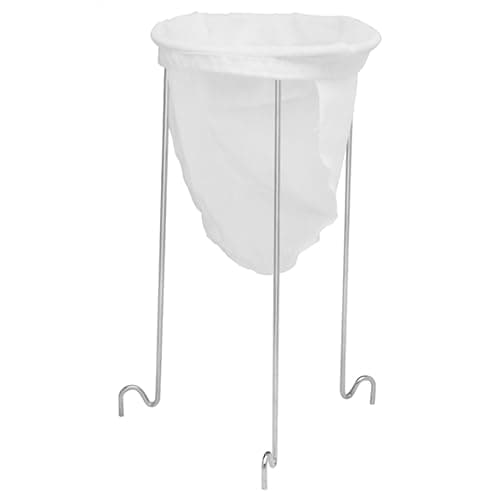
Norpro Jelly Strainer Stand (614)
The whole job of this thing is to hold a bag of hot fruit still for several hours without touching it, and a purpose-built stand does that better than a colander and a wooden spoon. Norpro's 614 stands 12 inches tall with adjustable hooked legs that sit on a bowl or pan, and it comes with one reusable bag.
Published specs
- Model
- 614
- Size
- 12" x 6.25" / 30.5 cm x 16 cm (Norpro)
- Included
- Stand plus one reusable polyester and cotton bag
- Mounting
- Adjustable legs with hooked feet, sit on pans and bowls
- Care
- Disassembles for storage; hand wash (Norpro)
What works
- Holds the bag clear of the collected juice, which is the detail a colander gets wrong — Colorado State says to hang the bag high enough that its tip cannot touch the strained juice
- Adjustable hooked legs fit ordinary mixing bowls, so there is nothing else to buy
- Comes apart flat, which matters for a tool used a few weekends a year
What to know first
- One bag is included and a big jelly day can fill it repeatedly, so replacement bags are a near-certain second purchase
- The frame is light. A bag heavy with hot fruit needs the legs seated properly or the whole thing tips
- It is not a press and should not be used as one — squeezing is what makes jelly cloudy
Specs from Norpro, 614 Jelly Strainer, Colorado State University Extension, Making Jellies. We have not handled this product — see how we pick.
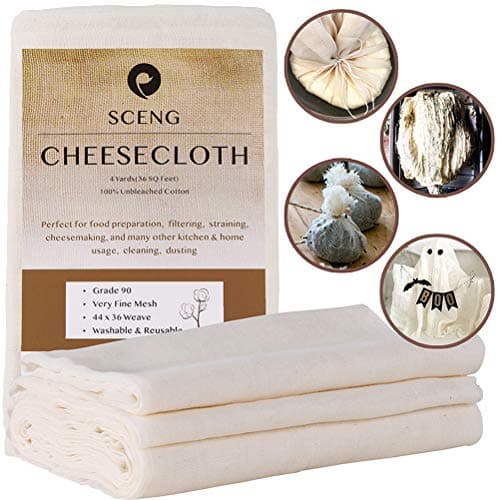
Grade 90 Unbleached Cheesecloth, 36 sq ft
The NCHFP's own instruction is "a damp jelly bag or double layers of cheesecloth", so cheesecloth is not the budget compromise here — it is the other half of the official answer. Grade 90 is the tight weave worth buying: the loose grade-40 packs sold in supermarkets let pulp through even doubled.
Published specs
- Grade
- Grade 90, 44 x 36 threads per inch (Hospeco, on grade 90 cheesecloth)
- Size
- 36 sq ft
- Material
- 100% unbleached cotton
- How to use it
- Dampen, use a double layer, suspend over a bowl in a colander
- Care
- Washable and reusable
What works
- Tight enough at grade 90 to strain jelly properly, where the loose grades sold beside the foil are not
- Doubles for straining stock, draining yogurt and bundling whole pickling spice, so it never sits idle
- No stand needed — a colander over a bowl works, which suits a kitchen with no room for another gadget
What to know first
- Fiddly: a cloth has to be folded, dampened and clipped, where a bag ties on once
- Stains and eventually frays, so it is a consumable in a way a sewn bag is not
- It is easy to squeeze a cloth without meaning to when lifting it, and squeezing is what clouds jelly
Specs from NCHFP, Extracting Juice for Jelly, Hospeco Brands, Unbleached Cheesecloth, Grade 90. We have not handled this product — see how we pick.
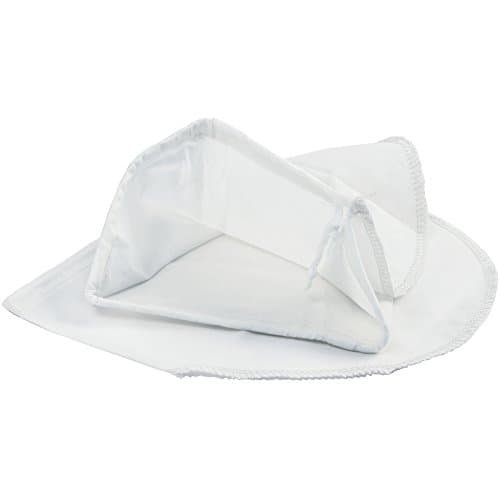
Norpro Jelly Strainer Bags, 2 Pieces (615)
Two replacement bags for the 614 stand, and the thing to buy at the same time as the stand rather than halfway through a jelly day. A bag that has held one batch of hot crushed fruit is not ready for the next one without washing and drying, and fruit waits badly.
Published specs
- Model
- 615
- Contents
- 2 replacement bags for the Norpro 614 stand (Norpro)
- Flat size
- 9" W x 8.5" H / 23 cm x 21.5 cm each (Norpro)
- Material
- Cotton and polyester mix (Norpro)
- Fit
- Ties around the frame opening of the 614 stand
What works
- Keeps a jelly day moving: wash one bag while the next batch drips through the other
- Cotton-polyester bags rinse clean and survive repeated use, unlike cheesecloth used once
- Cheap enough that having a spare costs less than the fruit it saves
What to know first
- Sized for the Norpro 614 frame specifically; they are not a universal fit for other stands
- Fruit stains the fabric permanently, which is cosmetic but startling the first time
- The stand is not included, so on its own this is an accessory rather than a solution
Specs from Norpro, 615 Jelly Strainer Bags, NCHFP, Extracting Juice for Jelly. We have not handled this product — see how we pick.
Squeezing the bag to get more juice
It is not a product, it is the mistake every jelly maker is tempted into at hour three. The NCHFP is explicit: "The clearest jelly comes from juice that has dripped through a jelly bag without pressing or squeezing." You gain juice and lose clarity, and you cannot get the clarity back.
Published specs
- NCHFP
- "Pressing or squeezing the bag or cloth will cause cloudy jelly."
- Colorado State
- "It may take several hours for all the juice to drip out."
- If you do squeeze
- Re-strain the pressed juice through a damp jelly bag or double cheesecloth (CSU, NCHFP)
What works
- A squeezed bag genuinely yields more juice, which is why the advice has to be repeated every season
What to know first
- Cloudy jelly is permanent — no amount of settling or re-boiling clears it
- Pulp forced through the weave also changes the set, because you are no longer working with strained juice
- The fix is free: start earlier in the day and let it drip
Specs from NCHFP, Extracting Juice for Jelly, Colorado State University Extension, Making Jellies. We have not handled this product — see how we pick.
Why squeezing is the one real mistake
Every jelly maker reaches hour three, looks at a bag still holding juice, and thinks about giving it a squeeze. The gain is real — Colorado State acknowledges that "a greater yield of juice can be obtained by twisting the bag of fruit tightly and squeezing" — and so is the cost, which is fine pulp forced through the weave and a jelly that will never be clear.
If you do squeeze, there is a documented remedy: both CSU and the NCHFP say pressed juice should be re-strained through a damp jelly bag or a double thickness of damp cheesecloth. It costs you another wait, which is what you were trying to avoid, which is the whole lesson.
Where the juice goes next
Straining is one step in a longer procedure, and the rest of it is fixed. Jelly is set by pectin, and which pectin you use decides both the recipe and the order you add things — that is in the best pectin for jam and jelly. Jars are processed after filling, five minutes for half-pints in a boiling water canner plus your altitude adjustment.
If juice extraction is the part of jelly you dislike most, there is a machine for it: a steam juicer drips juice out of whole fruit with no bag at all. It is a bigger purchase and a different workflow, and for one batch of crabapple jelly a year it is more equipment than the job needs.
Looking after a jelly bag
- Dampen it before use, as every NCHFP jelly procedure specifies. A dry bag drinks juice.
- Rinse it the moment it comes off. Dried fruit pulp in a tight weave is very hard to shift.
- Wash without detergent if you can — soap residue in a bag that will strain food is worth avoiding. Hot water and a scrub usually do it.
- Dry it completely before it goes away, because a damp cotton bag in a drawer grows mold.
- Expect stains. Blackcurrant and grape stain cotton permanently, and a stained bag strains exactly as well as a new one.
There is no NCHFP instruction to sterilize a jelly bag. The requirement is that it is clean and damp; the jelly is boiled afterwards and the jars are processed, which is where the safety comes from.
What else the bag and the cloth are for
A jelly bag is single-purpose in name only, and that changes the value calculation on a tool you might otherwise use two weekends a year. The same bag strains stock, drains yogurt into labneh, and rinses sprouts. The same cheesecloth ties up the whole pickling spice a brine recipe asks for, which is the form extension services recommend precisely because it lifts back out.
One use worth calling out: straining the sediment out of juice. The NCHFP's grape juice procedure has you strain through a damp jelly bag or double cheesecloth, refrigerate the juice for 24 to 48 hours, then pour the clear liquid off the sediment — and adds that for a clearer result still you can "strain through a paper coffee filter". If you press fruit with a steam juicer or a food mill, the bag is what turns cloudy extract into something worth canning.
That is also why we would not buy the cheapest bag on the shelf twice. A sewn bag with a stand outlasts a decade of jelly seasons; a piece of cheesecloth is a consumable. Both are correct answers to the NCHFP's instruction, and the difference between them is how often you reach for one.
The decision, in one paragraph
If you make jelly more than once a year, buy the Norpro stand and a pack of replacement bags at the same time — it is a small amount of money for the one thing a colander cannot do, which is hold the bag above the juice for four hours. If jelly is an occasional thing, buy grade 90 cheesecloth, use it doubled over a deep colander, and put the difference toward fruit. Either way, the equipment is not what makes the jelly clear. Not squeezing it is.
Next stepWhich pectin the recipe needsCommon questions
What can I use instead of a jelly bag?
Why should you not squeeze a jelly bag?
How long does jelly juice take to drip?
What grade of cheesecloth is best for jelly?
Do you have to sterilize a jelly bag?
Can I use a fine-mesh sieve instead?
How do you clean a jelly bag?
Is a jelly bag the same as a nut milk bag?
Do you earn a commission on these?
Sources
- NCHFP — Extracting Juice for Jelly
- NCHFP — Making Jelly without Added Pectin
- Colorado State University Extension — Making Jellies
- Norpro — 614 Jelly Strainer
- Norpro — 615 Jelly Strainer Bags
- Hospeco Brands — Unbleached Cheesecloth, Grade 90
Product specifications are taken from each manufacturer’s own published page, cited on the product. We have not handled these products — how we pick.